
TECH CLEAN CALIFORNIA WIKI
California Water Heating Market Study
Contractor Business Models, Training, and Electrification
March 29, 2024
This study is covered under CPUC Contract 17PS5017 between Opinion Dynamics and the California Public Utilities Commission (CPUC or the Commission).
Acknowledgments
This project was a collaborative effort under contract to the CPUC. The evaluation team would like to thank the CPUC Staff for guidance and input throughout the project planning and execution. We would also like to thank the water heater installers and the customers who responded to our research efforts.
Legal Notice
This report was prepared as an account of work sponsored by the CPUC. It does not necessarily represent the views of the Commission or any of its employees except to the extent, if any, that it has formally been approved by the Commission at a public meeting. For information regarding any such action, communicate directly with the Commission at 505 Van Ness Avenue, San Francisco, California 94102. Neither the Commission nor the State of California, nor any officer, employee, or any of its contractors or subcontractors makes any warrant, express or implied, or assumes any legal liability whatsoever for the contents of this document.
1. Executive Summary
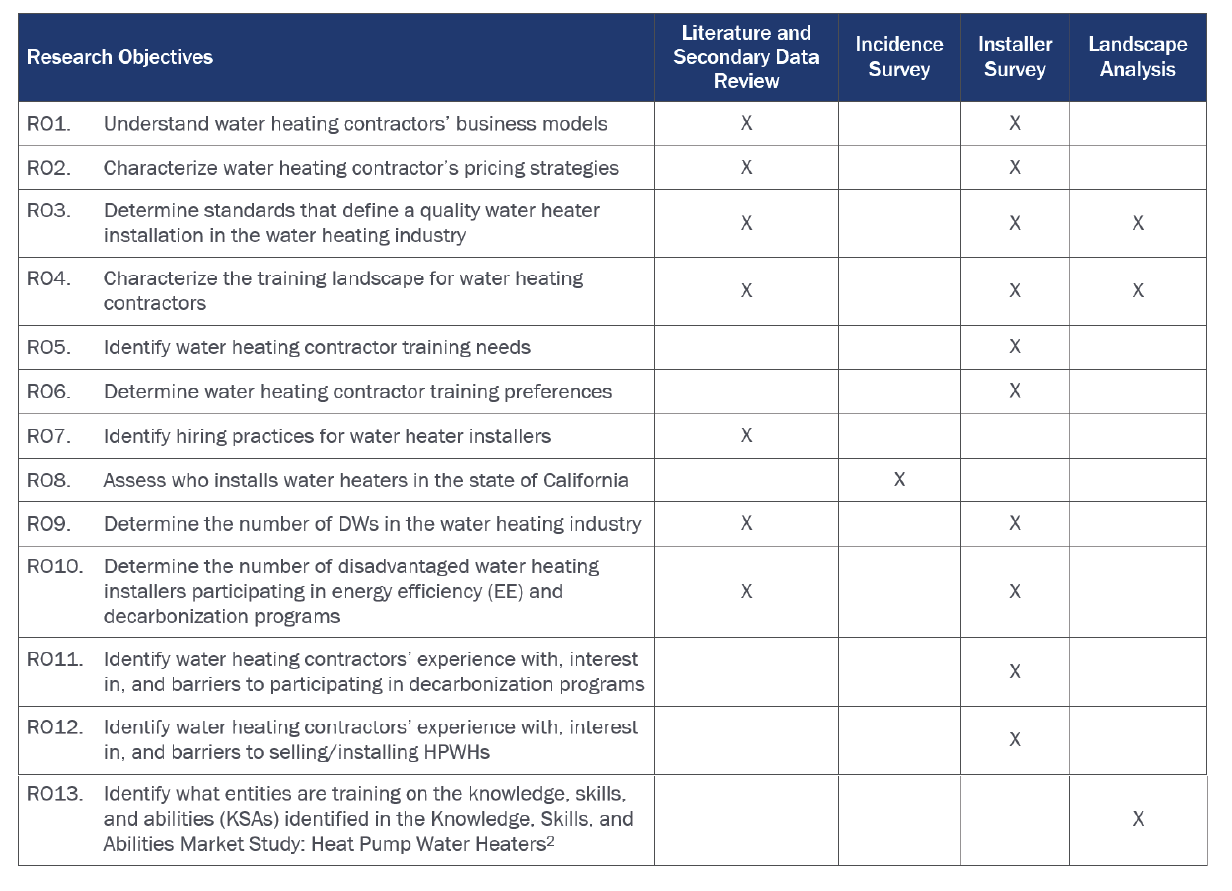
The California Public Utilities Commission (CPUC) tasked Opinion Dynamics with conducting a market characterization study of the water heater market in California. To effectively utilize heat pump water heaters (HPWHs) in meeting California’s climate goals, it’s crucial to have a comprehensive understanding of California’s current water heater market.[1] Understanding the intricacies of the California water heating industry will help optimize decarbonization programs and expedite the adoption of this important technology. This study aims to help the CPUC gain a strategic understanding of the state’s water heater market, including business models, pricing strategies, hiring practices, contractor behaviors, and the current training landscape. Additionally, Opinion Dynamics examined the prevalence of heat pump water heater installation, service, and maintenance in California and HPWH-related knowledge, skills, and abilities in the training landscape for water heater installers. This study also aims to assess contractor’s experience with heat pump water heaters and decarbonization programs to add to California’s growing knowledge about heat pump water heater installers. Our specific research objectives and the activities we employed to address each objective are listed in Table 1 below.
[1] There are many ongoing efforts in California to develop California’s heat pump water heater market by various state agencies and funding agencies, such as the California Air Resources Board (CARB), California Public Utilities Commission (CPUC), Program Administrators (PAs) and local air districts, such as the Bay Area Air Quality Management District (BAAQMD) and the South Coast Air Quality Management District (SCAQMD).
Table 1. Research Objectives by Research Activity
1.1 Methodology
Opinion Dynamics utilized several different methods to conduct this study. We initially conducted a literature and secondary data review[2] about the plumbing and water heating markets to enrich our understanding of California’s plumbing and water heating industry, including reviewing California State Licensing Board (CSLB) licensing data, D&B Hoovers, and the United States Census Bureau’s American Community Survey (ACS) data. We then conducted an incidence survey[3] to identify who is installing residential water heaters in California. We identified 149 customers (90/6.74 confidence/precision) who had replaced their water heater in the past two years and asked them to identify who conducted the installation and gathered information to understand their reasons for replacing their water heater, the type of unit replaced and installed, demographic data, and household characteristics. We then completed a survey with 127 water heater installers (90/7.21 confidence/precision) to understand plumbing contractors and water heater installers’ business models, pricing strategies, training needs and experiences, hiring practices, and experiences with HPWH equipment.
Finally, the research team conducted a training landscape analysis[4] to build upon a 2019 Opinion Dynamics study of the KSAs associated with HPWH work.[5] Through online searches, reviews of relevant literature, and responses from the installer survey, the research team identified three types of entities that provide HPWH training: original equipment manufacturers (OEMs), third-party training organizations, and investor-owned utilities (IOUs). Among the three types of training providers, we identified materials from 34 training offerings to review. The research team reviewed the training materials, including recordings of webinars, online learning modules, and presentations that instructors used to facilitate training offerings. The team attended several live webinar training sessions from third-party training providers and IOUs. Reviewing training materials, we identified instances where the training addressed any of the 80 KSAs identified in Opinion Dynamics’ previous KSA research.[6]
[2] California Public Utilities Commission (CPUC), “WE&T Deliverable 30: Knowledge, Skills, and Abilities Market Studies: HVAC Rooftop Package Units and Heat Pump Water Heaters,” January 17, 2020, prepared by Opinion Dynamics Corporation. https://www.calmac.org/publications/WET_KSA_Deliverable_6_12_2020.pdf.
[3] A secondary data and literature review involves reviewing relevant literature, websites, program materials, and program data to synthesize and summarize existing knowledge to provide background and context for how a research study fits in with the broader knowledge of a field, in this case, the water heater installer market.
[5] An incidence study is a study of the rate or range of occurrences of specific phenomena. In this case, the phenomenon we were focusing on is the rate of different market actors installing water heaters in the market.
[6] A landscape analysis involves assessing actors and associated activities in a field to understand how these actors contribute to the field. This involves reviewing resources from different actors relating to their contributions to their field. In this case, the actors are training providers, and the activities and contributions are training courses. Our analysis includes a review of course content based on the training provider’s affiliation (public entity, third-party, manufacturer, etc.).
[7] Ibid.
1.2 Findings and Recommendations
We summarize the key findings and recommendations of this study below.
A wide range of individuals install water heaters in California, including contractors registered with the CSLB, unlicensed handypersons, and Do-It-Yourselfers (DIYers).[8] Approximately one-third of the 149 surveyed California homeowners who recently replaced a water heater in the past two years hired a licensed contractor for the installation. As seen in Table 2, most respondents who did not hire a licensed installer installed the system on their own (DIYers).
[8] The Contractors State License Board (CSLB) provides licenses to construction contractors in California. These include 1) General Engineering Contractors (A Licenses), 2) General Building Contractors (B Licenses), 3) Specialty Contractors (C Licenses), and Limited Specialty Contracts (D Licenses). Currently, there are 42 specialty contractor license classifications, including C-36 plumbing contractors and C-20 warm-air heating, ventilating, and air-conditioning (HVAC) contractors. Anyone who contracts on projects with a combined labor and material cost in excess of $500 is required to hold a current valid license with the CSLB. https://www.cslb.ca.gov/About_Us/Library/Licensing_Classifications/
Table 2. California Homeowner Water Heater Installers
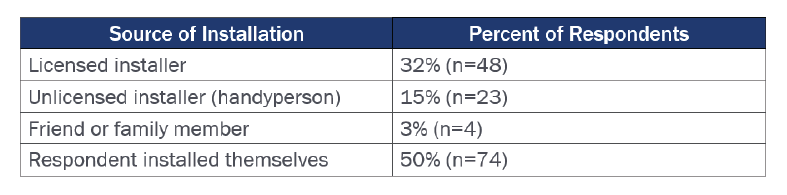
Recommendation: Fifty-two percent of homeowners who recently replaced a water heater installed the water heater themselves or used a friend or family member. In the TECH Clean California Time 1 Market Assessment, we also found that 36% of homeowners indicated they installed the water heater themselves or a friend or family member installed the new equipment.[9] DIYers indicated they chose this pathway to save money and time. This trend poses a significant challenge for transforming the water heater market, yet it has not been widely addressed. Given the nascent stage of the market, heat pump water heater programs are currently predominantly focused on plumbing contractors. However, as the market evolves, it will become crucial to engage unlicensed handypersons and DIY enthusiasts to drive market transformation to meet California’s climate objectives.
Due to safety reasons, we do not want to encourage DIYers to install heat pump water heaters, with the potential exception of the 110-volt HPWHs. One potential strategy is to develop a program that targets communities interested in electrification. This program would involve collaborating with homeowners associations (HOAs), community-based organizations (CBOs), and/or energy champions to make homes in these neighborhoods electrification ready as part of a comprehensive effort. In working with targeted neighborhoods, each home would receive an audit to determine what is needed to make the home electrification ready. Options include identifying panel optimizations— like circuit pausers and circuit splitters, panel upgrades, panel replacements, or even smart panels, which are costly but, when paired with DR programs and other interventions, might prove viable from a grid-resources perspective. Such a program would make a HPWH DIY installation safer and help meet DIYers’ motivations for cheap, quick, and easy installations. A second recommendation is to increase investment in technology solutions, such as 110-volt HPWHs, to improve efficiency and performance across a wider range of applications and then to develop programs to market, educate, and incentivize this equipment utilizing calls-to-action that will speak to DIYers.
Many licensed contractors installing water heaters in California work in multiple trades. When installation jobs involve a licensed contractor, we found that installers often work in multiple trades. For instance, most water heater installers who completed the online survey reported that their company does heating, ventilation, and air conditioning (HVAC) and plumbing work. Moreover, we found various licenses among surveyed water heater installers, including C-36 plumbing contractors, C-20 HVAC contractors, B general building contractors, B-2 residential remodeling contractors, C-10 electrical contractors, and C-46 solar contractors.[10]
Water heater installers indicate that, on average, 46% of their work is emergency replacements, and 43% is planned replacements. Other reports have found that the proportion of water heater installations that are emergency replacements can be as high as 90%.[11] The immediate need to reinstate hot water in a household often places a premium on speed, leaving minimal room for considering alternatives such as replacing a gas appliance with a heat pump.
Recommendation: Barnett Plumbing, which has provided residents in the California Tri-Valley area[12] with plumbing and water heating service over the past 15 years, received a Quick Start Grant through the Technology and Equipment for Clean Heating (TECH) Initiative to develop a water heater loaner program. To account for the immediate need to replace hot water systems, Barnett Plumbing offered customers the option to install a gas water heater on loan at no cost while the retrofit work took place to install a HPWH. Barnett Plumbing increased its rate of customer conversion from gas water heaters from less than one percent to 17.1 percent and installed 149 HPWHs during the program period (January – December 2022), including 127 gas loaners. The Quick Start Grant funds provided a supplemental contractor payment of $975 to cover the added cost of installation and removal of the loaner water heater. We suggest that the IOUs establish a statewide loaner program and provide a course for installers to learn best practices for running such a program as part of their business.[13] Lessons learned from Barnett Plumbing and other loaner pilots can be used as a basis for the course content.[14]
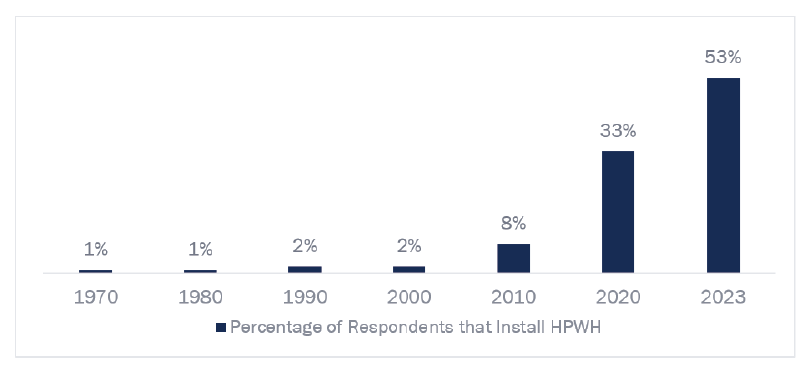
HPWH adoption is a relatively recent and growing phenomenon in California’s residential plumbing sector. Most installers reported they began installing HPWHs in the last several years, as 52% (n=35) reported that their HPWH installations started in or after 2019 (see Figure 1). Furthermore, fewer than a quarter (22%, n=17) said they had been installing HPWHs for a decade or longer. Most respondents (79%, n=53) whose company currently installs HPWHs expect more installations next year than in the last 12 months. The median number of HPWH installations respondents reported completing over the last year was 15, while the median number of installations these respondents expected to complete over the next year is 25. Additionally, nearly one-third of participants who indicated that they do not install HPWHs currently plan to do so within the next year (32%, n=19).
[9] https://www.calmac.org/publications/TECH_Time_1_Market_Assessment_Final_Report_4.22.24.pdf
[10] C-36, C-20, B, B-2, C-10, and C-46 are all licenses distributed by the California State Licensing Board (CSLB).
[11] Barnett_Plumbing_-_Final_Report_230810.pdf (apppack-app-tech-reporting-prod-privates3bucket-z0onruvirqb2.s3.amazonaws.com)
[12] The Tri Valley Area refers to the region in Northern California near the San Francisco Bay Area consisting of the San Ramon, Livermore, and Amador Valley.
[13] 3C-REN has offered an online course entitled “Gas Water Heater Loaner Program – How to Make it Work for You! However, we could not find any mention of the learning objectives or the curriculum content online.
[14] For key findings, see pages 6-9 of the Barnett Plumbing Bridging the Gap to Heat Pump Adoption: Water Heater Loaner Program. Barnett_Plumbing_-_Final_Report_230810.pdf (apppack-app-tech-reporting-prod-privates3bucket-z0onruvirqb2.s3.amazonaws.com)
Figure 1. Percentage of Respondents that Install HPWH by Decade of First HPWH Installation (n=127)
Recommendation: As of April 2023, the IOUs sponsored 22 unique courses that address water heating. However, on average, each course only covers 11 of the 80 KSAs identified in the WE&T Deliverable 30: Knowledge, Skills, and Abilities Market Studies: HVAC Rooftop Package Units and Heat Pump Water Heaters report published in 2020.[15] Given that HPWH adoption is a growing phenomenon, developing a standard curriculum for experienced plumbers to learn how to install HPWHs and a standard curriculum for HVAC installers (who are legal to install HPWHs in the state of California) to learn how to install HPWHs based on the validated KSAs from the 2020 study would support market transformation and faster attainment of California’s climate goals. The next finding and recommendation include specific topic areas that would be beneficial to include in a standardized HPWH training curriculum.
Installers reported needing additional training on electrical components of HPWH installations, HPWH service topics, and plumbing codes and regulations. However, we found limited instances where training offerings addressed these areas. By assessing KSAs coverage in HPWH-related training offerings and the responses to questions on the online survey regarding training needs, we found several examples where the training may not cover the topics that online survey respondents feel are important. More than a quarter of HPWH-installing respondents said understanding and working with electrical components were the aspects of HPWH installations that required the most training. Table 3 displays five training topics that would benefit installers in learning to begin installing and servicing HPWHs and the percentage of the 34 trainings that referenced these topics. As seen in the table, a few trainings reference important electrical concepts and HPWH tank maintenance topics. Six of the 34 trainings discussed codes in some capacity, one of which was an IOU-sponsored training.[16]
[15] California Public Utilities Commission (CPUC), “WE&T Deliverable 30: Knowledge, Skills, and Abilities Market Studies: HVAC Rooftop Package Units and Heat Pump Water Heaters,” January 17, 2020, prepared by Opinion Dynamics Corporation. https://www.calmac.org/publications/WET_KSA_Deliverable_6_12_2020.pdf.
[16] It is important to note that the training offerings we examined did not include any courses dedicated to codes and regulations such as Energy Code Ace training offerings.
Table 3. Percentage of Trainings that Reference Topics Desired by Surveyed Installers

Water heater installers report being motivated to pursue training to learn about new technologies, acquire new skills, and better serve their customers. They view manufacturers and distributors as trusted sources for professional learning and, as such, were the primary avenues through which they identified upcoming training opportunities. Among respondents in management roles, 66% (n=69) preferred training from manufacturers, and 55% (n=57) preferred training from distributors.
Recommendation: The IOUs should consider using these insights regarding contractor motivations, interests, and preferences to inform how they position and promote training opportunities. For instance, promoting HPWH training opportunities in the context of electrification/decarbonization may limit the appeal to specific audiences. However, framing the opportunities in the context of cutting-edge technology taps into humans’ natural curiosity and desire to stay updated with the latest technological innovations. Additionally, highlighting how acquiring new skills can enhance contractor revenue streams and help companies stand out from competitors will likely increase the value and attractiveness of training opportunities.
Recommendation: The IOUs should develop partnerships with manufacturers and distributors to promote and provide training opportunities related to plumbing and HPWHs, including potentially increasing access to hands-on lab opportunities. For example, on the HVAC side, TECH Clean California has partnered with Daikin to provide a mandatory 4-day Train the Trainer event for faculty at Riverside Community College, College of the Desert, Cypress College, Dehard Technical School, and San Bernardino Valley College on Daiken heat pump equipment donated to these schools.
Recommendation: The IOUs should develop more training opportunities that address the electrical components involved in HPWH installations, as well as service topics, plumbing codes, and regulations related to HPWHs. These could be new course offerings or additional topics added to existing courses.
Contractors who do both plumbing and HVAC install more heat pumps than contractors who work exclusively in plumbing. Respondents whose company does HVAC and plumbing work were more likely (55%, n=46) to report installing HPWHs than non-HVAC contractors (48%, n=21).
Contractors who do both plumbing and HVAC report marketing HPWHs more than contractors who exclusively do plumbing work. They report advertising HPWHs through their company websites (84% compared to 53%), social media (75% compared to 38%), and direct advertisements (67% compared to 11%).
Installers report that key barriers to HPWH customer adoption include many water heater installations occurring in emergency replacement scenarios, the higher upfront cost of HPWH equipment, and consumer awareness of HPWHs.
Recommendation: Considering the influence of consumer demand and general lack of awareness of water heater equipment, the CPUC and IOUs should identify strategies to build utility customers’ knowledge about HPWH equipment. Existing interventions include marketing regarding financial incentives via rebates or tax credits at the federal, state, and municipal levels.[17] While financial incentives are crucial in increasing consumer demand, investing in programs to raise awareness of HPWH technology and capacity-building opportunities to ensure a trained workforce are also essential. Such programs could include bill inserts on customer utility bills, marketing campaigns using online advertising, educational opportunities through trade ally engagement, and point-of-sale information efforts at big box retailers.
Despite contractor concern about HPWH costs, evidence suggests that HPWHs can be profitable for installers. Nearly one-third (32%, n=40) of installers reported HPWHs are the most profitable equipment their company installs. Installers without experience working with HPWHs perceive them to be the third most profitable, with gas conventional storage tank water heaters as the most profitable, followed by gas tankless systems.
Recommendation: Training developers, such as IOUs, manufacturers, and third-party training organizations, should use their platform to address concerns over equipment cost and illustrate how HPWH installations can be profitable to contractor’s businesses. In our training landscape analysis, we found that the discussion of HPWH cost typically focused on how to talk to customers about the higher upfront expense of the equipment. For instance, training addressed calculating the payback for a customer (i.e., how HPWH’s higher efficiency will result in lower operating costs that will pay for the equipment over time). However, we found no examples where training materials addressed how HPWH work can be profitable for contractors’ businesses and how to integrate HPWHs into existing contractor business models. While calculating payback is an essential skill to develop, it is also crucial for installers to see that HPWHs make financial sense for their businesses.
Almost half (46%) of installers indicated they had participated in an EE program, and about a quarter (24%) reported participating in an electrification/decarbonization program. A quarter of respondents say they are aware of these programs but never participated and one-fifth of respondents (20%) indicated they were unaware of programs altogether.[18]
Recommendation: Program implementers should consider focusing an effort on reaching contractors who are not currently participating in electrification/decarbonization programs. The CPUC should consider directing the IOUs to develop in-language outreach materials and workshops with free food targeted to installers who have participated in EE programs but are not participating in decarbonization programs and installers who have not participated in either. Such outreach material should cover opportunities to participate in programs as well as educational opportunities.
Nearly 60% of installers (59%, n=61) reported difficulty hiring technicians/installers over the last year. When asked about the sources of hiring challenges, 52% (n=32) of those who experienced difficulty said they could not find qualified applicants. Additionally, almost one-third of these respondents (30%, n=18) said they hired a candidate, but the new employee’s work ethic did not meet their expectations.
Recommendation: Developing standard curricula as referenced above and potentially offering a certification that could become a requirement for participating in EE and decarbonization programs would likely help businesses identify and hire qualified candidates as well as ensure a qualified workforce. Typically, a certification is an official recognition that an individual has met specific qualifications or standards in a particular field or profession.
Recommendation: IOUs should consider partnering with CBOs to offer a short water heating installation boot camp. The objective would be to help job seekers determine if a career in the plumbing field is right for them. For individuals still interested in pursuing a career in water heating after the boot camp, IOUs should work with CBOs to match them with paid internship opportunities.
According to the ACS, a substantial portion of the state’s plumbers and water heater installers meet one or more of the CPUC’s criteria to be considered a Disadvantaged Worker (DW).[19] Although our exploration of ACS data did not result in the total of disadvantaged plumbers, we found indications that a considerable share of California plumbers may meet one or more of the CPUC’s DW criteria. For instance, we learned that over 10% (7,336 of 66,939) of Californian plumbers received Supplemental Nutrition Assistance Program (SNAP) benefits, a form for public assistance, in 2022. In the same year, the ACS identified that approximately 23% (n=15,728) of plumbers did not possess a high school diploma or an equivalent, such as a General Educational Development (GED) certification, another DW criterion.
Recommendation: The CPUC should consider additional research regarding DW participation in the plumbing workforce that may not be available through existing channels such as the ACS. Considering the linguistic diversity of the plumbing workforce in California, Opinion Dynamics also recommends that program outreach material be offered in multiple languages.
[17] The Inflation Reduction Act included federal income tax credits for up to 30% of HPWH installation costs and up to $2,000 for Energy Star-certified HPWHs (Department of Energy 2022). Specifically in California, the CPUC offers incentives for HPWH installation for its customers. Single-family residential customers that classify as low-income are eligible for up to $4,885 in incentives. All other single-family residential customers qualify for up to $3,800 (CPUC 2022). The cities of Alameda, Anaheim, Burbank, Glendale, Lodi, Lompoc, Palo Alto, Pasadena, Riverside, Roseville, Santa Clara, Los Angeles, Modesto, Sacramento, San Diego, and Turlock offer HPWH incentives ranging from $50 to $1,500 for account holders installing new HPWHs (Department of Energy 2023).
[18] Respondents can fall into multiple groups.
[19] A Disadvantaged Worker, as defined in D.18-10-008 (October 11, 2018), “Decision Addressing Workforce Requirements and Third Party Contract Terms & Conditions”, defines a disadvantaged worker as “an individual that meets at least one of the following criteria: lives in a household where total income is below 50 percent of Area Median Income; is a recipient of public assistance; lacks a high school diploma or GED; has previous history of incarceration lasting one year or more following a conviction under the criminal justice system; is a custodial single parent; is chronically unemployed; has been aged out or emancipated from the foster care system; has limited English proficiency; or lives in a high unemployment ZIP code that is in the top 25 percent of only the unemployment indicator of the CalEnviroScreen Tool.”
2. Introduction
California has set some of the most ambitious climate goals in the United States. In fact, California Senate Bill 32 aims to reduce greenhouse gas (GHG) emissions by 40% below 1990 levels by 2030. Additionally, California Executive Order B-55-18 is committed to achieving a just and equitable transition to carbon neutrality by 2045 and maintaining net negative emissions thereafter. Furthermore, California Senate Bill 100 has established a landmark policy requiring renewable energy and zero-carbon resources to supply 100% of electricity to end-use customers by 2045. In a letter to the California Air Resources Board (CARB) in July 2022, Governor Gavin Newsom set a goal of 6 million heat pumps statewide by 2030 to help reduce emissions. On October 7, 2023, Governor Newsom signed two climate disclosure bills (SB 253 and SB 261) into law, making California the first state in the U.S. to impose requirements on GHG emissions disclosure and mandate reporting on climate-related risks. These measures demonstrate California’s commitment to tackling climate change and creating a sustainable future for all.
Direct emissions from residential and commercial buildings comprise 12 percent of California’s greenhouse gas (GHG) emissions and mainly stem from natural gas appliances such as furnaces and water heaters. Building GHG emissions are second only to California’s transportation sector when accounting for electricity use, water use, and wastewater treatment. Beneficial electrification is an essential strategy to meet California’s ambitious GHG reduction goals by simultaneously shifting away from fossil fuel sources on both the demand and supply side of the grid. Heat pump water heaters (HWPWs) are essential to reducing building fossil fuel energy use because they offer a low- or no-carbon pathway to meet a critical building function traditionally achieved through GHG-emitting appliances. Heat pump water heaters use electricity to heat water, providing a cleaner and more efficient option than natural gas water heaters as the state’s electricity mix becomes cleaner. HPWHs can also act as a thermal “battery” by heating water in the middle of the day when renewable energy is abundant, which can be used to reduce peak demand.
Water heating is a significant expenditure in US homes, totaling approximately 18% of the average home’s energy consumption, according to the Energy Information Administration.[20] Approximately 78% of homes in California use natural gas-powered water heaters,[21] down from 90%.[22] Approximately 800,000 water heaters are replaced every year in California. Given California’s climate goals, California has taken many steps to encourage the adoption of electric heat pump water heaters. California Senate Bill 1477 created the Technology and Equipment for Clean Heating Initiative, now known as TECH Clean California, a multi-year $265 market transformation focused on accelerating the adoption of heat pumps for space and water heating.[23] Regulators added a heat pump water heating program to the existing Self-Generation Incentive Program, providing $80.2M in new funding to scale HPWH adoption throughout California. In January 2024, 38 programs offered incentives for retrofit HPWH installations, more than twice as many as existed in 2022 (n=18). These programs were offered by California IOUs, Community Choice Aggregators, Regional Energy Networks, publicly owned utilities (POUs), and cities.
Unfortunately, very little research exists on the California water heating industry. Given the potential of heat pump water heaters to meet California’s ambitious climate goals,[24] it is crucial to have a strategic understanding of the California water heating contractor market, including business models, pricing strategies, hiring practices, contractor behaviors, and the current training landscape. These insights will help identify leverage points within the industry to drive contractor behavior that increases energy savings and reduces greenhouse gas emissions. Such insights will also aid in designing programs catering to the industry’s needs and preferences.
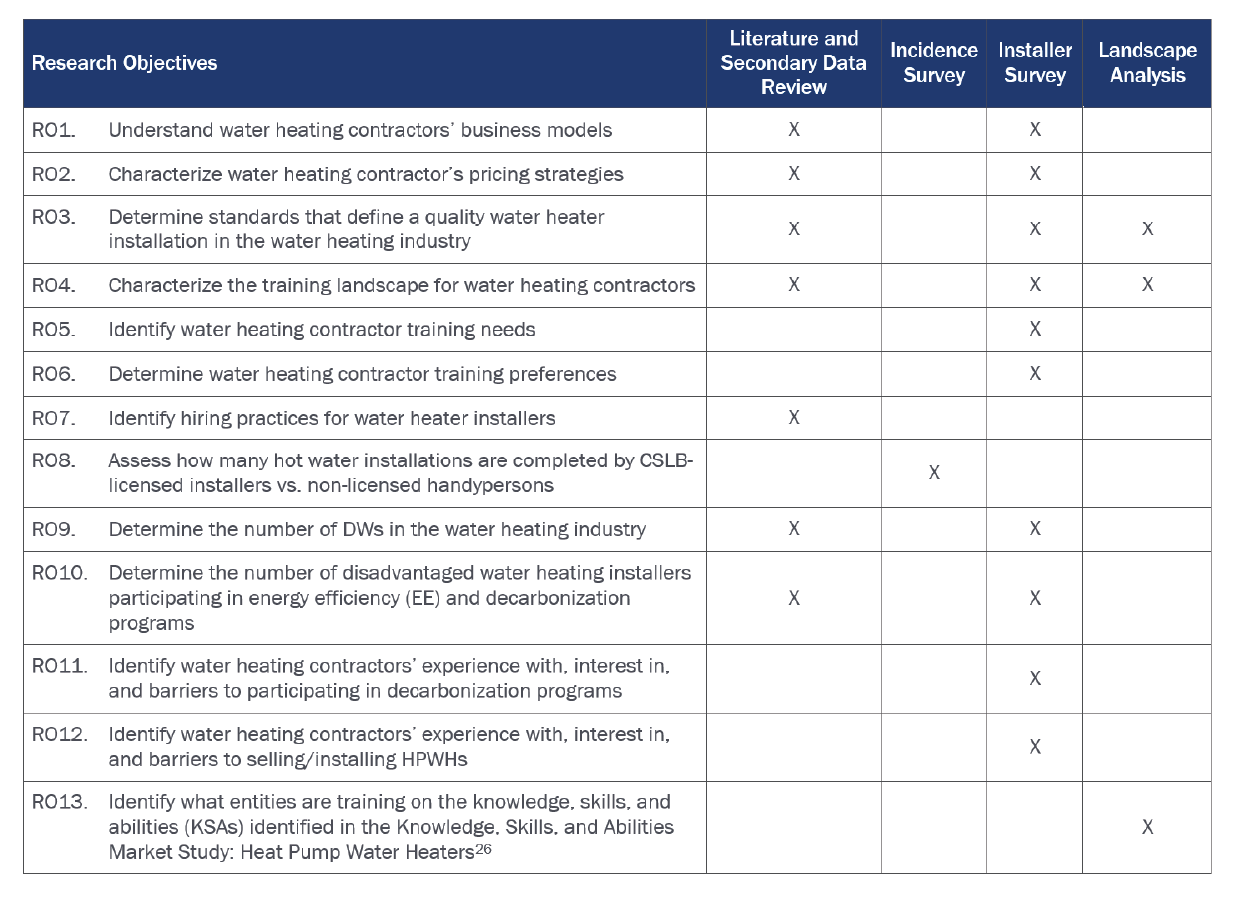
The Opinion Dynamics team conducted a comprehensive market study of plumbing and water heating in California to address this research gap. This study builds on the California Heat Pump Residential Market Characterization and Baseline Study of 2021.[25] To gather this data, the team conducted a literature and secondary data review, an incidence survey with homeowners of recent residential water heater replacements, an online survey of water heating contractors in California, and a water heating training landscape analysis. Table 4 presents this study’s research objectives and the activities we employed to address each objective.
[20] United States Department of Energy. “Reduce Hot Water Use for Energy Savings.” Energy.gov. https://www.energy.gov/energysaver/reduce-hot-water-use-energy-savings.
[21] U.S. Energy Information Administration. “Highlights for water heating in U.S. homes by state, 2020.” Eia.gov. U.S. Energy Information Administration, March 2023. State Water Heating.pdf (eia.gov)
[22] U.S. Energy Information Administration. “2020 Residential Energy Consumption Survey: Consumption and Expenditures Detailed Tables, Table CE4.5 – Water Heating Characteristics by Type of Housing Unit, 2020.” https://www.eia.gov/consumption/residential/data/2020/c&e/pdf/ce4.5.pdf.
[23] The initial program budget for TECH Clean California was $120M. In late August of 2022, the state of California passed the California Energy Trailer Bill what directed an additional $145M to TECH Clean California.
[24] There are many ongoing efforts in California to develop California’s heat pump water heater market by various state agencies and funding agencies, such as the California Air Resources Board (CARB), California Public Utilities Commission (CPUC), Program Administrators (PAs) and local air districts, such as the Bay Area Air Quality Management District (BAAQMD) and the South Coast Air Quality Management District (SCAQMD).
[25] Opinion Dynamics. California Heat Pump Residential Market Characterization and Baseline Study. May 17, 2022. Waltham, Massachusetts, United States, Opinion Dynamics Corporation. OD-CPUC-Heat-Pump-Market-Study-Report-5-17-2022.pdf (calmac.org).
Table 4. Research Objectives by Research Activity
[26] CPUC. “WE&T Deliverable 30: Knowledge, Skills, and Abilities Market Studies: HVAC Rooftop Package Units and Heat Pump Water Heaters,” January 17, 2020, prepared by Opinion Dynamics Corporation. https://www.calmac.org/publications/WET_KSA_Deliverable_6_12_2020.pdf.
3. Methods
This section describes Opinion Dynamics’ approach to each research activity.
3.1 Literature and Secondary Data Review
The research team reviewed relevant literature about the plumbing and water heating markets to enrich our understanding of California’s plumbing and water heating industry. We reviewed studies published via the California Measurement Advisory Council (CALMAC), including prior research from Opinion Dynamics and other third-party evaluators. The team also examined various research papers presented at American Council for an Energy-Efficient Economy (ACEEE) conferences and studies from the Northwest Energy Efficiency Alliance (NEEA).
To further our understanding of the water heating industry in California, Opinion Dynamics collected and analyzed data from the California CSLB and Dun & Bradstreet’s Hoovers (D&B Hoovers) database, a business-to-business sales and recruitment software that provides firmographic information on over 500 million global companies.[27] We used data from the CSLB and D&B Hoovers to collect firmographic and licensing data to further characterize the market for water heater installations. We also used these data sources to help construct our sample and contact list for the online installer survey.
The research team reviewed data from the United States Census Bureau’s American Community Survey (ACS) to understand the demographics of the plumbing workforce and to estimate the number of plumbers who qualify as Disadvantaged Workers (DWs).[28] The ACS is an annual survey that collects information about the American population, including housing, demographic, and workforce characteristics.[29] These data are made publicly available via a Public Use Microdata Sample (PUMS) file that contains a sample of individual survey response records with identifying information removed. There are two types of PUMS files: one for Person records and one for Housing Unit records. Each record in a Person file represents a single person, and each record in the Housing Unit file is a single housing unit. Because PUMS data represent a sample of the population, individual records are assigned a weight to express the number of housing units or persons that the microdata represents. The sum of person weights for a geographic area equals the estimated total population for that area, and the sum of housing unit weights equals the estimate for the number of housing units in a given area. The research team used the Census Bureau’s online microdata tool that references PUMS data via API calls and generates tables that present estimates for the number of people or housing units in a specific geographic area based on selected characteristics.
The information we gathered in our literature and secondary data review supported our other research activities. Namely, our literature and data review informed how the research team designed the incidence survey instrument and the online installer survey instrument (copies of these instruments are in Appendix B and Appendix C, respectively). Additionally, we include relevant findings from our literature and data review throughout Sections 4 and 5 of this report to provide additional context around the discussion of our primary data collection efforts. We provide a complete list of sources that we reviewed in Appendix A.
[27] Dun & Bradstreet. “D&B Hoovers is Your Sales Accelerator.” D&B Hoovers, Dun & Bradstreet, accessed November 7, 2023. D&B Hoovers is Your Sales Accelerator – Dun & Bradstreet (dnb.com).
[28] Please see Section 4.1.4 for the CPUC’s definition of DWs and our discussion of DW participation in the plumbing industry.
[29] United States Census Bureau. “Explore Census Data.” United States Census Bureau, last modified July 1, 2023, https://data.census.gov/.
3.2 Homeowner Incidence Survey of Recent Residential Water Heater Replacements
The incidence survey aimed to identify who is installing residential water heaters in California. Past research indicates that the average effective useful life of a standard tank natural gas water heater—the predominant type of water heater in California—is between 8 and 12 years. We estimated conservatively that 10-15% of single-family homeowners have likely replaced their water heater in the past two years. Using these assumptions, we estimated that we would need to screen 1500 single-family homeowners to reach our target of 150 participants.
Opinion Dynamics wrote the survey guide provided in Appendix B and used YouGov’s internet panel as our sample frame. YouGov employs a unique and innovative sample design method to build representative samples of the California adult population. Their methods have been tested and produced accurate results that stand up to public and scientific scrutiny. [30]
YouGov invited 4,128 panelists to complete the survey, with 1,769 remaining eligible after screening based on several eligibility requirements. Eligibility criteria included being a California homeowner, replacing a water heater at their California residence in the last two years, and knowing who installed the new equipment. In addition to asking screening questions, YouGov took additional steps to authenticate responses. To confirm respondents’ residency in California, YouGov screened out individuals who indicated a different state of residence when they initially registered for the survey panel. Additionally, YouGov removed respondents who failed tests designed to remove bots from the sample. YouGov also excluded individuals who skipped more than one-third of the questions. After all screening questions and procedures, 149 respondents (8% of the eligible panelists) completed the survey.
After screening, the survey collected respondents’ reasons for replacing their water heater, the type of unit replaced and installed, demographic data and household characteristics, and the name and contact information of the installer they used. We then reviewed respondent-provided installer information and cross-referenced installers with the CSLB database to identify the licensure status of the installers. Further, we conducted web searches to collect additional contact information for installers that respondents may not have provided (e.g., email) to include them in our outreach for the online survey described below.
[30] The New York Times, the Cooperative Congressional Election Study (CCES), The Economist, and The Huffington Post use YouGov. For more information on YouGov Panel Methodology, see “Panel Methodology,” YouGov: About YouGov, Last modified May 23, 2022, https://today.yougov.com/about/panel-methodology/.
3.3 Plumbing Contractor/ Water Heating Installer Survey
A critical research activity in this study was an online survey of water heater installers in California. This survey aimed to understand plumbing contractors and water heater installers’ business models, pricing strategies, training needs and experiences, hiring practices, and experiences with HPWH equipment. We provide a copy of the survey instrument, which Opinion Dynamics fielded online via Qualtrics in Appendix C. Respondents received a $75 incentive as a thank-you for their time completing the survey.
Outreach
Our population of interest for this survey was any professional installing, repairing, or maintaining water heating equipment in California’s residential and small commercial settings. The research team created a contact list for the survey using CSLB data, contact information of trainees who attended a plumbing-related training via any of four major investor-owned utilities (IOUs) in California between 2021 and the spring of 2023, and Dun & Bradstreet Hoovers data. We also included the contact information of installers that respondents in the incidence survey provided (see Section 3.2 above). Finally, to support the inclusion of unlicensed individuals and handypersons, the team conducted online searches for handyperson services in California and collected email and phone numbers to the extent possible.
After Opinion Dynamics’ survey team deduplicated the sample data, we contacted individuals through email and text outreach that provided a link to open the survey. Our outreach efforts included three rounds of email outreach per email address in the contact list and two rounds of text message outreach for all phone numbers that were able to receive texts.[1] The team also conducted phone outreach to invite unlicensed contractors in the sample to ensure representation from installers other than licensed contractors.
Response Rate
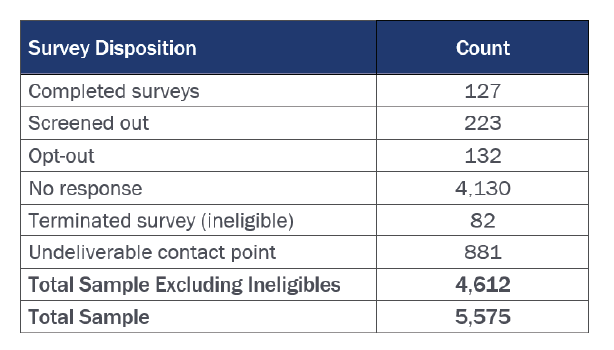
Overall, the team sent survey invitations to over 5,000 water heater installers in California. Most did not respond to the survey, and several hundred did not have proper contact information in the team’s sampling data. Opinion Dynamics’ survey team calculated the survey response rate using the American Association for Public Opinion Research’s (AAPOR) response rate formula, which we attached in Appendix E for reference. The response rate for the survey was 2.8% for all responses, not counting partial completes or ineligible responses. Table 5 lists the number of respondents per survey disposition.
[31] We used Tele Town Hall to conduct text outreach. We provided a list of all available phone numbers in the contact list. Tele Town Hall identified 1,461 as cell phones that could receive text message.
Table 5. Survey Disposition Summary for Online Survey
3.4 Training Landscape Analysis
The research team also conducted a training landscape analysis to build upon a 2019 Opinion Dynamics study of the knowledge, skills, and abilities (KSAs) associated with HPWH work.[32] In the 2019 study, researchers facilitated workshops with California-based water heater installers who, at the time of the research, either held a C-36 license with the CSLB or worked for someone who did, had completed at least five HPWH installations and had EE knowledge. The workshop facilitators asked participants to identify the duties and tasks of installing HPWHs. They asked participants to explain the steps involved in each of the tasks. Opinion Dynamics curated a list of 80 KSAs using this information, including 36 knowledge topics, 33 skills, and 11 abilities. These KSAs were validated by 22 HPWH installers in the Northwest Energy Efficiency Alliance’s Hot Water Solutions network, ETO’s Trade Ally network, or Efficiency Maine’s Registered Vendor list. Given the nascent market for HPWHs in California and the difficulty of locating HPWH experts in California, we selected experienced installers in states with more mature HPWH programs. The purpose of the training landscape analysis in our present study was to identify entities that provide plumbing and water heating training and to understand the degree to which their training offerings addressed the KSAs we identified in our prior research.
Through online searches, review of relevant literature (Section 3.1), and responses from the installer survey (Section 4.5.1), the research team identified three types of entities that provide HPWH training: OEMs, third-party training organizations, and IOUs. For OEMs, we focused our collection and review of training materials on A.O. Smith, Rheem, and Bradford White, as these three companies manufacture nearly 60% of residential HPWHs in the US.[33] Where applicable, we also reviewed the training materials from the subsidiaries of each of these three OEMs. Additionally, we identified third-party training through our research that offered extensive training opportunities related to water heating and HPWHs, including Hot Water Solutions, the Association for Energy Affordability, and Focus on Energy. For the IOUs, we submitted a data request for copies of training materials from training related to plumbing and water heating sponsored by Southern California Edison (SCE), Southern California Gas (SCG), San Diego Gas & Electric (SDG&E), and Pacific Gas and Electric (PG&E).
Among the three types of training providers, we identified materials from 34 trainings to review. Of these, six were OEM trainings, six were from third-party training organizations, and 22 were IOU-sponsored trainings. The research team reviewed the training materials, including recordings of webinars, online learning modules, and presentations that instructors used to facilitate trainings. The team attended several live webinar training sessions from third-party training providers and IOUs. Reviewing training materials, we identified instances where the training addressed any of the 80 KSAs from Opinion Dynamics’ previous research. Section 4.5.7 summarizes our findings from this analysis.
[32] CPUC. “WE&T Deliverable 30: Knowledge, Skills, and Abilities Market Studies: HVAC Rooftop Package Units and Heat Pump Water Heaters,” January 17, 2020, prepared by Opinion Dynamics Corporation. https://www.calmac.org/publications/WET_KSA_Deliverable_6_12_2020.pdf
[33] Thormundsson, Bergur. Residential water he ater market share by vendor in the United States from 2018 to 2021. Technology & Communications, Household Appliances; Statista. 2022
3.5 Study Limitations
It is important to note that our study experienced several limitations and challenges. First, the response rate to the online survey of water heater installers was lower than the research team expected. At a rate of 2.8%, the sample in the online survey may not represent the actual population of water heater installers in California. This low response rate translated to a small sample size of 127 respondents. We were initially targeting a sample size of 400 completes, assuming approximately a 7% response rate.
Along with a small total sample size, some subpopulations of installers were under-sampled. Notably, only one of the 127 respondents in the survey was unlicensed. The research team learned through interviews with SMEs in the plumbing industry that as many as half of water heater installations in California are performed by individuals who do not hold a license with the CLSB. The research team conducted targeted phone outreach to this population to address the low response rate among unlicensed contractors, but this yielded no further survey completions. A CSLB-licensed contractor in California must complete any water heater installation project that surpasses $500 in total cost; unlicensed installers may have hesitated to respond to the survey due to the underground nature of their work.[34]
Union members were also under-sampled, as only three of the 127 respondents worked for union-affiliated companies. California has 39 local plumbing and pipefitting unions, so the sample does not represent the entire union contractor population. Operational differences between union and non-union contractors in the sample will be less evident due to the lack of sampled union contractors.
[34] What Kind of Contractor Do You Need? – CSLB (ca.gov)
4. Detailed Findings
The following sections present the detailed findings from Opinion Dynamics’ research activities.
4.1 Water Heating Contractors’ Business Models, Pricing, and Staffing
In this section, Opinion Dynamics discusses findings from our online contractor survey and review of relevant literature and secondary data addressing three research objectives: (1) understand plumbing contractors’ business models, (2) characterize plumbing contractors’ pricing strategies, and (3) determine the number of DWs in the plumbing industry.
4.1.1 Water Heating Contractor Business Models
Respondents to the installer online survey predominantly represented small businesses in terms of number of employees and annual revenue. In terms of staff size, 14% (n=10) of respondents reported being the only employee at their company (i.e., sole operators), and 60% (n=76) reported having less than ten employees, with a median of six full-time employees. In terms of annual revenue, 22% of respondents reported their company makes between $1 million and $2.9 million (n=28), 13% said they make between $3 million and $7.9 million (n=17), 13% said they make between $100,000 and $249,000 (n=16), and 23% (n=29) of respondents preferred not to report this information.
Generally, we found that the respondents’ firmographics were similar to the statewide trends we identified in our analysis of the Californian plumbing businesses listed in the D&B Hoovers database. For instance, the median staff size among all California plumbing companies we identified was six staff members, with 76% of these businesses having fewer than ten employees. Two-thirds (66%) of the California plumbing contractors on D&B Hoovers had annual revenue under $1 million, average annual sales of approximately $1.8 million, and median annual sales of about $262,000.
The vast majority of respondents (91%, n=115) indicated that at least 60% of their water heating business occurs in residential settings, with the other 9% (n=12) of respondents reporting that at least 60% of their company’s water heating business occurs in commercial buildings. Only three (2%) survey participants also said they work for a union-affiliated company. It is important to note that most individuals said their company completes both plumbing and HVAC work (65%, n=83).
We asked respondents to provide additional details about their water heating business. On average, respondents reported that 87% of their general water heating work encompasses installations, service, and maintenance in retrofit settings, with only 13% involving new construction jobs. Respondents reported a slightly larger percentage of water heater installation work in emergency (46%) than in planned (43%) replacement scenarios. Water heater installation represented a larger portion of respondents’ water heating business (70% of total business, on average) compared to repair (17%) and maintenance (13%). Further, the median number of water heater installations respondents reported conducting over the last year was 30, compared to a median of 12.5 repair/maintenance jobs.
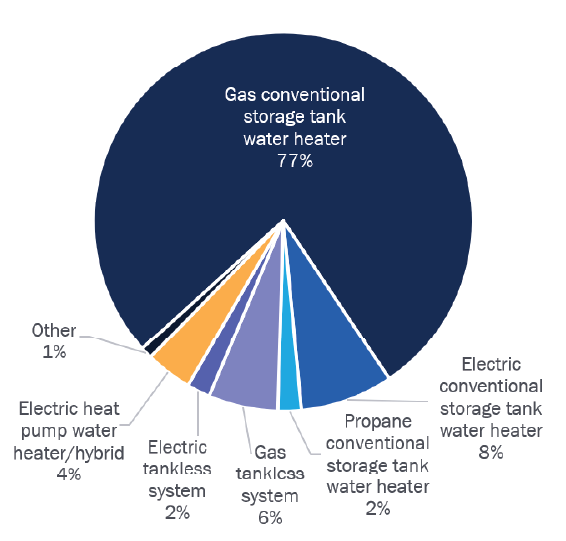
We asked respondents to estimate the percentage of their installation and repair work involving typical water heaters to understand the types of water heaters their companies install and repair. Figure 2 and Figure 3 display the average percentage breakdown for each type of equipment in installation and repair work, respectively. Gas conventional storage tank water heaters represent the largest proportion of respondents’ companies’ installation and repair work (49% of installations jobs, on average), followed by HPWHs (20% of installation jobs, on average).
Figure 2. Average Percentage of Water Heater
Installation by Equipment Type (n=126)
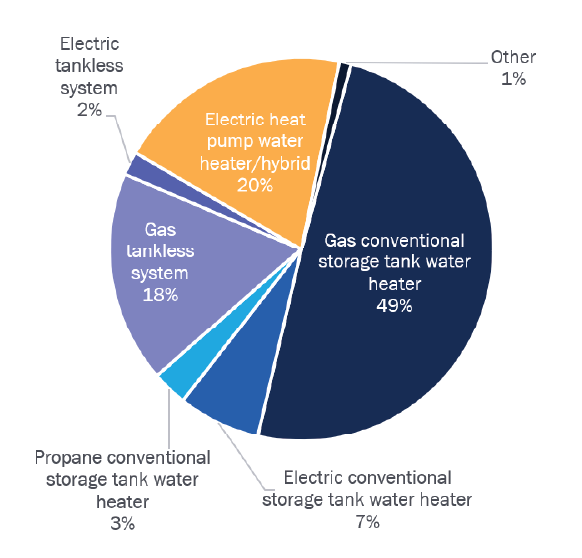
Figure 3. Average Percentage of Water Heater Repair by
Equipment Type (n=121)
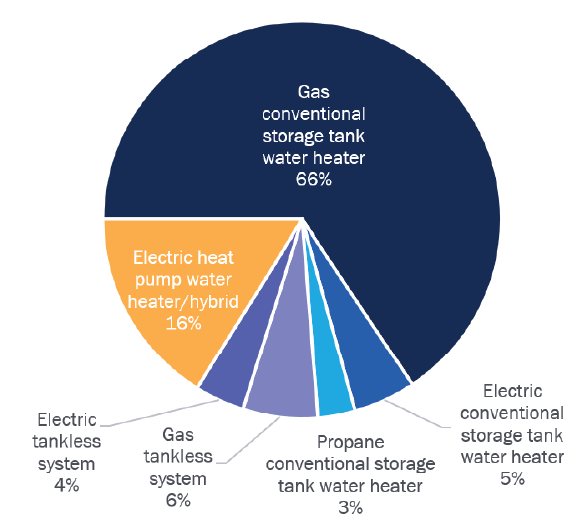
In addition to asking respondents about the types of units their company typically installs and repairs, the online survey also asked installers to identify the types of water heaters they most frequently removed in replacement scenarios. As Figure 4 presents, conventional gas storage tank water heaters represent the majority of units replaced by respondents’ companies (66%, on average), with HPWH replacements coming in second) (16%, on average).
Figure 4. Average Percentage of Water Heater Equipment Type Being Replaced (n=126)
4.1.2 Water Heating Contractor Pricing Strategies
The online survey also asked installer survey participants where they purchase water heaters, the profitability of different water heater installations, and how they set prices for their customers. The following sections summarize responses on these topics.
Sourcing Water Heaters
When asked where respondents typically purchase water heater units, most survey-takers (87%, n=110) said they purchase equipment from a distributor. Eighteen percent (18%, n=23) said they purchase water heaters from big box stores or hardware stores, and 11% (n=14) of respondents purchase units directly from manufacturers.
Water Heater Profitability and Pricing
Regarding which type of water heater equipment is most profitable for contractors to install, survey participants most frequently selected gas conventional storage tank water heaters (40%, n=51), followed by gas tankless systems (28%, n=35) and HPWHs (26%, n=33). Few respondents selected electric conventional storage tanks (2%, n=2), propane conventional storage tanks (2%, n=2), and electric tankless water heaters (2%, n=2). However, when removing the survey participants who do not install heat pumps (47%, n=60) from the analysis, survey participants reported that HPWHs (49%, n=33) are their most profitable water heater equipment, followed by gas conventional storage tank water heaters (24%, n=16) and gas tankless systems (24%, n=16). Among HPWH installers only, few said that propane conventional storage tank water heaters (1%, n=1) and electric tankless water heaters (1%, n=1) are their most profitable equipment.
We asked participants about their pricing strategies for water heater installation jobs. For the equipment cost of the water heater unit itself, just over half of installers (57%, n=72) charge customers the price of the unit plus a markup, 28% (n=35) charge a markup sometimes, and 15% (n=19) said they never charge a markup. We also asked respondents to identify how they charge their customers for labor. The majority of respondents (53%, n=67) said they charge a flat rate for labor based on the scope of the project, while a smaller share (32%, n=40) said it depends on the job or that they charge an hourly rate for labor installing water heaters (15%, n=19).
Respondents also offered insight into how they expect the prices they charge their customers to change and how frequently they adjust their pricing. The vast majority of respondents (83%, n=105) said they think the price of water heater equipment will increase. Respondents also said they anticipate the price of HPWHs equipment will rise in the next year (66%, n=84). Regarding changes to labor costs, 67% of respondents anticipate an increase in what they charge a customer for labor. Respondents cited inflation as the predominant reason for their predictions. Regarding the frequency of price adjustments, most respondents stated that they adjust their pricing at least as frequently as once per year (55%, n=70).
4.1.3 Water Heating Contractor Hiring Practices
The following sections discuss respondents’ answers regarding the number of experienced staff, hiring needs and practices, and the attributes they value in candidates for plumbing jobs.
Experience and Job Assignment Practices
Regarding experience levels, we asked respondents about the tenure of and the typical amount of time between promotions for water heater installers at their company and the number of years of experience they have. On average, survey participants said that their installers have typically been at their company for about six years, and the average time it takes for an installer to earn a promotion is slightly under two years. Respondents have spent considerable time in the plumbing industry, with an average of 19 years of industry experience.
Most respondents identified that technicians are assigned work based on their skillsets (56%, n=61) or the technician/installer’s availability (37%, n=40).
Hiring
Respondents reported hiring a limited number of water heater installers over a typical year and experiencing challenges in hiring candidates. The median number of water heater installer candidates reported hiring annually was one, and only 12 participants (9%) stated that their company hires more than five water heater installers in a year. Furthermore, nearly 60% of respondents (59%, n=61) reported difficulty hiring technicians/installers over the last year. When asked about the sources of hiring challenges, 52% (n=32) of those who experienced difficulty said they could not find qualified applicants. Additionally, almost one-third of these respondents (30%, n=18) said they hired a candidate, but the new employee’s work ethic did not meet their expectations.
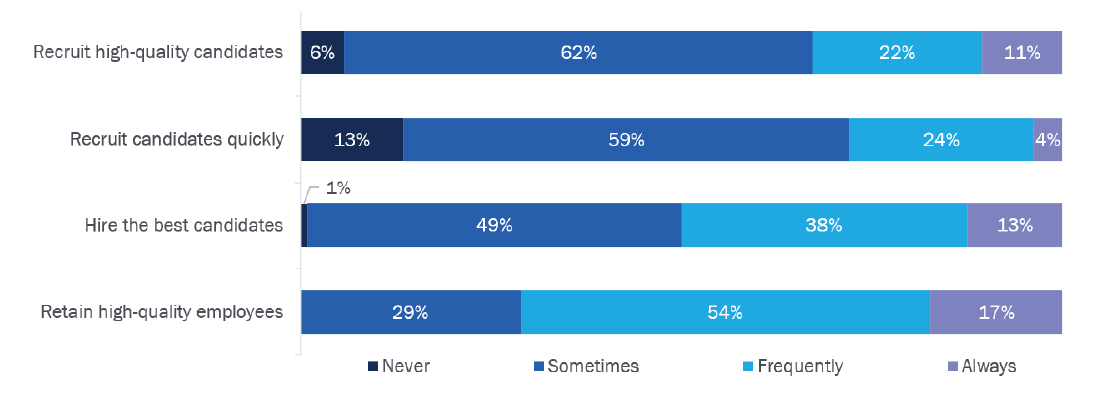
To further our understanding of respondents’ experiences recruiting and retaining installers, we asked respondents to indicate how often they can recruit high-quality candidates, recruit candidates quickly, hire the best candidates, and retain high-quality employees. As Figure 5 indicates, respondents reported more challenges recruiting candidates than hiring and retaining them. Notably, 24% (n=25) of respondents said they can frequently recruit candidates quickly, and 22% (n=23) said they recruit high-quality candidates. Conversely, 38% (n=38) said they can hire the best candidate frequently, and 54% said they can retain high-quality employees frequently.
Figure 5. Frequency of Being Able to Recruit, Hire, and Retain Employees (n=104)
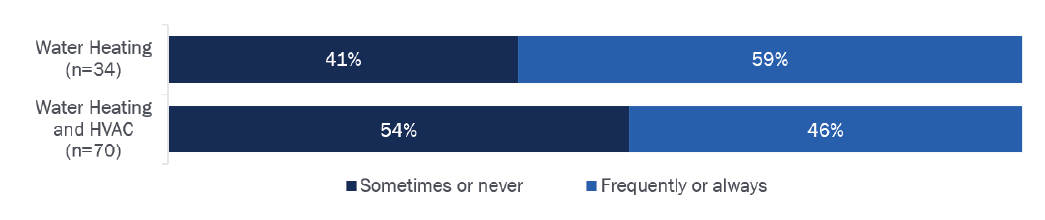
Exploring the differences between installer subpopulations in our sample, we found that respondents whose company conducts HVAC work reported more difficulty hiring the best candidates than those whose company only does water heating work. As Figure 6 illustrates, 59% (n=20) of non-HVAC survey-takers reported being able to always or frequently hire the best candidate. In comparison, 46% (n=32) of HVAC respondents reported being able to do so at the same frequency.
Figure 6. Frequency of Being Able to Hire the Best Candidate—Water Heating vs. Water Heating and HVAC
We also asked survey-takers about the channels used to recruit candidates. Respondents most frequently indicated they use employee referrals (84%, n=88) and advertising on career websites or job boards (63%, n=66) to recruit potential candidates.
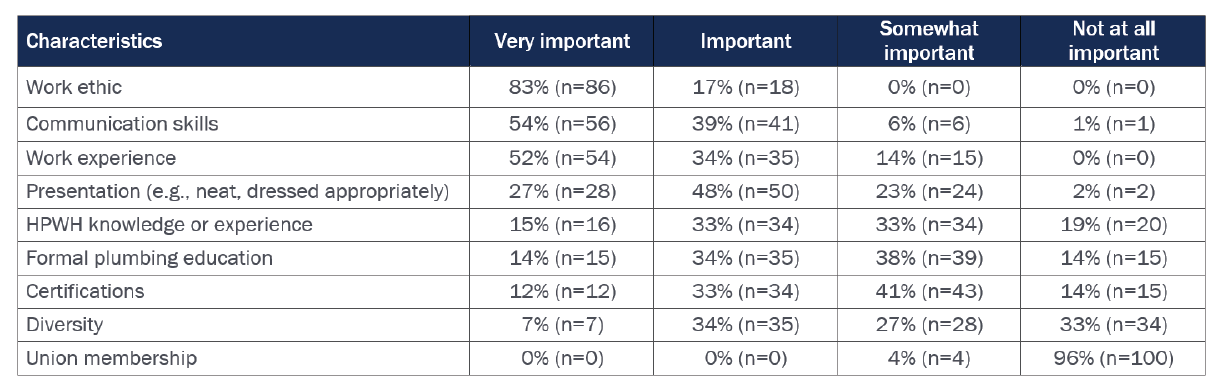
We asked participants to identify the importance of different attributes when their company considered hiring an employee. Table 6 displays the respondents’ perceived importance for each potential attribute. Notably, surveyed installers most frequently cited work ethic as a very important quality (83%, n=86). Additionally, survey-takers said work experience was more important to employers than formal education or certifications.
Table 6. Importance of Candidate Characteristics When Hiring (n=104)
Diversity and Hiring in the Plumbing Industry
The online survey included questions to understand practices and perspectives concerning diversity in the hiring process. As Table 6 illustrates above, respondents viewed diversity as one of the least important candidate characteristics. To dig deeper into diversity in hiring, we asked respondents if their company has explicit organizational goals to recruit or hire diverse candidates. Fewer than one-third of survey-takers said their business explicitly aims to recruit and hire diverse candidates (28%, n=29).
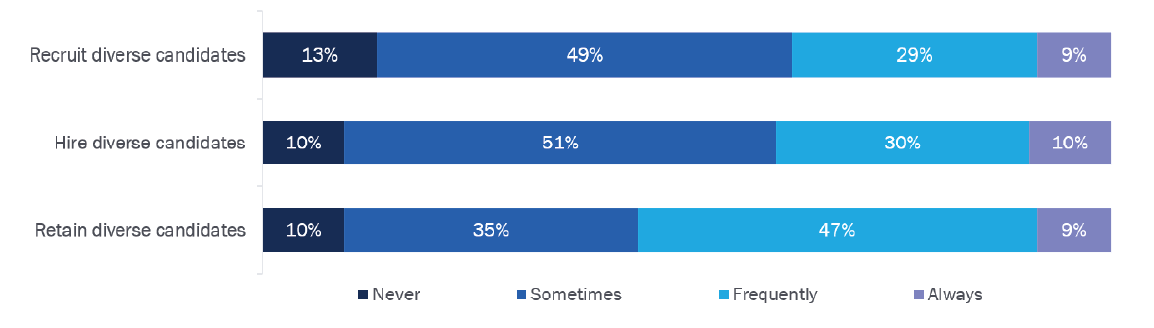
We also asked respondents how frequently their company can recruit, hire, and retain applicants and candidates from underrepresented groups. Notably, more than half of respondents indicated that they were either never or only sometimes able to recruit (62%, n=65) and hire (60%, n=63) diverse candidates. However, more than half of survey-takers reported being able to retain diverse candidates frequently or always.
Figure 7. Ability to Recruit, Hire, and Retain Diverse Candidates (n=104)
Diversity in the California Water Heating Workforce
The online survey also prompted respondents to provide firmographic and demographic information. We asked sole operators, or individuals who reported being the only individual employed at their company, whether they identify as a person of color, a woman, or someone who speaks English as a second language. Of the 18 sole operators, three identified as a racial minority or person of color, one identified as a person whose primary language is not English, and none identified as a woman. We also asked non-sole operators about their staff’s race, gender, and English language proficiency. They reported that people of color comprise 50% of their company on average, women constitute 19% on average, and employees who speak English as a second language represent 29% of their company on average.
Opinion Dynamics also identified demographic trends in the national and California plumbing workforce via our review of relevant literature and secondary data sources. According to the United States Census Bureau ACS, there were approximately 642,000 Americans whose occupations were categorized as Plumbers, Pipefitters, and/or Steamfitters in 2022. Of those, approximately two-thirds identified as white alone (n= 422,149), and 98% identified as male (n=630,834) on the ACS. Compared to the national plumbing workforce, the California plumbing industry is more racially diverse, with roughly 36% (or 24,256 of 66,939) identifying as white alone on the 2022 ACS. However, the California plumbing industry is more predominantly male, with nearly 100% (99.5%, n=66,643) identifying as male.
The research team searched for Minority Business Enterprises and Women Business Enterprises (MBE/WBE) that operate in California. The team used the Supplier Clearinghouse Certified Directory, the database listed on the CPUC’s website, to identify enterprises owned and operated by individuals identifying as women, minorities, disabled veterans, LGBT, and/or persons with disabilities. As of March 2023, the database lists 281 businesses that hold one or more certifications of diverse ownership and offer plumbing services. To put that in perspective, more than 14,000 businesses hold a C-36 license with the CSLB. Similarly, according to the City of Los Angeles, four plumbing contractors are registered as MBE/WBE, while 631 C-36 licensed businesses are registered with the CSLB and based out of Los Angeles.
4.1.4 Disadvantaged Worker Participation in the Plumbing Industry
One of our research objectives was to determine the number of DWs in the plumbing industry. The CPUC defines DWs as any individual who meets one of the following criteria:
- Lives in a household where total income is below 50% of the area median income
- Is a recipient of public assistance
- Is a custodial single parent
- Lacks a high school diploma or GED
- Has limited English proficiency
- Is chronically unemployed
- Lives in a high unemployment ZIP code that is in the top 25 percent of only the unemployment indicator of the CalEnviroScreen Tool
- Has been aged out or emancipated from the foster care system
- Has a previous history of incarceration lasting one year or more following a conviction under the criminal justice system
In our review of relevant literature, the research team did not find previous studies that estimated the number of plumbers in the national or California workforce who meet the above criteria. As such, we reviewed secondary data sources to explore disadvantaged plumber participation. Specifically, we relied on the United States Census Bureau’s ACS Public Use Microdata Sample (PUMS) data. Please refer to Section 3.1 for additional information about this data source and how the research utilized this data to estimate DW participation in California’s plumbing sector.
The team analyzed data from the 2022 ACS, the most recent data set available. After we set the geographic region to California, we used the ACS occupation variable to estimate the number of individuals employed as a plumber, steamfitter, or pipefitter in the state. This resulted in an estimated 66,939 Californians in this occupational category in 2022. Next, we identified variables in the PUMS data that aligned with the nine DW criteria outlined above. We discuss data for each of the nine criteria below and summarize the variables in detail in Appendix F.
Household income
The CPUC considers an individual who lives in a household with less than half of the area’s median household income to be a DW. For our analysis, we identified the number of plumbers whose household income was less than 50% of California’s median household income in 2022 (median=$91,905). Because the PUMS variable for annual household income is continuous, we recoded the variable to identify records with an annual household income below $45,952.50. We found 9,767 plumbers’ households below this annual income threshold (Recoded HINCP=1). This PUMS variable is summarized in Table 29 in Appendix F.
Public Assistance
We identified two variables related to public assistance recipiency, which we detail in Table 30 in Appendix F. One variable (PAP) captures an individual’s income from public assistance in the last twelve months. A second variable (FA) indicates if an individual is enrolled in the Supplemental Nutrition Assistance Program (SNAP). According to the 2022 ACS PUMS, there are an estimated 615 individuals who received some public assistance income (PAP>4) and 7,336 SNAP recipients (FA=1) in California employed as a plumber, steamfitter, or pipefitter.
Custodial Single Parents
The ACS does not ask about an individual’s status as a custodial single parent. However, it asks about the number of children living in a household (NOC) and the respondents’ marital status (MSP). We estimate that there were 10,006 single individuals (MSP≥2) with at least one child in their household (NOC≥1) employed as a plumber in California in 2022. Please refer to Table 31 in Appendix F for additional information about the PUMS variables we used to estimate the number of California plumbers who are custodial single parents.
Educational Attainment
The ACS also asks about individuals’ highest level of educational attainment. The variable (SCHL) that indicates an individual’s highest educational attainment level is summarized in Table 32 in Appendix F. We found there are an estimated 15,728 California plumbers who lack a high school diploma or a Test of General Educational Development (GED) (SCHL≤15).
English Language Proficiency
The ACS also collects information on language proficiency by asking respondents if a household member speaks a language other than English at home. If a household includes a non-English speaker, the respondents are asked how well that home member speaks English. The variable associated with this question in the PUMS data (ENG) is summarized in Table 33 in Appendix F. According to the available data, we estimate that 6,318 California plumbers live in households with someone who does not speak English well (ENG≥3). While it is unclear how many of those 6,000-plus plumbers have limited English proficiency, this data affirms the linguistic diversity in the California plumbing industry.
Chronic Unemployment
The ACS asks one question related to the duration of unemployment, which asks individuals when they last worked. We use this variable (WKL) as a proxy to estimate chronic unemployment. The US Bureau of Labor Statistics defines long-term (i.e., chronic) unemployment as lasting at least 27 weeks. To arrive at an estimate, we excluded records for individuals who had last worked within the last year because we could not tell how many of these records involved someone who had last worked more than 27 weeks ago. We acknowledge this as a limitation in the PUMS data. We found that an estimated 4,344 California plumbers last worked more than one year ago (WKL≥2). We detail this PUMS variable in Table 34 in Appendix F.
Proximity to High Unemployment
The ACS data reviewed did not include the zip codes; therefore, we could not determine how many plumbers live in zip codes in the top quartile of unemployment in California. While the PUMS data does not enable the estimation of the plumber population by zip code, it does support exploring data by county. We identified the counties with the highest unemployment rates using data from the State of California’s Employment Development Division. We found that an estimated 4,932 plumbers reside in counties in the state’s top unemployment quartile.
Criminal Justice and Foster Care
Opinion Dynamics determined estimates for all but two DW criteria using 2022 ACS data: the number of plumbers previously incarcerated and those formerly in foster care. The ACS does not collect these data; therefore, we could not estimate these criteria.
4.2 Standards for Quality Water Heater Installation
Another objective of this study was to determine standards defining quality water heater installation in the industry. Opinion Dynamics reviewed previous research and training materials involving water heater installations to address this objective. However, our review of relevant literature and training materials did not yield a standard definition of quality water heater installation.
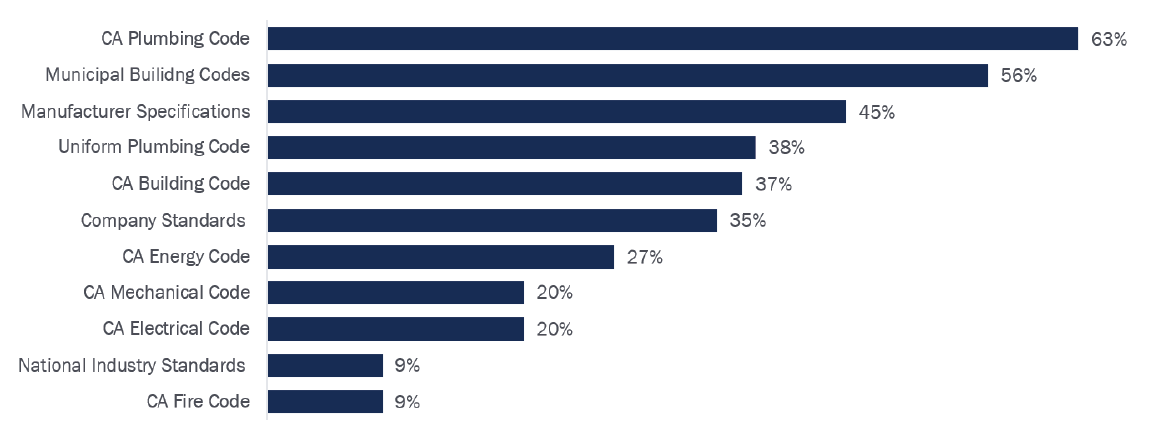
In addition to reviewing relevant literature and training materials, we addressed this objective through our online survey of water heater installers. Specifically, we asked survey-takers to indicate the standards for water heater installation they reference when installing water heaters in California. Survey data suggests no uniform standards for water heater installation in the California plumbing industry. Instead, contractors combine elements of different resources to create their company standards. Figure 8 lists the most and least commonly used resources by contractors in our survey. Some respondents added that they include installing and checking seismic strapping as part of their company standards, while others said they check and test for proper ventilation.
Figure 8. Standards for Quality Water Heater Installation Followed by Contractors (n=127)
4.3 Residential Water Heater Installations in California – Incidence
The research team learned through interviews with SMEs in the plumbing industry that as many as half of water heater installations in California are performed by individuals who do not hold a license with the CLSB. Opinion Dynamics conducted an incidence survey of California homeowners who replaced their water heaters in the last two years to understand who is installing residential water heaters and the proportion of licensed and unlicensed persons installing them. In addition to obtaining information about who installed water heaters, the incidence survey asked respondents to provide details about the type of unit they replaced and installed and about household demographics and characteristics. The following sections summarize the data the research team collected via the incidence survey.
4.3.1 Installer Licensure in Residential Water Heater Replacements
We asked homeowners to provide information about the installer they used when replacing their water heater. Slightly more than half of the respondents did not hire an installer (52%, n=78), with four respondents reporting a friend or family member installed their water heater and 74 reporting they installed their water heater on their own. Hereafter, we will refer to these cases as DIY installations or replacements and to these respondents as DIYers. Of the 48% (n=71) homeowners who hired an installer, eight reported hiring a handyperson, and 63 reported hiring a professional.34F[35]
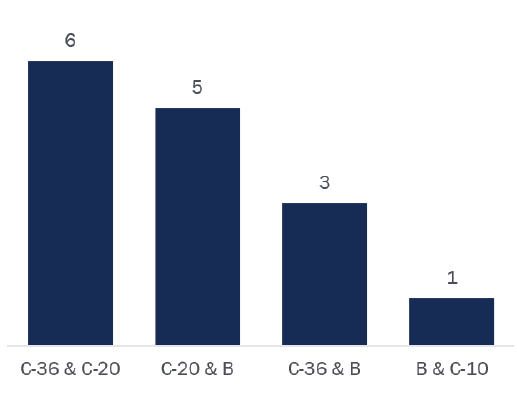
Using respondents-provided installer contact information, we cross-referenced installers with the CSLB database to identify the licensure status of the hired installers (i.e., professionals and handypersons). Among all hired installers (n=71), 68% (n=48) were licensed. Among the 48 licensed contractors who installed water heaters, most held a single license (58%, n=28), 15 had two licenses, and five held three licenses (see Figure 9). Most installers with only one license type (71%, n=20) held a C-36. Among installers with two licenses, 40% (6) held C-36 and C-20 licenses. Figure 10 displays the combinations of licenses among installers with two licenses. All five installers with three licenses possessed C-36, C-20, and General B licenses.
[35] The survey instrument did not define the difference between a handyperson and a professional. Respondents assessed the meaning of these terms themselves.
Figure 9. Number of Installers Possessing Licenses (n=71)
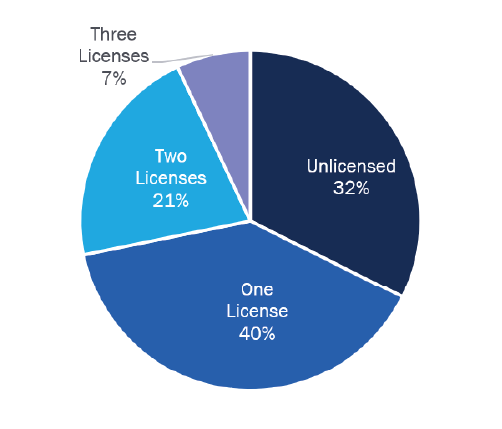
Figure 10. Combination of Licenses Among Installers with Two Licenses (n=15)
4.3.2 Reasons for Water Heater Replacements
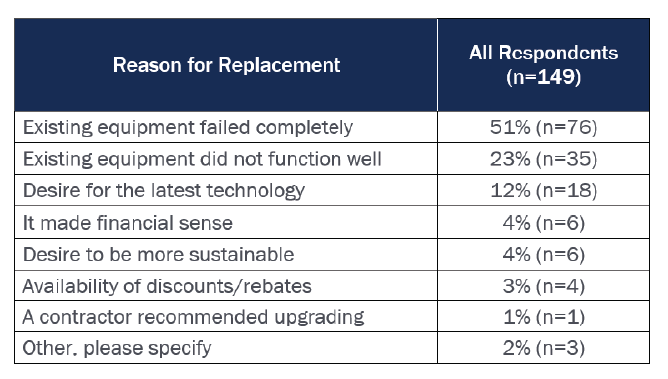
When asked why they replaced their water heater, homeowners most commonly reported system failure as the reason for replacement (51%), followed by the existing water heater not functioning well (23%). We summarize reasons for replacement in Table 7.
Table 7. Reason for Replacement by Installer Type (n=149
We compared reasons for replacement between those who hired an installer and DIYers. As Table 8 displays, system failure was the most common reason for replacement among both groups. Compared to those who hired an installer, DIYers were more likely to replace their water heater because of a desire for the latest technology. Similarly, DIYers were more likely than their counterparts to report financial benefit or a desire to be more sustainable as their reason for replacement.
Table 8. Reason for Replacement by Installer Type (n=149)
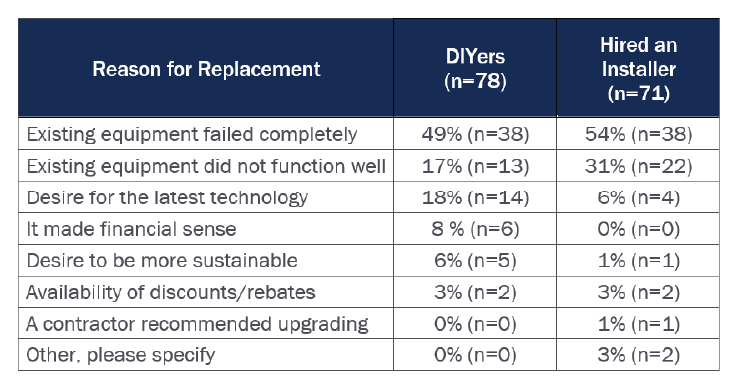
We also compared reasons for replacement between homeowners who hired a licensed installer and those who hired an unlicensed one. The research team did not find any notable differences based on installer licensure in terms of reasons for replacement.
4.3.3 Residential Water Heater Equipment Selection and Installer Types
The incidence survey asked homeowners about the type of equipment they removed and installed during their recent water heater replacement. In the following sections, we summarize the types of water heaters survey-takers reported removing and installing, explore various trends in equipment selection among respondents, and detail the types of installers involved in various installation scenarios.
Water Heater Replacement Patterns
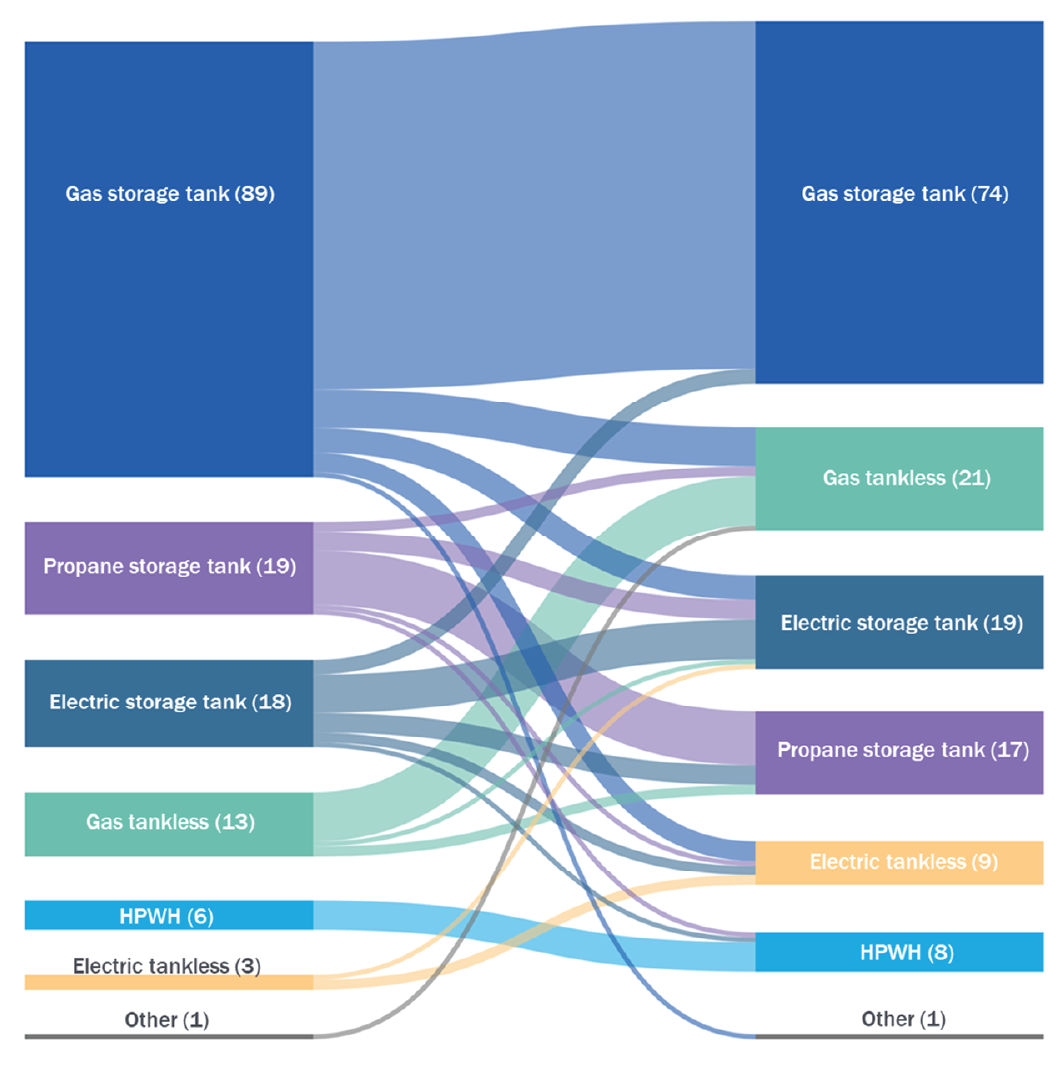
Figure 11 summarizes the types of water heaters that were replaced and installed by surveyed homeowners. The rectangles on the left-hand side represent the types of water heaters respondents reported removing in their recent water heater replacement. In contrast, the rectangles on the right-hand side represent the units they reported installing. The segments in the middle of the figure illustrate the respondents’ selection of their new water heater. The width of the rectangles on either side and segments in the middle correspond to the share of survey respondents represented.
As illustrated below, there was a substantial decline in the number of gas storage tank and propane storage tank units installed among respondents. Gas storage tank units were the most common type of existing water heaters removed (60, n=89) and new water heaters installed (50%, n=74). However, approximately 20% of (18 of 89) surveyed homeowners who removed a gas storage tank unit opted for a different type of new water heater, choosing a gas tankless unit (8), an electric storage tank unit (5), an electric tankless unit (4), or other (1). An even higher proportion of respondents with a propane storage tank unit changed equipment types when installing their new unit (42%, or 8 of 19).
Conversely, gas and electric tankless units saw the largest increase in installations. Ten of 13 (77%) respondents who removed a gas tankless system installed the same type of equipment, while another 11 respondents opted for a gas tankless system after removing a different type of unit. In addition to the two individuals who removed an electric tankless unit and installed the same type of new water heater, seven other respondents selected an electric tankless option to replace a different unit type.
There was also a modest increase in the number of HPWHs installed. Notably, all respondents who removed an HPWH (n=6) installed another HPWH, making it the only type of water heater that retained all respondents through the replacement process.
Figure 11. Types of Water Heaters Removed and Installed—All Homeowner Respondents (n=149)
Like-for-Like and Change-of-Type Replacements
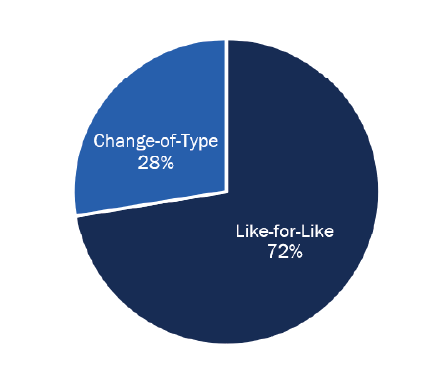
We explored two specific types of replacement situations: like-for-like and change-of-type replacements. Like-for-like replacements refer to situations in which the water heater installed is the same type of equipment as the one removed (e.g., replacing an old gas-fueled storage tank water heater with a new one). Conversely, in change-of-type replacements, the installation involves changing the type of water heater equipment (e.g., replacing a gas-fueled storage tank unit with a gas-fueled tankless water heater). Overall, homeowner respondents were more likely to report completing a like-for-like than a change-of-type replacement (see Figure 12 below).
Figure 12. Like-for-Like and Change-of-Type Replacements (n=149)
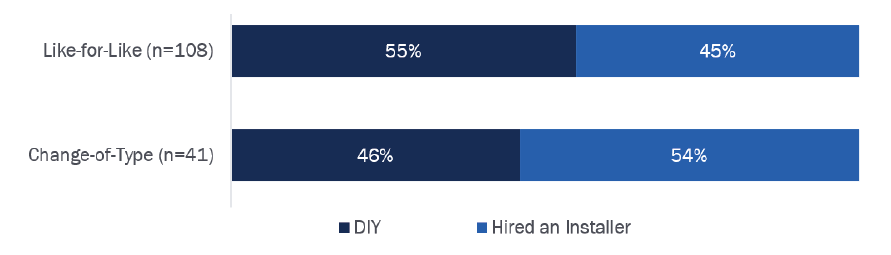
As we explored how homeowners replaced their water heater in these two scenarios. We found a larger share of like-for-like replacements were DIY installations compared to change-of-type replacements (55%, n=59, vs. 46%, n=19; see Figure 13).
Figure 13. Installers in Like-for-Like and Change-of-Type Replacements
Examining the characteristics of the installers that survey-takers hired, we observed the licensure rates in like-for-like and change-of-type replacements were similar. For both replacement types, roughly two-thirds of the installers that homeowners hired were licensed with the CSLB (see Figure 14).
Figure 14. Licensure Among Hired Installers in Like-for-Like and Change-of-Type Replacements
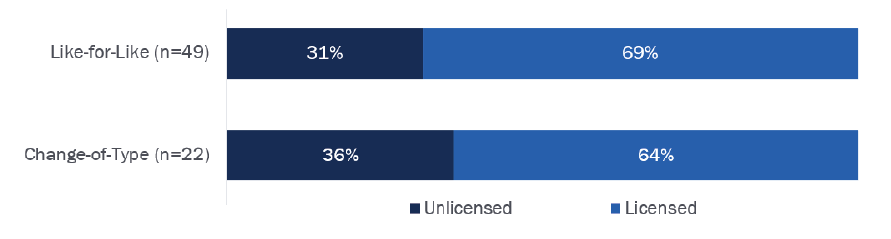
Next, we examined the types of water heaters that licensed contractors installed in like-for-like (Figure 15) and change-of-type (Figure 16) replacements. While gas storage tank units were the most common type of water heater that licensed contractors installed in like-for-like replacements (70%, n=24), no change-of-type replacements involved a licensed professional installing a gas storage tank unit. Additionally, gas tankless units were most commonly installed in change-of-type replacements where the homeowner hired a licensed installer (72%, n=10).
Figure 15. Licensed Contractor Water Heater Installations—Like-for-Like (n=34)
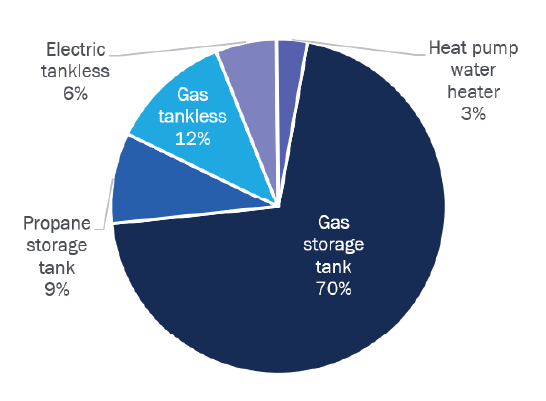
Figure 16. Licensed Contractor Water Heater Installations—Change-of-Type (n=14)
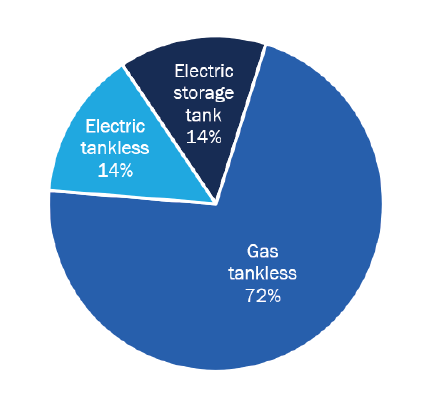
Most like-for-like replacements that unlicensed installers conducted involved installing a gas storage tank unit (87%, n=13). Conversely, one gas storage tank unit was installed (12%) in a change-of-type replacement by an unlicensed installer. Electric tankless units were the type of water heater unlicensed installers most frequently installed in scenarios with an equipment change. These results are displayed in Figure 17 and Figure 18.
Figure 17. Unlicensed Installer Water Heater Installations—Like-for-Like (n=15)
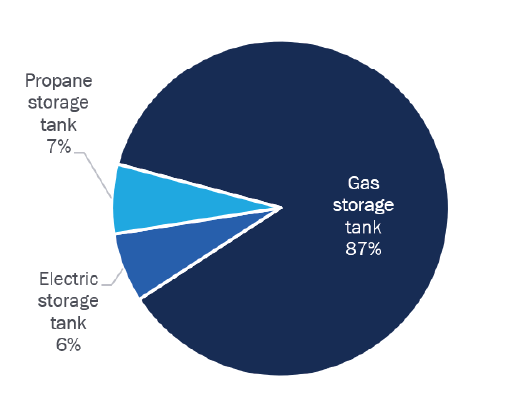
Figure 18. Unlicensed Installer Water Heater Installations—Change-of-Type (n=8)
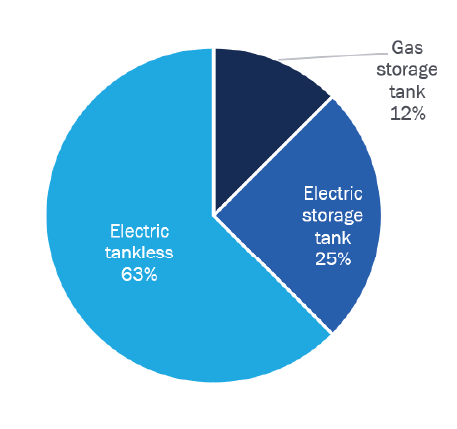
Fuel-Switching Replacements
We also analyzed responses involving fuel switching, a subset of change-of-type replacements where the new water heater uses a different fuel type than the old unit. We found that over half of change-of-type replacements involved fuel switching (56%, n=23; Figure 19). Additionally, the vast majority (87%, n=20) of these replacements did not involve a licensed contractor, with respondents opting for a DIY installation (61%, n=14) or hiring an unlicensed installer (26%, n=6). We display installer types in fuel-switching replacements in Figure 20 below.
Figure 19. Fuel Switching in Installations with an Equipment Change (n=41)
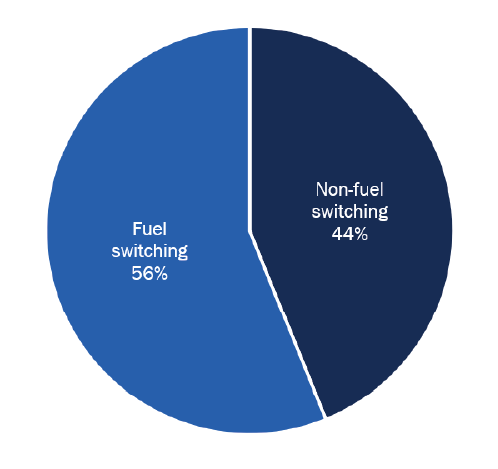
Figure 20. Installers in Fuel Switching Replacements (n=23)
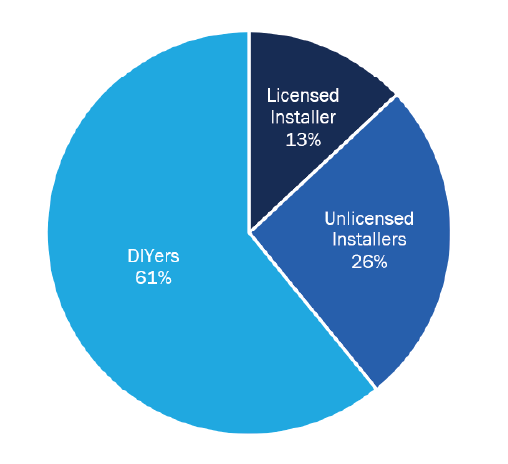
4.3.4 Respondent’s Demographic and Household Characteristics
The incidence survey also collected demographic information and household characteristics from respondents. When asked about the type of home where they recently replaced a water heater, most survey-takers selected single-family detached homes (65%, n=97). We summarize home types for all respondents in Figure 21 below.
Figure 21. Type of Home – All Respondents (n=149)
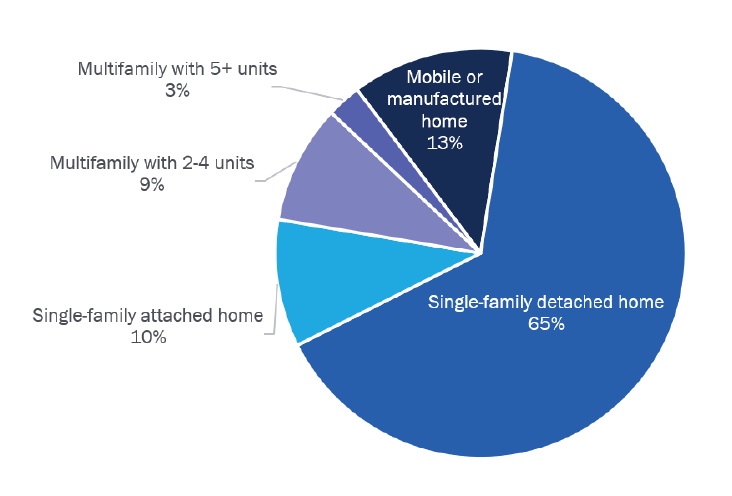
The research team found differences in home types between respondents who hired an installer and those who did not. Respondents who hired an installer were more likely to report replacing a water heater in a single-family detached home than those who conducted a DIY installation (79%, n=56 vs. 53%, n=41). Mobile or manufactured homeownership was more common among DIYers (19%, n=15) than those who hired an installer (6%, n=4). Additionally, the four respondents who reported replacing a water heater in a multifamily home with five or more units were DIYers. Home types for DIYers and those who hired an installer are displayed in Figure 22.
Figure 22. Type of Home by Installer Types
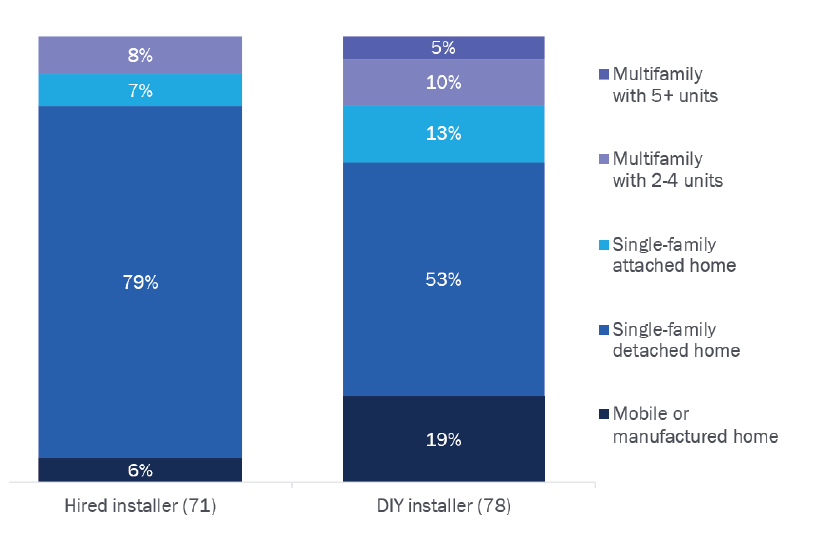
Respondents reported household incomes of $110,000 to $120,000, exceeding the California state median income of $84,097, as reported by the Census. The median income is the same for respondents who hired an installer and those who did not hire an installer. Among those who hired an installer, respondents who hired licensed installers reflect a higher median annual household income ($100,000 to $120,000) than those who hired unlicensed contractors ($80,000 to $99,000). Respondent household income information, including a comparison between installer groupings, is provided in Figure 23 and Figure 24 below.
Figure 23. Annual Household Income—DIYers vs. Hired Installer
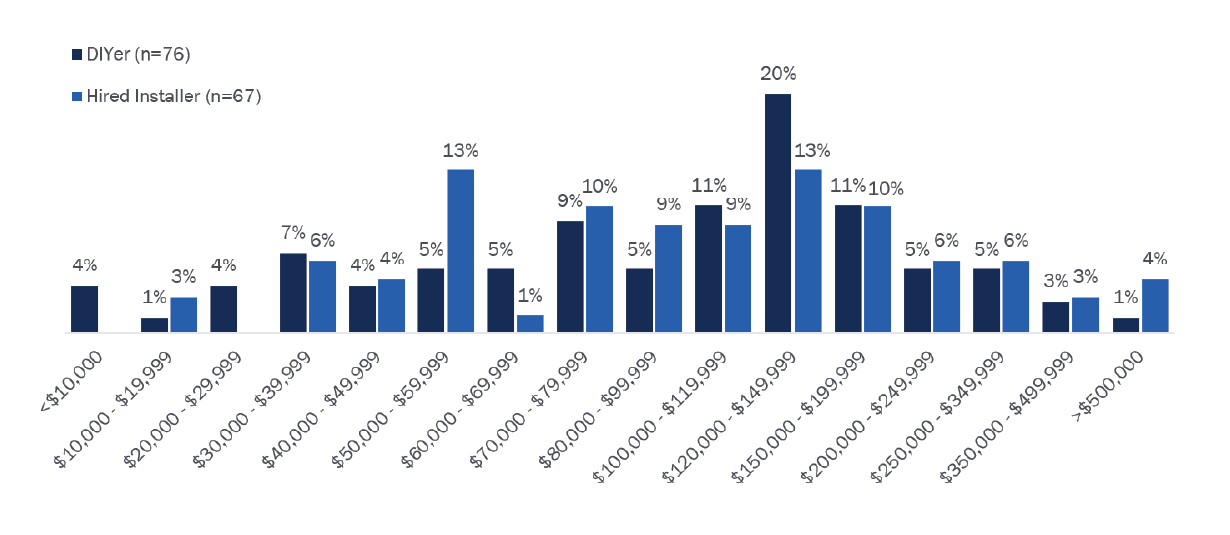
Figure 24. Annual Household Income—Hired Licensed vs. Unlicensed Installers
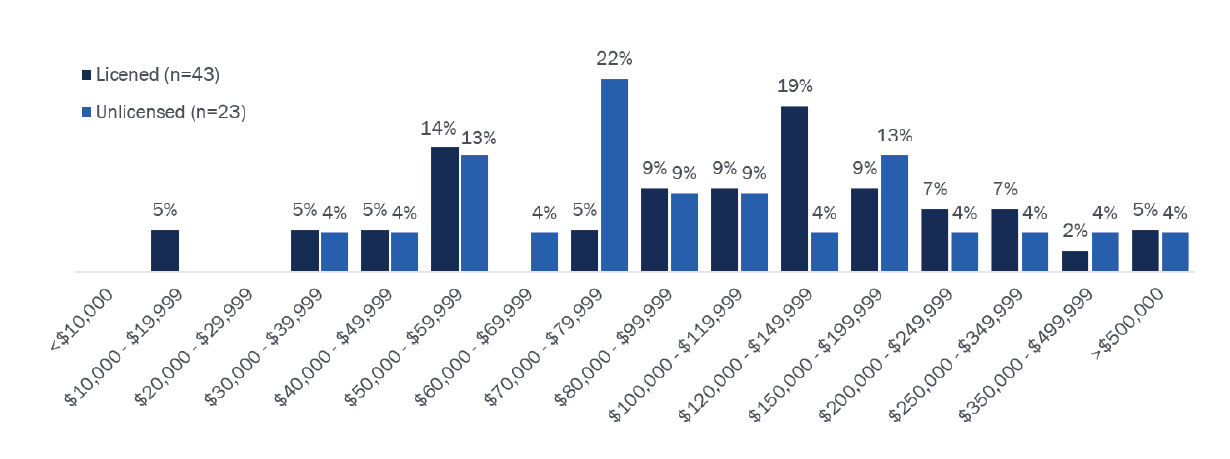
4.4 HPWH Installation Experience – Online Installer Survey
An essential objective of our online contractor survey was to understand water heater installer experiences with HPWH installations. We also sought to understand the barriers preventing installers from pursuing HPWH installation business. We explore these topics in the subsections below.
4.4.1 HPWH Installer Characteristics
Of the 127 survey-takers, 53% (n=67) indicated that their plumbing business installs HPWHs. Table 9 illustrates that respondents whose business conducts HVAC work were slightly more likely to install HPWHs than their counterparts. Additionally, respondents who reported being a sole operator were less likely to install HPWHs than respondents who reported working for a company with more than one employee. Companies with a larger staff size of 10 or more employees were likelier to install HPWHs than companies with less than 10.
Table 9. Frequency of HPWHs Installation Among Respondents (n=127)
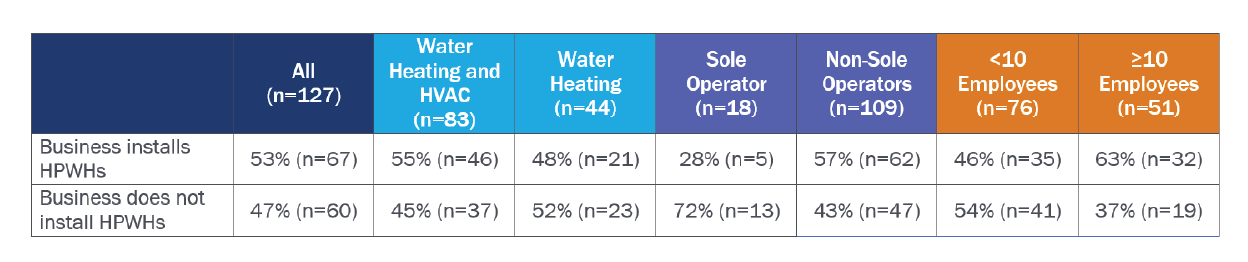
Most respondents indicated they began installing HPWHs in the last several years, with 52% (n=35) reporting their HPWH installation work started in 2019. Fewer than a quarter of respondents (22%, n=17) reported that they had been installing HPWHs for at least a decade before taking the survey (i.e., installing HPWHs since 2013 or earlier). Notably, two respondents stated that they started installing HPWHs before 2000, with one individual reporting beginning this work in 1978 and the other in 1990.
We then asked respondents to explain their reasons for adopting the technology. Many said their company began installing HPWHs (43%, n=29) because EE is important to their business. Other respondents said they began installing HPWHs in response to California’s clean energy policies (37%, n=25) and increased customer demand (37%, n=25).
By comparing reasons for HPWH adoption across respondent subpopulations, we found several notable differences between respondents whose companies have fewer than 10 employees and their counterparts with 10 or more employees. The most considerable discrepancy between these two groups was the proportion of respondents reporting that they began HPWH installation work to stay competitive with other plumbing businesses in their area. Respondents whose companies reportedly have fewer than 10 employees were more than twice as likely to select staying competitive than those who report having 10 or more staff members (44%, n=16 vs. 19%, n=6). Survey-takers who reported working for businesses with fewer than 10 employees were also more likely to select customer demand as a reason for beginning to install HPWHs than their counterparts (42%, n=15 vs. 31%, n=10). Conversely, respondents who said they have more than 10 employees were more likely to report pursuing HPWH installations because of the higher profitability of the work (25%, n=8 vs. 14%, n=5) and California energy policies (41%, n=13 vs. 33%, n=2), compared to those with smaller staff sizes. We present these differences in Figure 25 below.
Figure 25. Reasons for Installing HPWH by Staff Size
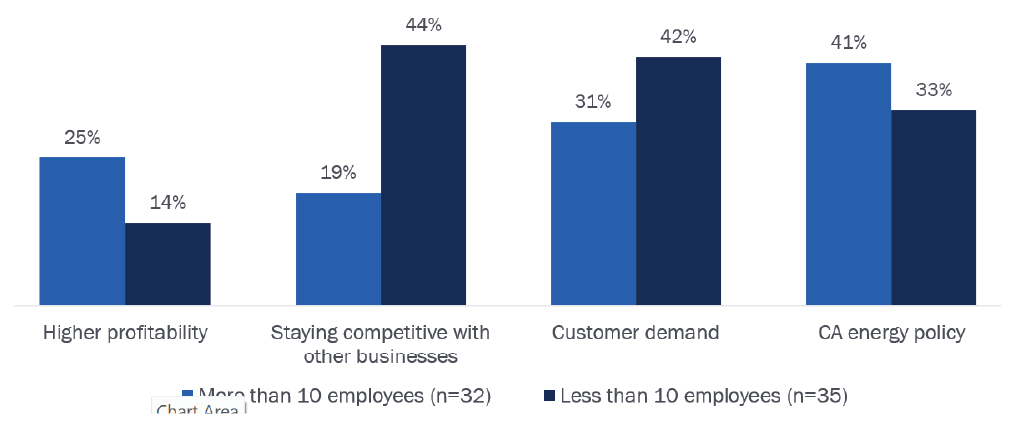
The survey then asked respondents who install HPWHs to breakdown the types of water heaters removed during HPWH installation. Many respondents said they replace gas storage tank water heaters with HPWHs (65% of the time on average). An existing HPWH is the second most frequently replaced type of unit during a HPWH installation (16% of the time on average), while electric tank and tankless, propane storage tank, and gas tankless systems are replaced less than 6% of the time on average by a HPWH.
4.4.2 HPWH Marketing and Promotional Efforts
We then asked the respondents who reported installing a HPWH if they made a conscious effort to market HPWHs. Eighty-one percent of HPWH installers said they market HPWHs (n=54), with 19% saying they do not promote HPWHs at all (n=13). The 54 respondents who market HPWHs were then asked which advertising channels they use. More than half of respondents said they advertise HPWH equipment on their website (73%, n=35) or through social media (61%, n=20), while slightly less than half use direct mail advertisements (46%, n=11) and emailed newsletters (46%, n=11).
We compared advertising channels by firmographics and found that HVAC contractors were significantly more likely to market HPWHs through their company websites (84%, n=26, vs. 53%, n=9), social media (75%, n=15, vs. 38%, n=5), and direct mail advertisements (67%, n=10, vs. 11%, n=1) than non-HVAC contractors. Figure 26 illustrates these differences.
Figure 26. Marketing Channels Used to Promote HPWHs Offering—Water Heating vs. Water Heating and HVAC
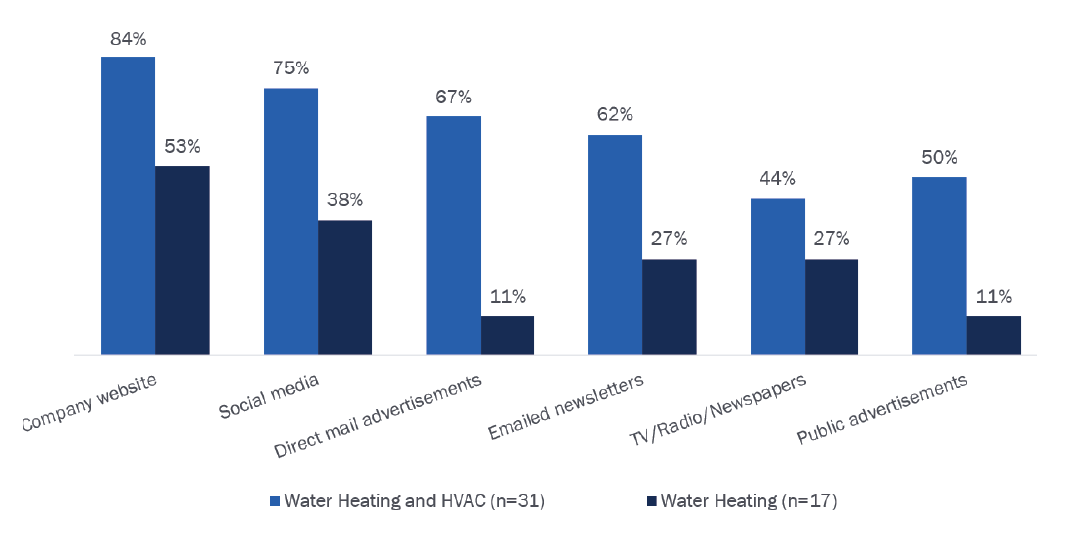
4.4.3 Number of HPWH Installations Completed and Expected
Respondents indicated an average of 50 HPWH installations over the last year and a median of 15 HPWH installations. Almost half (48%, n=32) of the HPWHs installers reported installing ten or fewer HPWHs in the last year, while 30% (n=20) stated they installed more than ten but no more than 50 and 21% (n=14) installed more than 50 HPWHs.
We also asked respondents to indicate the number of HPWHs they expect their company will install in the year ahead. The average and median number of installations respondents reported are 134 and 25, respectively. Roughly 36% (n=24) of respondents indicated that they expect to complete 10 or fewer installations, 34% (n=23) stated they expect to install more than 10 and no more than 50, and 29% (n=19) expected to complete more than 50 installations.
We compared the number of installations respondents expect to install in the next 12 months and the number they reported completing over the last year to understand the degree to which respondents expect their HPWH installation business to grow. The vast majority of respondents (78%, n=52) who install HPWHs expect to complete more installations in the next year than they did in the last 12 months. Five respondents expected to complete at least 1,000 installations over the next year. Eight respondents reported that they expect no change in the number of completed installations over the next year compared to last year. Six individuals reported that they expect to complete fewer installations in the next 12 months, with three respondents stating they do not expect to install any HPWHs next year despite installing at least one HPWH in the last year. One of these respondents is a sole operator, and the other two said that less than 65% of their staff can install an HPWH. Two companies began installing HPWHs because of customer demand but will no longer be installing them in the following year.
4.4.4 HPWH Installation Scenarios
On average, HPWH installers reported that 62% of HPWH installations occur in retrofit scenarios, compared to 38% in new construction settings. In new construction jobs, HPWH installers said that customers request a HPWH about half the time (52%, on average). Similarly, HPWH installers indicated they recommend HPWHs in about half of new construction jobs (53%, on average). More than three-quarters (76%) of retrofit HPWH installations were planned replacements, while 24% were emergency replacements, on average (see Figure 27).
Figure 27. Average Proportion of Planned and Emergency Replacement HPWHs Installations (n=29)
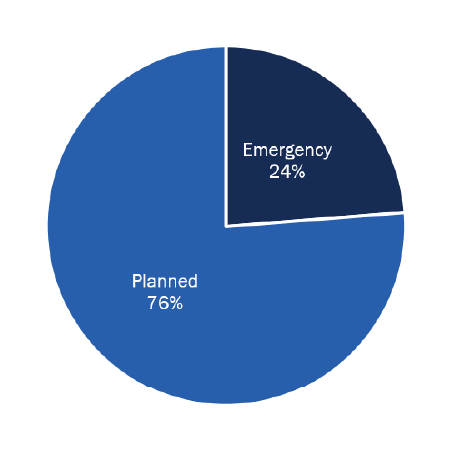
In planned replacements, respondents indicated, on average, that their customers request HPWHs half of the time, and they recommend HPWHs to their customers more than half the time (56%). These proportions are substantially lower in emergency replacement situations, as respondents said their customers request HPWHs less than 30% of the time, and they recommend HPWHs to their customers less than 40% of the time in these circumstances, on average.
The survey then asked installers which type of water heater they replace when installing HPWHs. They often reported replacing gas storage tank water heaters with gas storage tank water heaters (65%). The other commonly-replaced system is an older HPWH (17%). Table 10 summarizes the types of water heaters installers typically remove when installing a HPWH. We found no notable differences between subpopulations regarding the frequency of removing each system type. It is important to note that this table depicts equipment that is replaced by a HPWH as opposed to Figure 10 above which shows which equipment was replaced in 149 water heater replacements not specific to HPWHs.
Table 10. Water Heating Equipment Being Replaced by HPWHs (n=29)
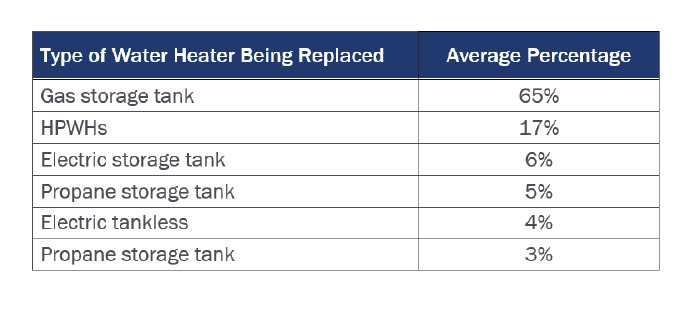
4.4.5 HPWH Installation Logistics
We asked respondents about the inventory and availability of HPWHs. Most respondents (61%, n=41) reported that they do not keep any HPWHs in stock at their business, while 16% of respondents who install HPWHs said they had ten or more on hand at the time of taking the survey. The average number of HPWHs respondents reported keeping in stock was four. Most respondents (81%, n=54) indicated that it typically takes less than one week to receive an HPWH that they order from a distributor.
The survey asked respondents how they handle the electrical work involved in HPWH installations. Respondents reported that approximately 30% of the HPWHs they install require upgrading the customer’s electrical panel. Approximately 21% of respondents said they exclusively rely on a staff electrician to complete electrical components of an HPWHs installation, with the remainder of individuals reporting that they either exclusively rely on an electrical subcontractor (45%, n=30) or a mix of subcontractors and in-house staff (34%, n=23). Most respondents who reported using electrical subcontractors for at least some of their HPWH installations indicated that electricians typically require less than a week of lead time to complete the job (68%, n=36).
Next, the survey asked HPWH installers if they were confident in their staff’s ability to sell, size, install, maintain, and service HPWHs. As Figure 28 below illustrates, more than half of the respondents were at least very confident in their staff’s ability to complete all aspects except for servicing HPWHs. Individuals also indicated a higher degree of confidence in HPWH installation than the other aspects, with 86% being very or extremely confident in their staff’s capacity.
Figure 28. Confidence in Staff Capacity to Perform HPWH Tasks[36]
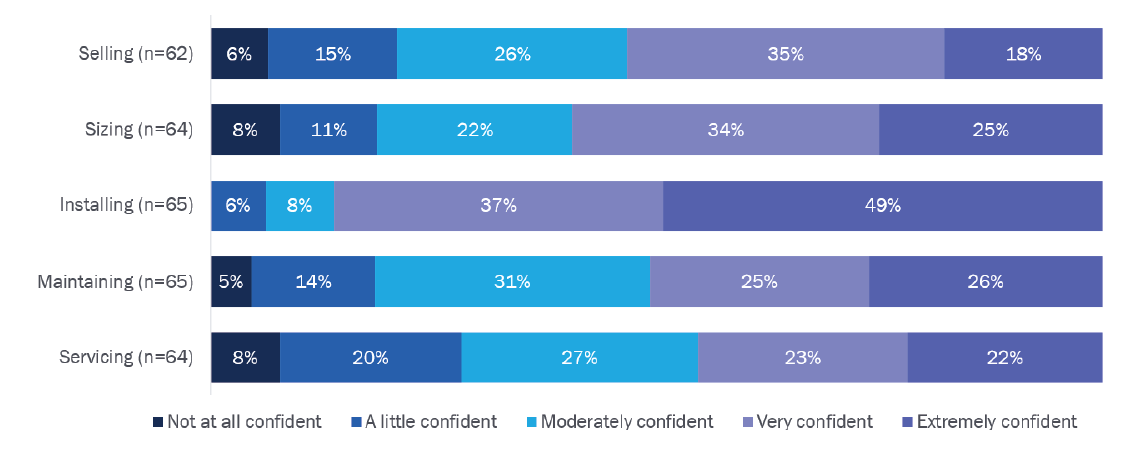
[36] Sixty-seven survey-takers received these questions based on their indication that they hold a management role in their company. The number of answers for each question varies because some individuals declined to respond.
An open-ended question asked respondents to identify the aspect of HPWH installation that requires the most training. The most common response was that the electrical component of HPWH installation and aspects related to wiring require the most training. Additional aspects mentioned often were sizing, venting/ducting, startup/installation, and the thermostatic mixing valve. Table 11 summarizes the percentage of open-ended responses that mentioned various aspects of HPWH installation.
Table 11. Aspects of HPWH Installation that Require Training (n=69)
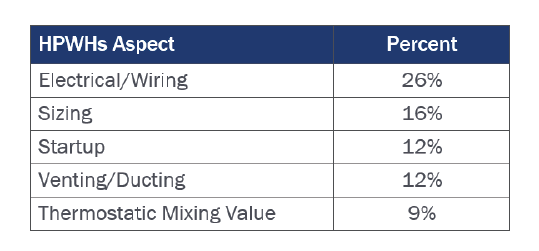
4.4.6 Non-HPWH Installers
The survey asked respondents who reported not installing HPWHs to provide their top three reasons for not adopting the technology. More than half said demand for HPWHs is low among their customer base (56%, n=33), so they do not install them. Other common barriers were the price of the equipment (41%, n=24) and the complexity of HPWH installations (39%, n=23). These results are presented in Figure 29 below.
Figure 29. Reasons for Not Installing HPWHs—All Respondents (n=59)
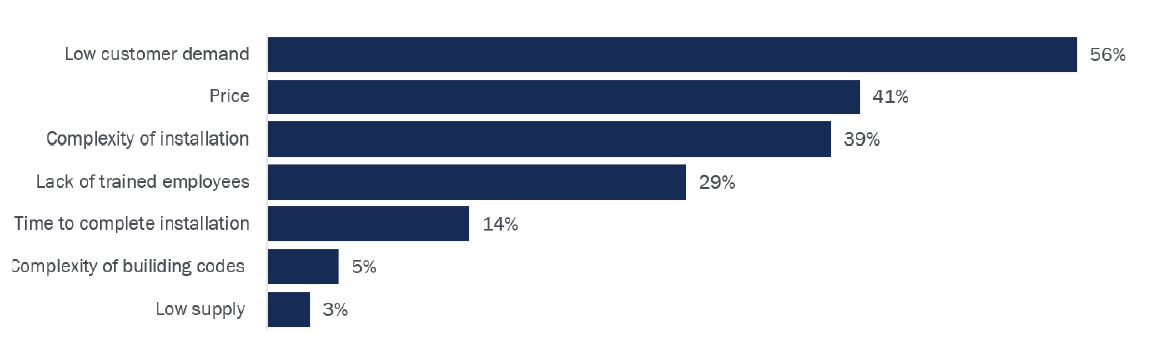
The research team also compared reasons for not installing HPWHs across business characteristics. Contractors who work in both HVAC and plumbing were more likely (39%, n=14 vs. 13%, n=3) to say that a lack of trained installers limits the adoption of HPWH technology than contractors who work in plumbing only (see Figure 31). Companies operated by a sole employee were more likely to say that the time it takes to install an HPWH (31%, n=4 vs. 9%, n=4) is a barrier to adoption than non-sole operators (see Figure 31).
Figure 30. Not Installing HPWHs Due to Lack of Trained Employees—Water heating and HVAC vs. Water Heating (n=59)
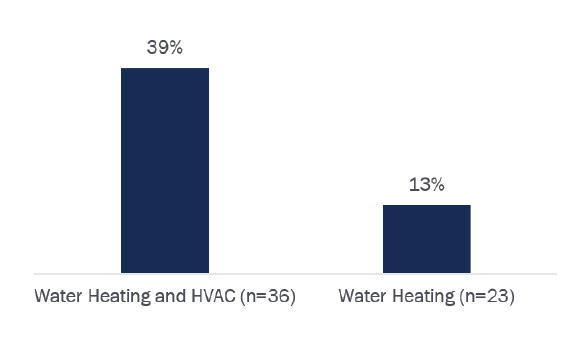
Figure 31. Not Installing HPWHs Due to Time to Complete Installation—Sole Operator and Non-Sole Operator (n=59)
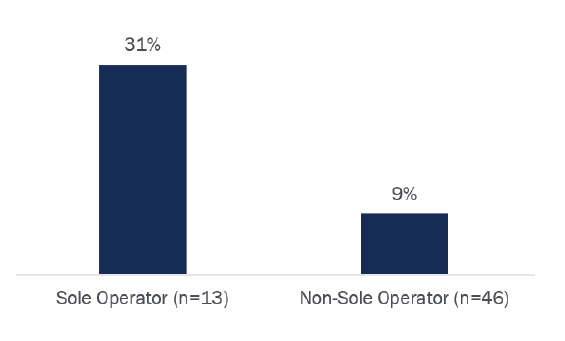
We also asked the non-HPWH installers if they planned to offer HPWH installation in the next year. Forty percent (n=24) of these respondents indicated they did not know. At the same time, 32% (n=19) stated they plan to begin installing HPWHs, and 27% (n=16) do not. There were several differences between sole operators and respondents whose businesses have more than one employee. While both groups had a similar proportion of respondents who said they were uncertain about whether they would begin installing HPWHs in the next year, a larger share of sole operators (38%, n=5) stated they did not plan to begin installing HPWHs than non–sole operators (23%, n=11). Please note that the difference between sole and non-sole operators is not statistically significant. However, we found it notable that non-sole operators may potentially be less inclined to begin installing HPWHs in the near term.
4.5 Plumbing Training Landscape
Another critical component of this study was to characterize the plumbing training landscape. We discuss our findings related to this research objective in the following sections.
4.5.1 Training Outreach and Identification
The online survey asked respondents with a management-level role (82%, n=104) how their company identifies training opportunities for its employees. Management-level respondents most frequently selected outreach from distributors as the channel through which they find training (65%, n=68). Outreach from manufacturers (55%, n=57) was the second most frequently selected channel. The unions were the least commonly cited way of learning about training opportunities among all respondents who reported holding a management-level role (1%, n=1). However, this is likely related to low union representation among respondents, as only 3 of the 104 management-level respondents indicated having union membership. After union outreach, advertising via television or radio ads (3%, n=3) was the least frequently selected channel for learning about training opportunities. Figure 32 summarizes the distribution of answers from management-level respondents.
Figure 32. Channels for Identifying Training Among Respondents with Management-Level Roles (n=104)
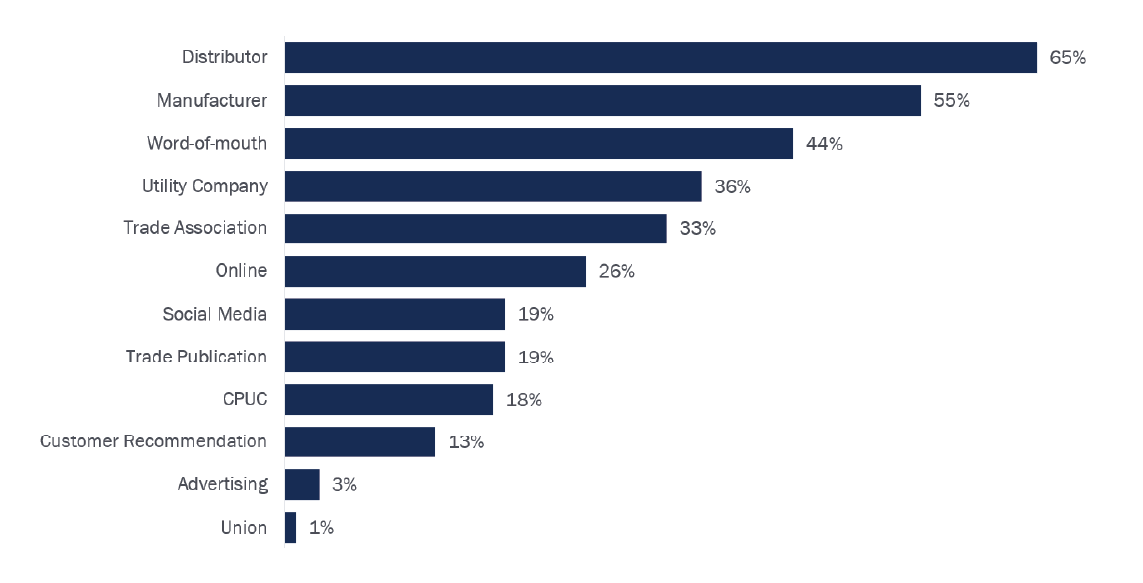
We compared responses by business characteristics that contractors reported and found differences between respondents who reported working in the HVAC and plumbing trades and those who reported only working in plumbing. Specifically, managers who reported working in both trades were more likely than those who work in plumbing alone to indicate they find training opportunities for their company from utilities (44%, n=31 vs. 18%, n=6), trade associations (40%, n=28 vs. 18%, n=6), and trade publications (26%, n=18) vs. 6%, n=2). Figure 33 presents these differences.
Figure 33. Outreach Channels Used to Identify Company Training—Water Heating vs. Water Heating and HVAC
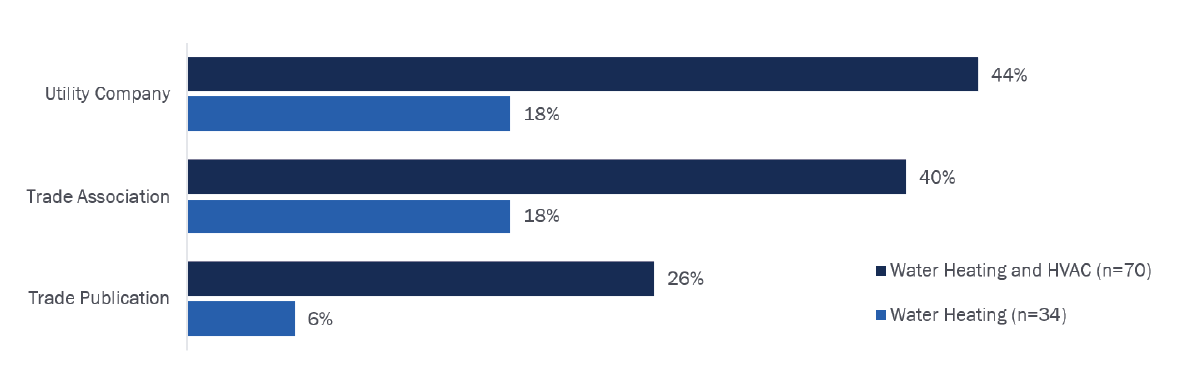
We also found differences between individuals who indicated their business installs HPWHs and those who did not (see Figure 34). Managers at companies that install HPWHs (44%, n=27) were more likely than their counterparts (23%, n=10) to find training via outreach from utility companies. Similarly, a higher share of managers at HPWH-installing companies (25%, n=15) reported finding training for their business through CPUC outreach than those at non-HPWH-installing companies (9%, n=4).
Figure 34. Outreach Channels Used to Identify Company Training—HPWH vs. Non-HPWH Installers
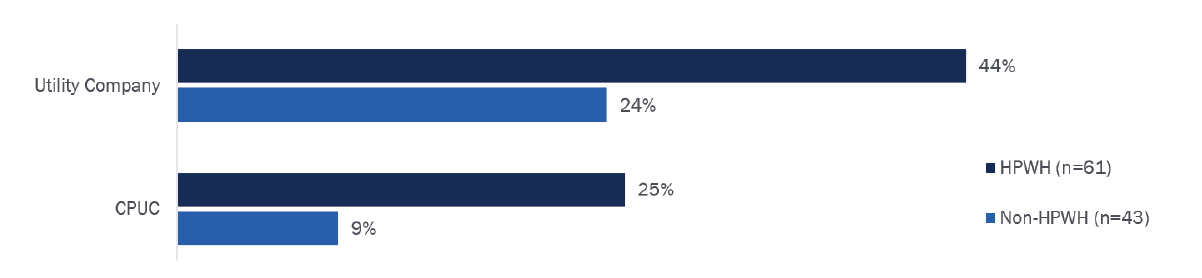
In addition to asking management-level respondents about the channels they use to find training opportunities for their company, we asked all respondents how they stay abreast of professional development. Respondents’ personal preferences mirrored answers from managers that we described above. As Figure 35 illustrates, more installers prefer to learn about training opportunities from distributors (69%) and manufacturers (59%) than other outreach channels.
Figure 35. Installer’s Personally Preferred Outreach Channels (n=127)
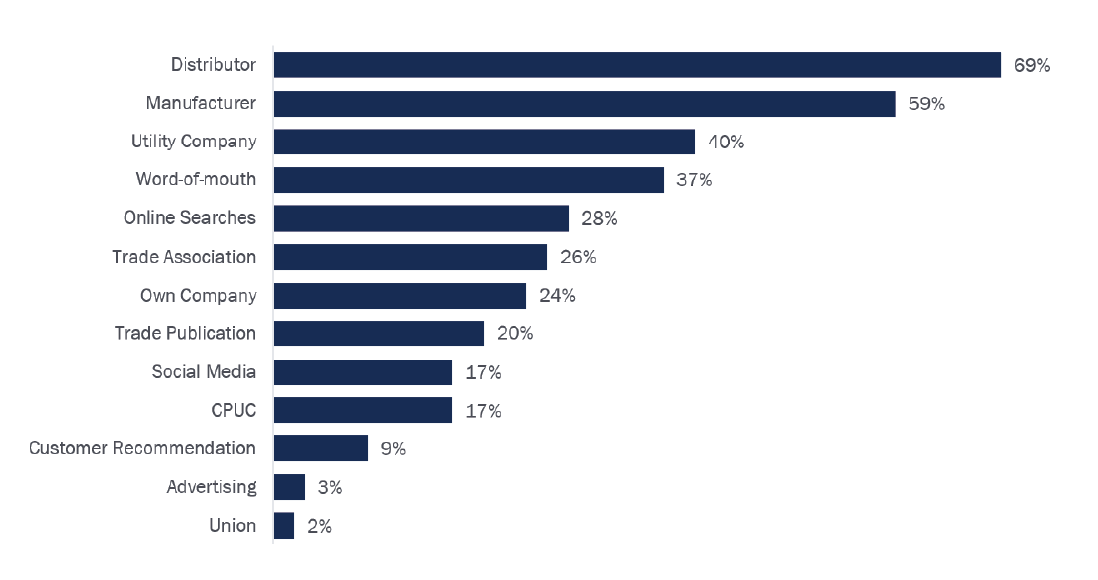
We compared training outreach preferences between respondents who reported working in both HVAC and water heating and those whose company does not do HVAC work. We found the most substantial difference in the preference for utility company outreach between the two groups; nearly half of respondents who work in both trades (49%) included utility company outreach among their preferred channels, while less than a quarter of those whose business focuses on water heating selected this option. Below, Figure 36 displays notable differences between these two groups.
Figure 36. Personally Preferred Outreach Channels—Water Heating and HVAC vs. Water Heating
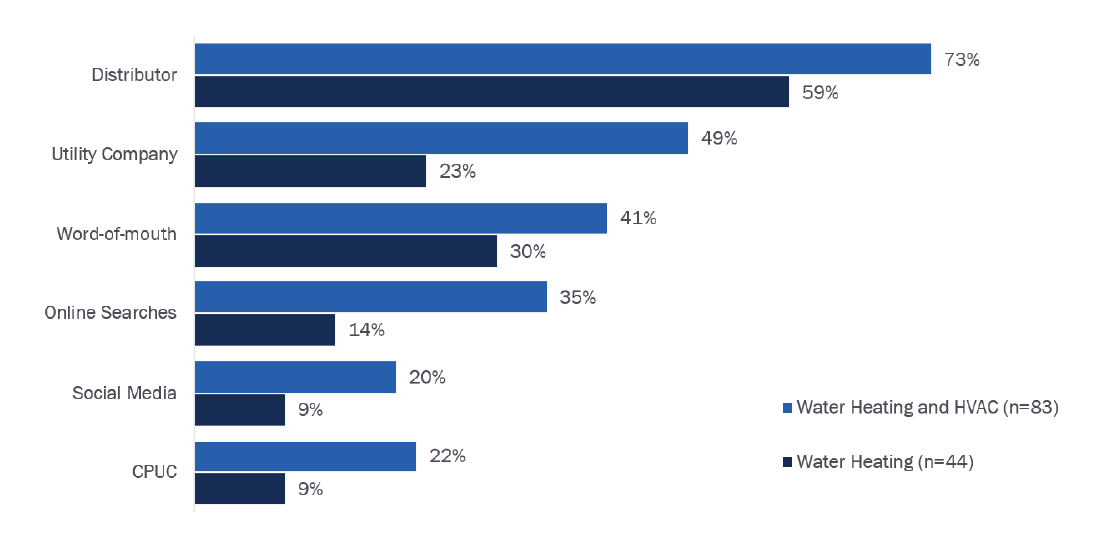
We also found differences between those survey-takers who have HPWH installation experience and those who do not (HPWH vs. non-HPWH), which we display in Figure 37. As illustrated below, we found the largest difference in the preference for training outreach from utility companies where 54% of HPWH installers indicated a preference for this channel, compared to 25% of non-HPWH installers.
Figure 37. Personally Preferred Outreach Channels—HPWH vs. Non-HPWH Installers
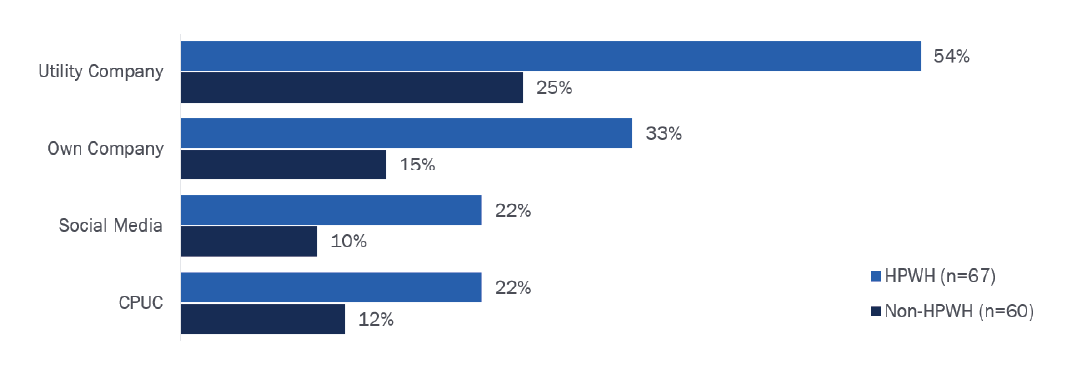
There were also differences in outreach preferences between sole and non-sole operators, the largest of which involved preference for distributor outreach. While nearly three-quarters (72%) of non-sole operators indicated they prefer distributor outreach, less than half (44%) of sole operators in our sample said they prefer this channel. Figure 38 presents all notable differences between these two subgroups.
Figure 38. Personally Preferred Outreach Channels—Sole Operator vs. Non-Sole Operator
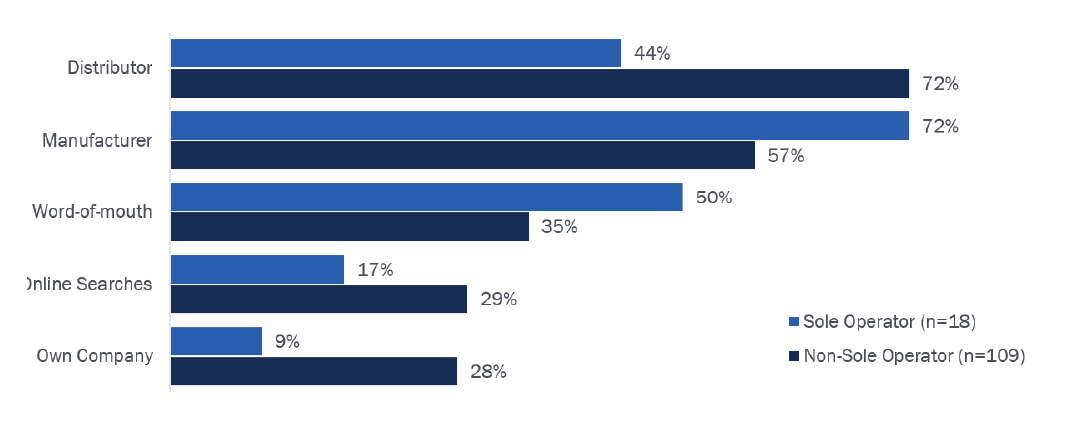
These responses offer valuable insights for maximizing the reach of efforts to promote training opportunities. Future contractor outreach for training opportunities could be conducted based on company characteristics. For example, outreach from utility companies could be the most effective channel to reach contractors who work in both the HVAC and plumbing trades or those who have yet to pursue HPWH installation business.
4.5.2 Training Providers
The survey asked respondents who reported holding a management-level role to select the type of training providers from which they pursue training for their company’s employees. As Figure 39 displays, nearly 70% of management-level respondents indicated that they pursue on-the-job training (69%, n=72). Managers also frequently indicated a preference for manufacturer-provided (66%, n=69) and distributor-provided (55%, n=57) training. Respondents were least likely to report pursuing training from unions (3%, n=2) or community colleges (13%, n=14). As noted in the previous section, the research team believes that the low frequency of respondents indicating they pursue union-provided training for their employees is likely related to the low representation of union members among survey-takers.
The team compared training-provider preferences by business characteristics and found differences between management-level respondents who work in both HVAC and water heating and those who do not conduct HVAC work. We present differences in manager training provider preferences between these two groups in Figure 39 below. The largest difference between these groups was in preference for private training institutes, which managers at companies that work in both trades were more likely to prefer (37%, n=26) than their counterparts (15%, n=5).
Figure 39. Manager-Preferred Providers for Company-Wide Training—Water Heating and HVAC vs. Water Heating
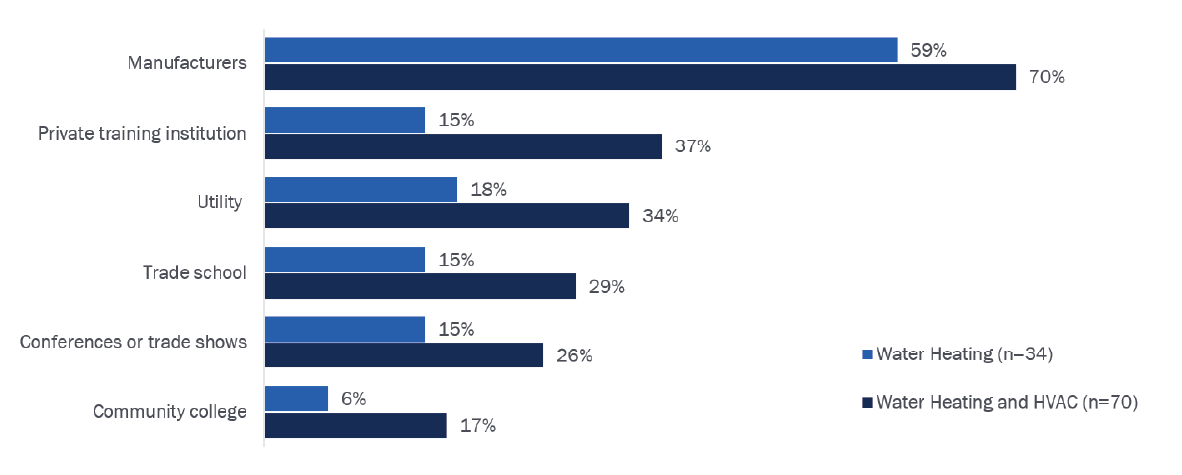
We also asked all respondents—managers and non-managers—about the types of training providers they prefer personally. Manufacturers and distributors were the most popular providers but by a lesser margin than companywide preferences. Approximately one-quarter of respondents (26%, n=33) said they preferred their company’s on-the-job training, a sizeable decrease from the 69% of managers who said it was their preferred source of training for their employees.
Once again, we found notable differences between respondents who work in HVAC and water heating and those who do not work in HVAC. The largest difference involved preference for utility-sponsored training. Over one-third of HVAC respondents preferred utility training (37%, n=31), while 14% (n=6) of non-HVAC contractors preferred this option. Figure 40 presents the differences between these two groups below.
Figure 40. Contractors’ Personal Training-Provider Preferences—Water Heating and HVAC vs. Water Heating
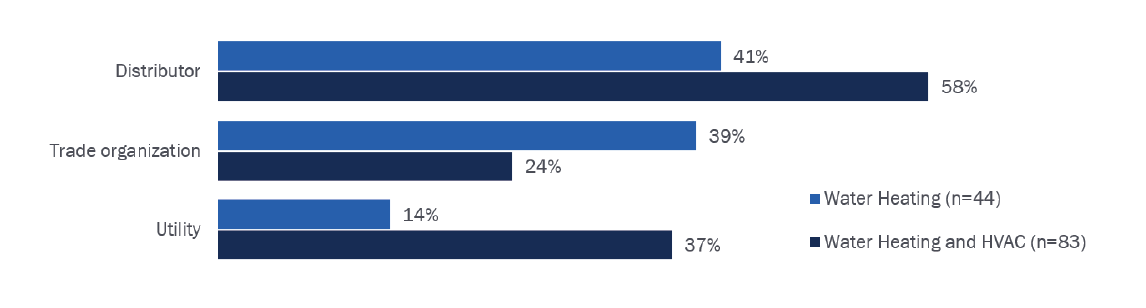
4.5.3 Company Training Policies
We asked respondents about their company’s training policies for its employees. Of the 109 respondents who reported working for a company with more than one employee, 50% (n=55) indicated their company requires professional development at least once a year. A similar proportion of respondents (52%, n=57) said installers at their company complete water heating-specific training at least once a year (see Figure 41).
Figure 41. Frequency of Required and Water Heating-Specific Training (n=109)
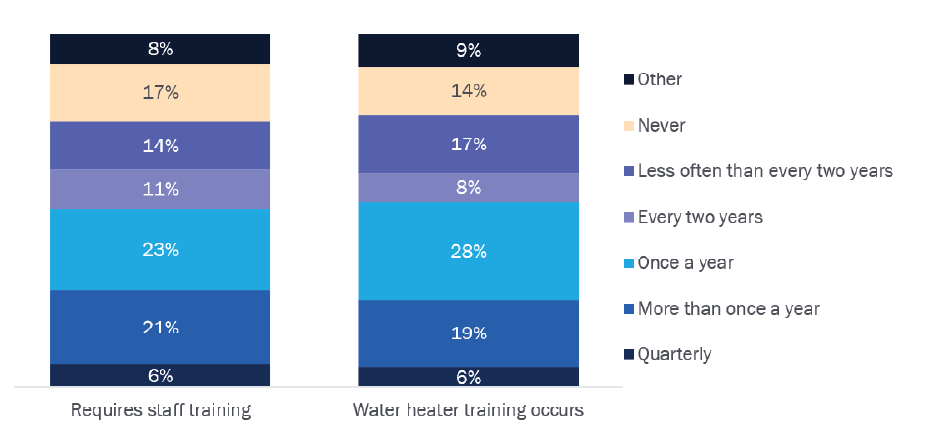
The research team examined differences across subpopulations of respondents. Respondents who install HPWHs were more likely to pursue training on water heating more frequently than those who did not. Of the HPWH installers in the survey, 65% said they pursue staff training at least once per year, while 36% of those who do not install HPWHs pursue staff training at least once per year.
4.5.4 Desired Training Topics
The survey also asked respondents about their company’s training needs. We presented respondents with eight plumbing-related topics, which they ranked in order of importance for their company’s plumbing business. Figure 42 presents the average rank for each of the eight training topics, with higher average scores indicating the topics more respondents selected as the most important. Plumbing codes and regulations and water heater installation were the two most important topics among all respondents, while branding and marketing were the least.
Figure 42. Average Ranking of Plumbing Training Topics (n=104)
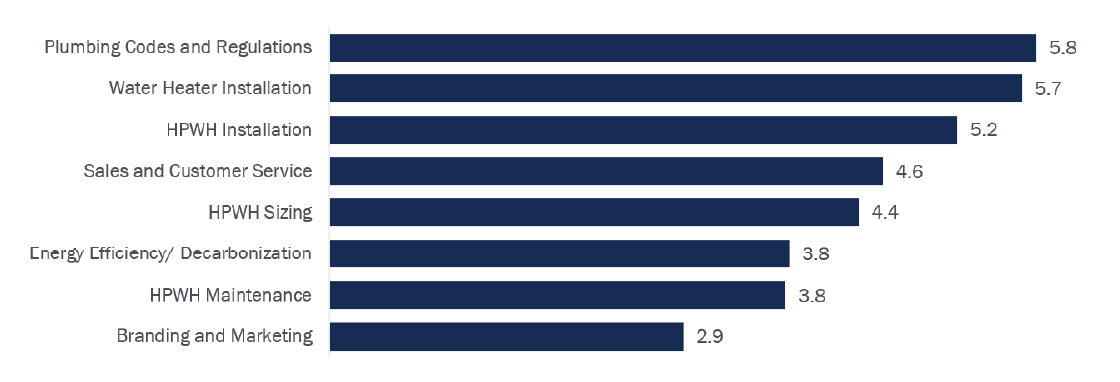
When comparing topic preference based on business characteristics, we found several notable differences between respondents whose company conducts HVAC work and those whose company does not. As Figure 43 shows below, respondents who work in both HVAC and water heating ranked sales, customer service, and plumbing codes and regulations lower on average than their counterparts (4.1 vs. 5.4 and 5.5 vs. 6.3, respectively). Conversely, survey-takers who work in both trades ranked HPWH sizing, installation, and maintenance higher on average than respondents whose business focuses on water heating (4.5 vs. 4.0, 5.5 vs. 4.9, and 3.9 vs. 3.3, respectively).
Figure 43. Average Ranking of Plumbing Training Topics—Water Heating and HVAC vs. Water Heating
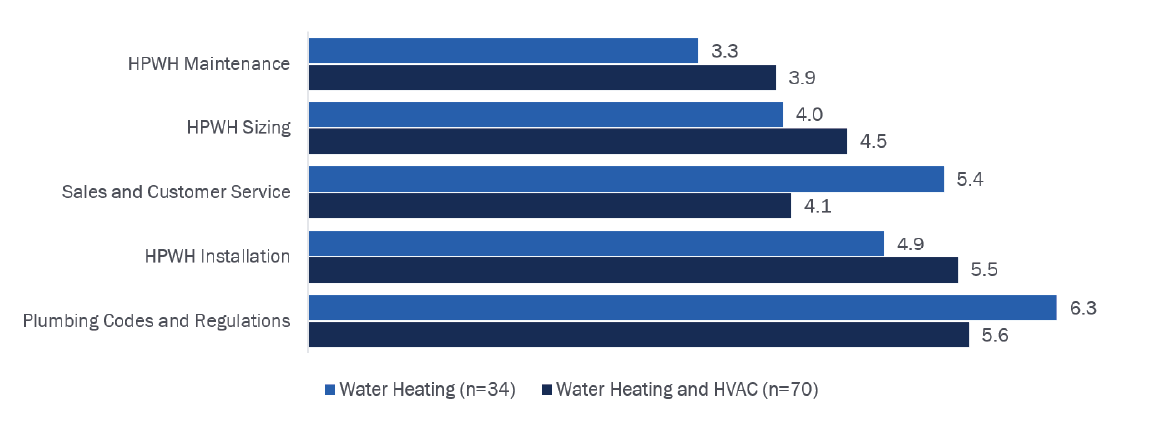
We also found differences between survey-takers whose business installs HPWHs and those whose businesses do not (i.e., HPWH vs. non-HPWH). Specifically, HPWH respondents ranked HPWH sizing and installation lower on average than non-HPWH survey-takers (4.8 vs 3.8 and 5.7 vs 4.5, respectively). Additionally, on average, HPWH respondents ranked the general water heater installation topic lower than non-HPWH survey respondents (5.1 vs. 6.7). Figure 44 presents the notable differences between these two respondent groups.
Figure 44. Average Ranking of Plumbing Training Topics—HPWH vs. Non-HPWH Installers
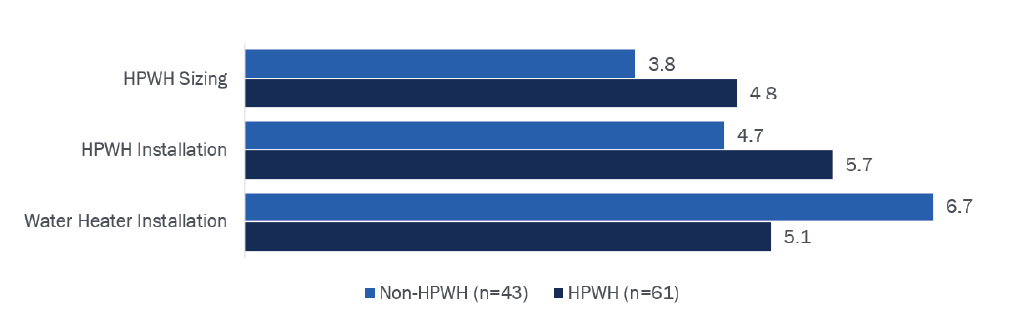
In addition to asking survey-takers about the importance of training topics for all installers at their company, we asked respondents which training topics would benefit their most senior employees specifically. Respondents ranked plumbing codes as the most and branding and marketing as the least essential topics for the senior staff (see Figure 45 below). Notably, these were also the highest and lowest ranked topics when respondents were asked about the needs of all company staff (illustrated in Figure 42 above).
Figure 45. Average Ranking of Training Topics for Senior Employees (n=104)
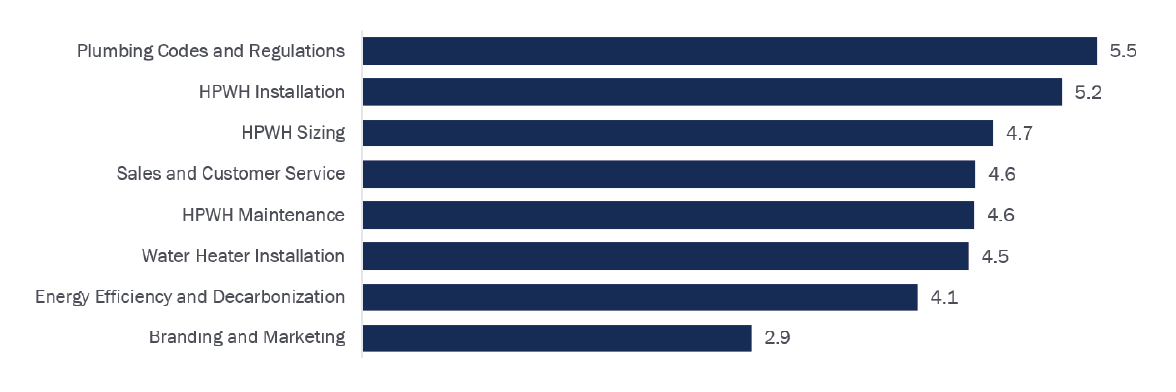
Analyzing differences between respondent groups, we found that, on average, contractors who work in HVAC and water heating ranked HPWH installation higher than water heating-focused contractors (5.0 vs. 4.1). Contractors who work in both trades also ranked HPWH sizing higher and sales and customer service skills lower than their counterparts (5.4 vs. 4.7 and 4.2 vs. 5.4, respectively). We found the largest difference between the average ranking of branding and marketing, which water heating-focused contractors ranked substantially higher than contractors who work in both trades (5.0 vs. 2.8). We present these differences in Figure 46 below.
Figure 46. Average Ranking of Training Topics for Senior Employees—Water Heating and HVAC vs. Water Heating
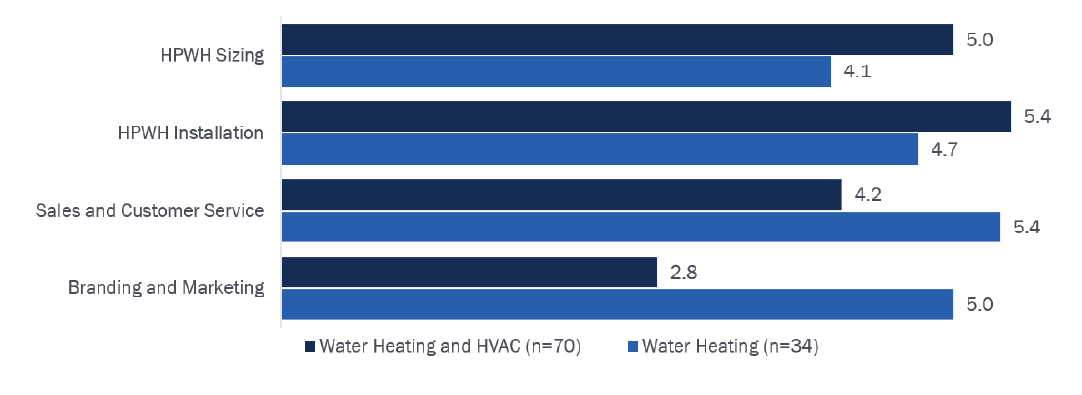
We also found one notable difference between respondents who install HPWHs and those who do not. On average, respondents whose company installs HPWHs ranked branding and marketing lower than non-HPWH respondents (2.5 vs. 3.4; Figure 47).
Figure 47. Average Ranking of Training Topics for Senior Employees—HPWH vs. Non-HPWH Installers

After asking survey-takers about the training topics that would benefit their staff, we prompted respondents to identify the areas in which they personally desired additional training. Respondents most frequently selected HPWH service, EE programs, HPWH installation, and plumbing codes as valuable training topics. Survey-takers selected servicing other plumbing equipment, water heater maintenance, and water heater installation least frequently. These findings are listed in Figure 48.
Figure 48. Desired Training Topics—All Respondents (n=127)
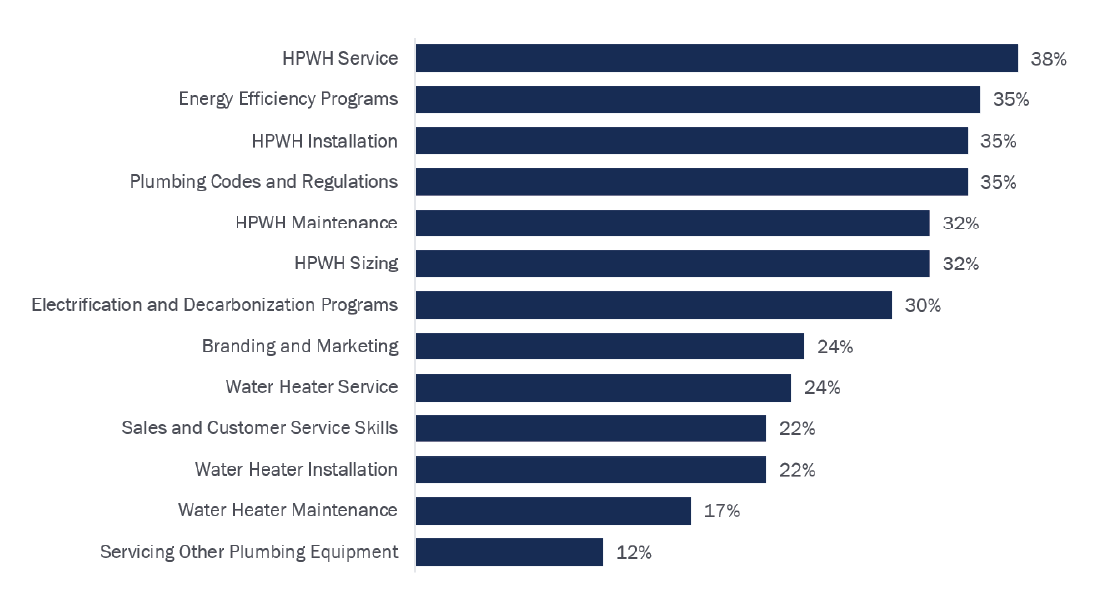
In comparing respondent preferences between subgroups, we found several notable differences between those whose company does HVAC and water heating work and those whose company is not involved in HVAC. Namely, respondents who work in both trades were more likely to want more water heater maintenance (23%, n=19 vs. 7%, n=3), service (31%, n=26 vs. 9%, n=4), HPWH installation (41%, n=34 vs. 23%, n=10), and HPWH service (45%, n=37 vs. 25% n=11) training opportunities than their water heating-focused counterparts (see Figure 49 below).
Figure 49. Desired Training Topics—Water Heating and HVAC vs. Water Heating
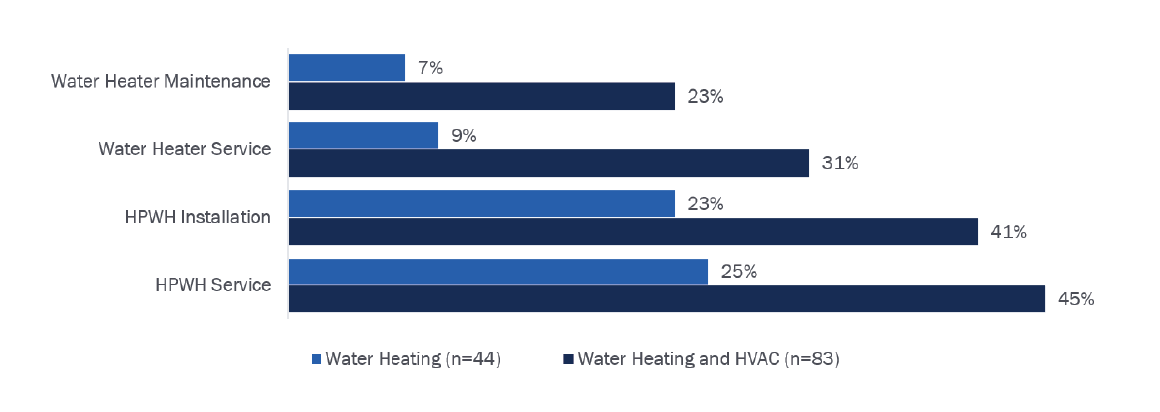
Additionally, respondents who work for a company that installs HPWHs were more likely to want more branding and marketing training opportunities than non-HPWH installers (31%, n=21 vs. 17%, n=10). On the other hand, non-HPWH installers were more likely to want more water heater installation (30%, n=18 vs. 15%, n=10) and HPWH installation (43%, n=26vs. 27%, n=18) training opportunities than HPWH installers. Figure 50 presents these differences below.
Figure 50. Desired Training Topics—HPWH vs. Non-HPWH installers
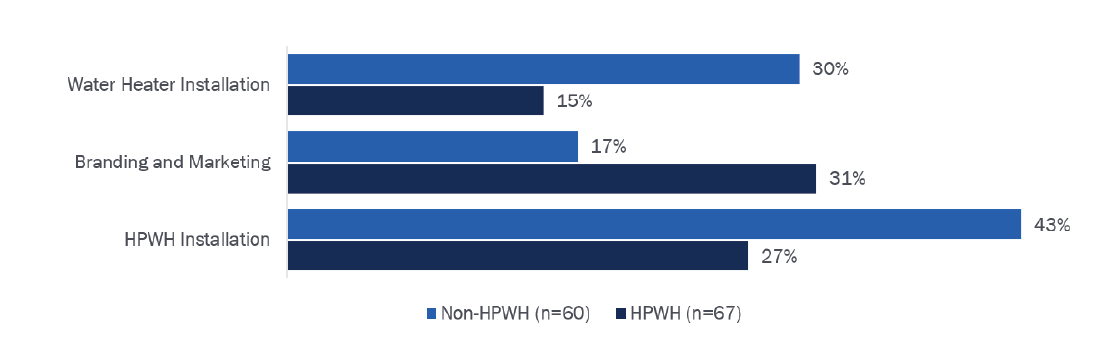
4.5.5 Training Motivations, Preferences, and Experiences
In the online survey, the research team asked contractors about their motivations for completing training. Figure 51 presents results from a question prompting respondents to select their top three motivations. The most common motivators included learning about new technology, skills, and customer service. The least common motivator was obtaining a promotion. Respondents seldom selected other personal benefits, such as earning and maintaining a certification or license. Few respondents indicated being motivated by learning about EE and electrification/decarbonization programs, though more respondents were motivated by EE than electrification/decarbonization.
Figure 51. Motivations for Completing Training (n=127)
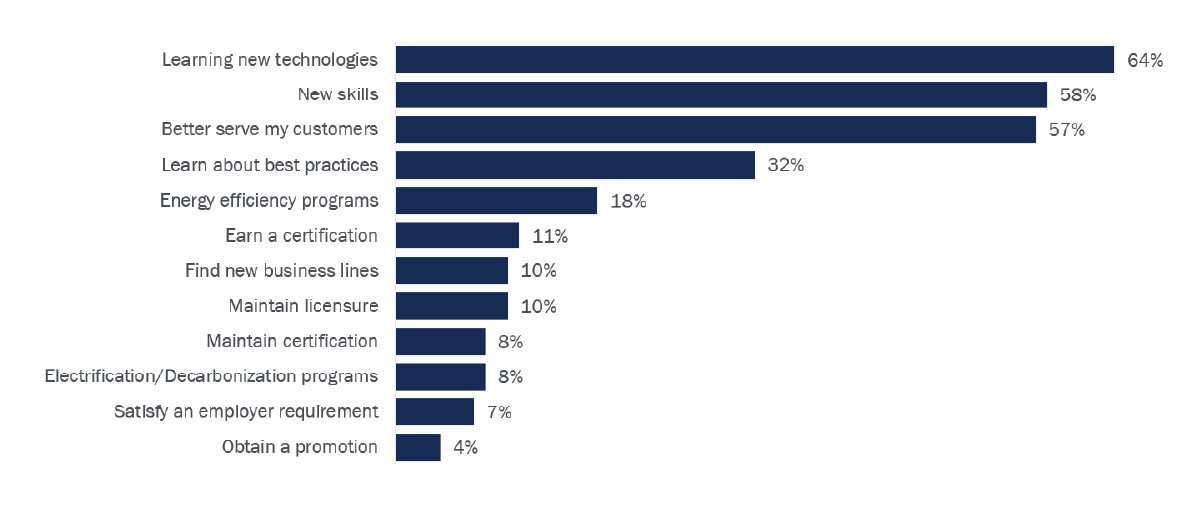
Respondents were split on their preferred training modality. Forty-five percent preferred in-person instruction, while 21% preferred online training. Thirty-one percent said they like a combination of in-person and online training.
The research team asked respondents in the online survey whether they had attended training related to HPWH sales, sizing, installation, maintenance, or service in the past year. Less than half of the online survey respondents had attended training on these topics. The most covered topic related to HPWH was installation, with 45% of respondents saying they received training on this topic in the past year. Only 13% of contractors said they had attended training that focused on servicing HPWH.
4.5.6 Plumbing Certifications, Licenses, and Credentials
Opinion Dynamics identified many of the common certifications, licenses, and credentials that plumbing professionals possess by conducting web searches, reviewing relevant literature, and asking surveyed contractors to list the credentials they possess and look for when hiring candidates for plumbing positions at their company. After identifying various certifications, licenses, and credentials, we sorted these endorsements into distinct categories, as discussed below. Throughout the following discussion, we will provide specific examples of each type of endorsement we identified in our research.
Licenses and Certifications from the State of California
Through our research, we identified a handful of licenses issued through the CLSB that plumbing companies could possess (Table 12). In addition to the licenses issued via the CLSB, several respondents to the online survey also indicated possessing a lead abatement certification issued through the California Department of Public Health.
Table 12. Type and Description of Relevant CLSB Licenses Among Water Heater Installers
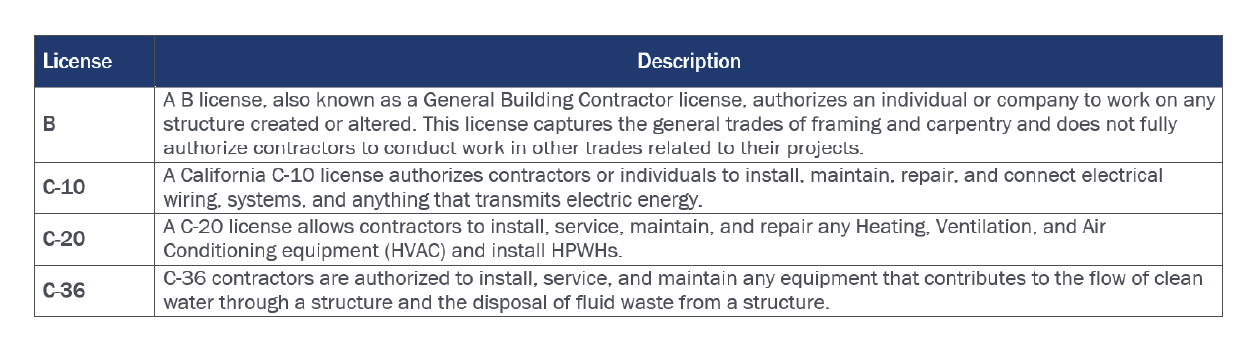
Union-Affiliated Endorsements
Plumbing technicians in the state of California can pursue a career in the trade through union-sponsored apprenticeship programs. These programs last four to five years and teach apprentices the necessary skills to become journey-level employees at a licensed plumbing contractor. Applicants to apprenticeship programs must be at least 18 years of age and have a valid driver’s license. Some programs have minimum education requirements, such as a high school diploma or GED. Other programs require written exams and conduct classroom education for their apprentices. Apprentices complete onsite work with their respective licensed contractors for on-the-job experience. Once the apprentice completes the program and documents at least four years of work under a licensed contractor, they are classified as a journey-level plumber. An individual must work for at least four years as a plumbing journeyperson before being eligible for a C-36 license.
Third-Party Trade Organizations and Certifications
The research team found several third-party trade organizations that offer plumbing and water heating installation, service, and maintenance certifications. Table 13 describes these third-party organizations and their training offerings.
Table 13. Examples and Description of Third-Party Certifying Organizations
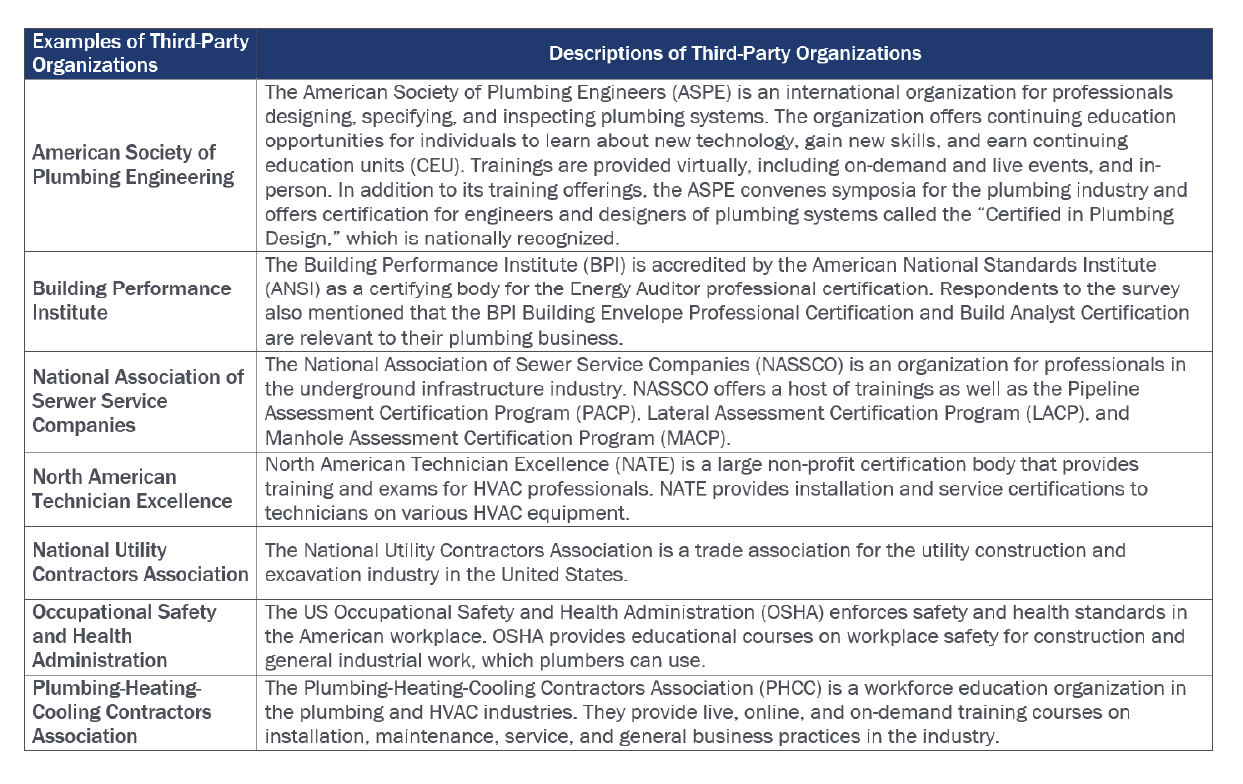
Table 14 describes the specific certifications available to plumbers and water heater installers that we found in our research.
Table 14. Examples and Description of Specific Certifications
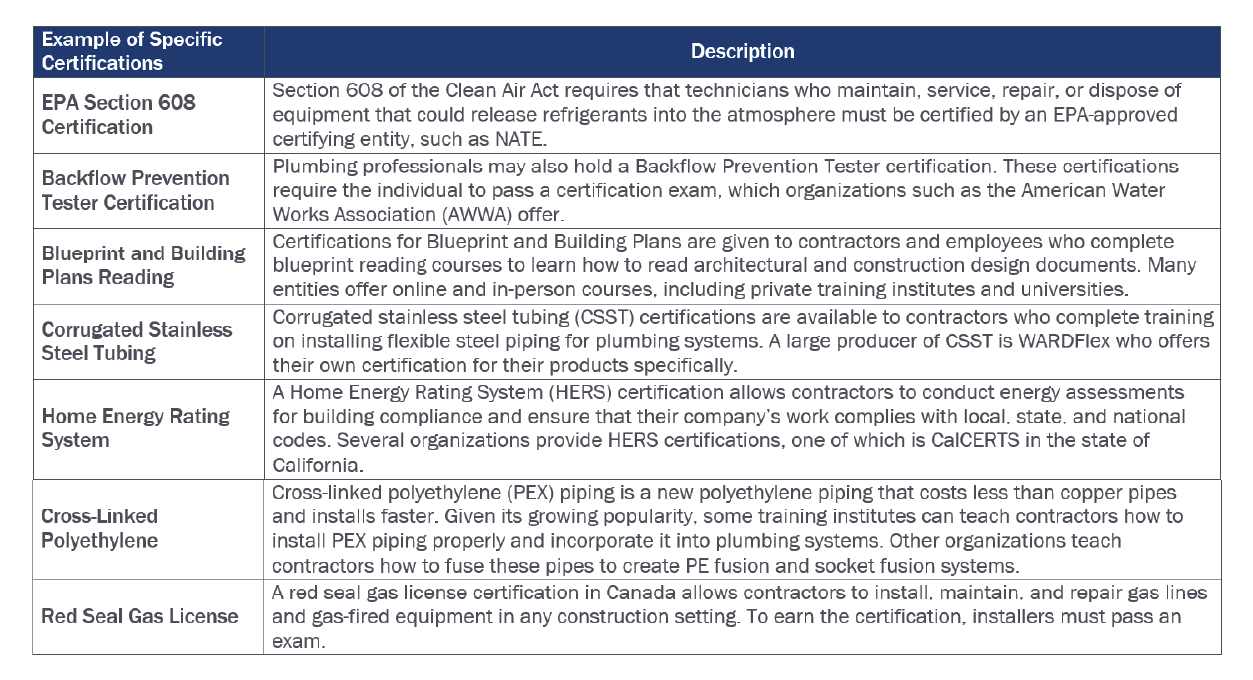
Certifications from Original Equipment Manufacturers
Original equipment manufacturers (OEM) offer trainings to certify an individual’s ability to install, service, repair, and maintain the products of a specific brand. Table 15 lists examples of some water heater manufacturers and a description of their water heating business.
Table 15. Examples and Descriptions of Manufacturer Training
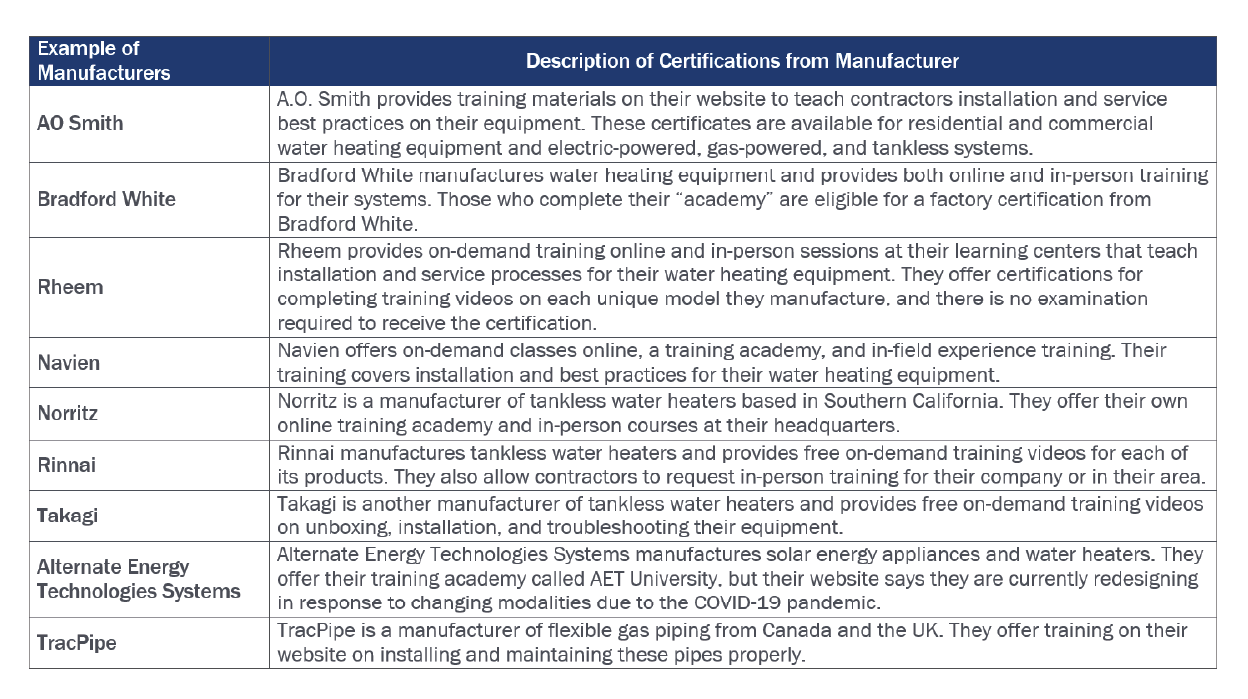
Credentials from Institutions of Higher Education
Plumbing credentials can also come from institutions of higher education, such as colleges and universities. However, credentials from higher education institutions were rare among the contractors who completed our online survey. Four respondents (3%) reported receiving plumbing training in the form of trade school and college programs. One respondent reported having a Master of Business Administration degree (MBA).
4.5.7 HPWH Training Landscape Analysis
The objective of the training landscape analysis in our study was to identify the training providers whose trainings address the KSAs that Opinion Dynamics identified in a 2019 study as being associated with the duties and tasks that support the installation of HPWHs to optimize energy-efficient operation.36F[37] After identifying training providers, we reviewed training materials to identify how training addressed the KSAs from the 2019 study. The following sections present the results of our analysis.
Entities Providing HPWH Training
Through online searches, reviews of relevant literature, and responses from the installer survey (see Section 4.5.1), the research team identified three types of entities that provide HPWH training: OEMs, third-party training organizations, and IOUs. For OEMs, we focused our collection and review of training materials on A.O. Smith, Rheem, and Bradford White, as these three companies combined manufacture nearly 60% of residential HPWWs in the United States.37F[38] Where applicable, we also reviewed the training materials from the subsidiaries of each of these three OEMs. The training materials we examined included each manufacturer’s video training library and HPWH installation certification courses. The third-party training providers we explored included live and previously recorded webinars from organizations with extensive training libraries, including Hot Water Solutions, the Association for Energy Affordability, and Focus on Energy. For IOUs, we identified and reviewed training materials from four large utilities in California: SCE, SDG&E, SCG, and PG&E.
Among the three types of training providers, the research team identified 34 trainings about HPWHs that incorporated at least some of the KSAs of interest. Of those, six were OEM trainings, six were from third-party providers, and 22 were IOU-sponsored trainings. Reviewing materials from IOU-sponsored training, we identified several entities involved in authoring and facilitating professional development in collaboration with the IOUs. We offer a description of these training affiliates in Table 16.
[37] Please see the description of the 2019 study in Section 3.4.
[38] Thormundsson, Bergur. 2021. “Residential water heater market share by vendor in the United States from 2018 to 2021.” statista.com. May. Accessed February 2023. https://www.statista.com/statistics/700257/us-residential-water-heater-market-share/
Table 16. Name and Description of Training Affiliates Identified in IOU Training Materials
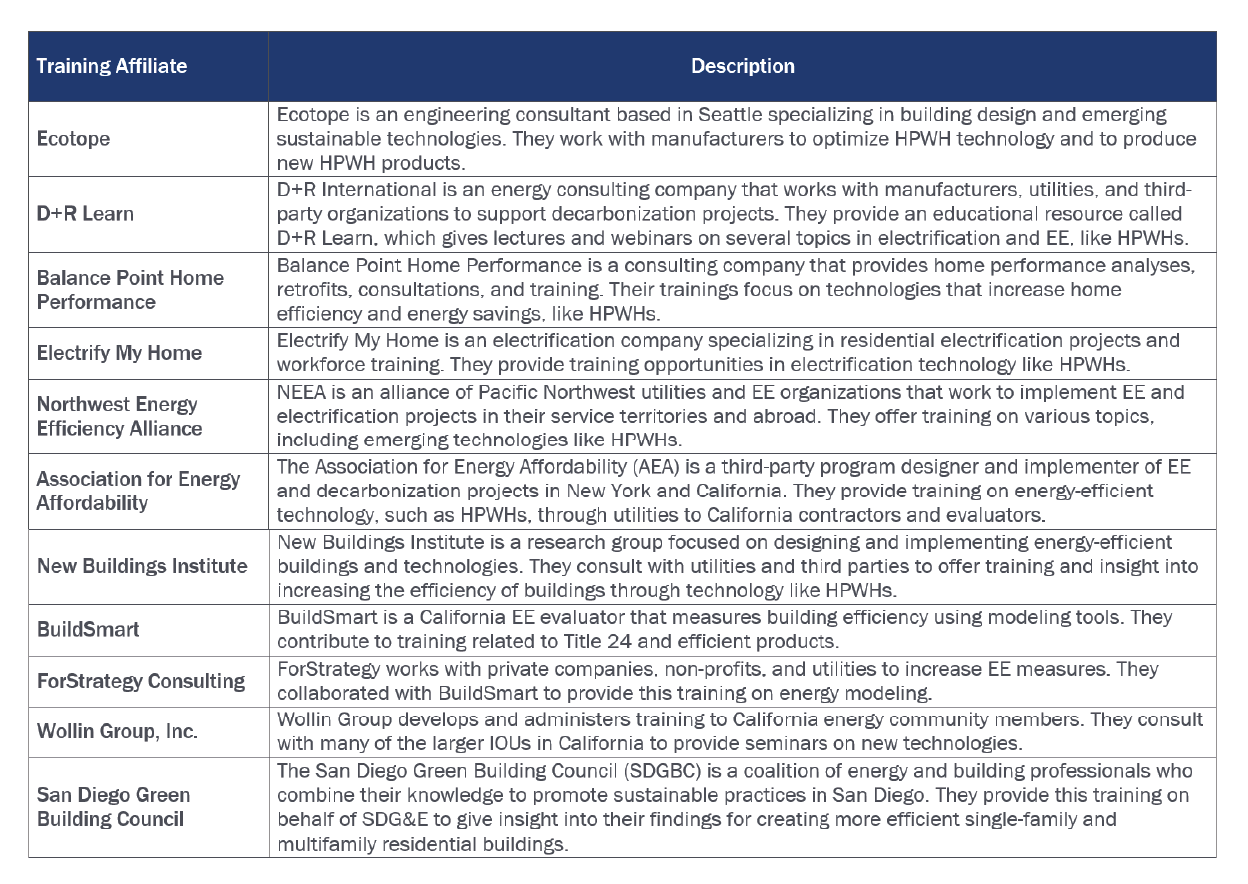
KSA Coverage in HPWH Training
We identified how many of the 80 KSAs from Opinion Dynamics’ 2019 study are addressed in each of the 34 trainings. We found that, on average, there were 13 (16%) KSAs addressed per training. The average number of topics covered per training by training provider type varied from 11 KSAs in IOU-provided trainings to 26 KSAs in third-party trainings. Figure 52 below displays the average number of KSAs covered per training overall and by training provider type.
Figure 52. Average Number of KSAs Covered Per Training by Training Provider Type
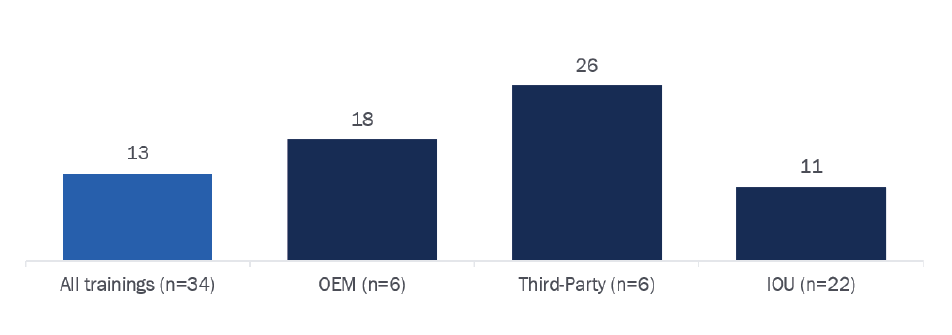
Next, we examined the average number of individuals’ knowledge topics, skills, and abilities included per training. On average, each training covered nine of the 36 knowledge topics (25%), as Figure 53 displays below. The average varied by training provider type from six (16%) knowledge topics per IOU training to 17 (47%) per third-party training.
Figure 53. Average Number of Knowledge Topics Covered Per Training by Training Provider Type
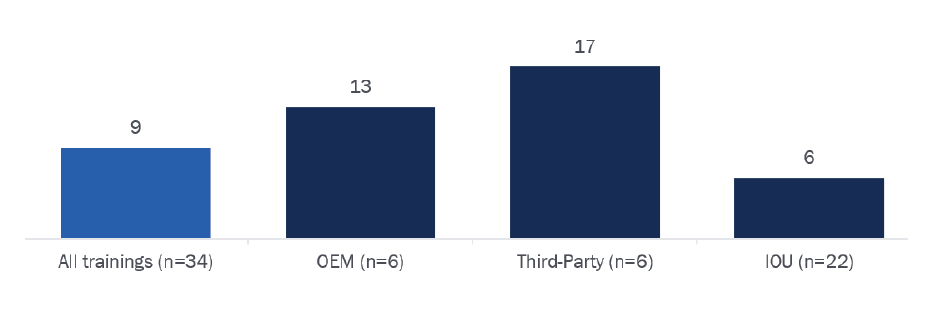
We also found a limited number of skills and abilities included in each training on average, which we present in Figure 54 and Figure 55 illustrate below. On average, only four (12%) of the 33 skills were covered per training. The average number of skills included varied by training provider type from three (9%) skills in IOU trainings to eight (24%) in third-party trainings. Furthermore, the trainings we reviewed included less than one (3%) of the 11 abilities on average. The average number of abilities included was similar across training provider types.
Figure 54. Average Number of Skills Covered Per Training by Training Provider Type
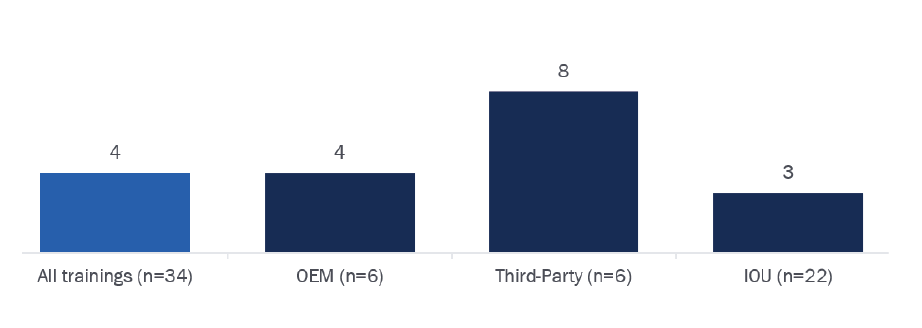
Figure 55. Average Number of Abilities Covered Per Training by Training Provider Type
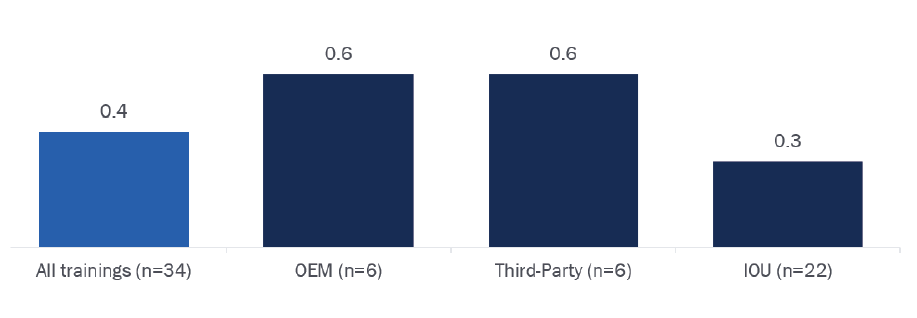
We further examined the training material to identify the KSAs most frequently covered. Tank sizing was the most frequently addressed knowledge topic, appearing in 22 of the 34 trainings (65%). Sales was the most frequently addressed skill, appearing in 13 trainings (38%). The most frequently addressed ability was use of hand tools, which was included in 4 trainings (12%).
Table 17 below presents the most frequently addressed KSAs by training-provider type. We found a few commonalities across provider types. For example, all OEM and third-party trainings we reviewed included discussion of EE or rebate programs. Sales was the most frequently addressed skill in our reviewed OEM and IOU-sponsored trainings. Finally, hand tools and hand-eye coordination appeared most frequently in third-party and OEM trainings. Other than these examples, we found that the topics most frequently addressed varied depending on the type of entity providing the training.
Table 17. KSAs Included Most Frequently by Training Provider Type
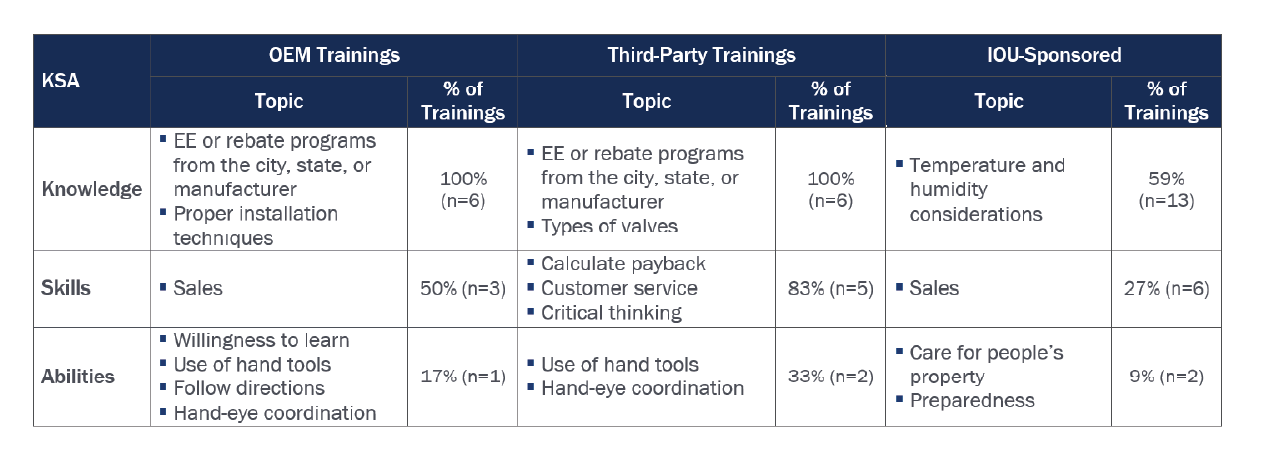
Please refer to Appendix D for the detailed analysis of KSAs inclusion in water heating trainings.
HPWH Training Landscape and Survey Responses
Opinion Dynamics compared KSA coverage to the results from the online contractor survey. Specifically, we examined the alignment between the training topics survey-takers reported needing and the types of KSAs trainings addressed. Through this process, we found several examples where the trainings we reviewed may not cover topics that the online survey respondents said are important for their company or personal professional development.
One area of misalignment involves training on HPWH service. As we explored in Section 4.4.5, survey-takers whose companies install HPWHs reported being the least confident in their staff’s ability to perform HPWH service out of a list of HPWH-related tasks (see Figure 28). Furthermore, when asked to identify areas on which they personally desired more training, HPWH service was the most frequently selected topic among all respondents (see Figure 48 in Section 4.5.4). However, we found limited references to HPWH servicing in the materials reviewed in the KSA landscape analysis. For example, three trainings touched on tank corrosion and no trainings addressed flushing HPWHs.
There was also a misalignment between the importance of electrical training to respondents and the coverage of electrical topics we identified in the landscape analysis. More than a quarter of HPWH-installing respondents said understanding and working with electrical components was the aspect of HPWH installations that requires the most training (see Table 11 in Section 4.4.5). The research team observed few examples where the training materials covered electrical knowledge. For instance, eight of the 34 trainings discussed electrical concepts, such as current, amps, and voltage, and four trainings addressed circuit breakers as a training topic.
The final important example of misalignment is related to codes and regulations. Respondents with managerial roles at their companies ranked plumbing codes and regulations as the most critical training topic for the company. Managers who completed the survey also said this was the most important training topic for their senior staff specifically (Section 4.5.4). Additionally, when asked about areas where respondents personally desire more training, codes and regulations was the third most frequently selected topic (Section 4.5.4). However, we found that six of the 34 trainings we reviewed discussed codes in any capacity. Of those six training, four were offered by third-party providers, one was an OEM trainings and one was an IOU-sponsored training.
Although we found notable examples of misalignment, we also identified several areas where the current HPWH training landscape appears aligned with the needs of water heating professionals articulated on the online survey. One such example involves the topic of HPWH installation. Management-level survey-takers reported HPWH installation as the third most crucial training topic for their company and the second most important for senior staff. Furthermore, among all respondents, HPWH installation was the third most frequently selected area in which survey-takers personally desire training (Section 4.5.4). As we conducted the KSA landscape analysis, we found that 13 of the 34 trainings we reviewed addressed proper installation techniques. Moreover, we observed that this was the primary topic covered in all six OEM-provided trainings we reviewed.
The research team noted alignment between how frequently survey-takers expressed interest in training on EE programs and how frequently the training that we reviewed addressed this topic. In fact, 35% (n=45) of all survey respondents selected training on EE programs as a desired area for their personal professional development; this was the second most frequently selected topic among all individuals surveyed. This was also one of the more well-covered areas in the training materials we reviewed. Twelve of the 34 trainings included in our analysis addressed EE programs and rebates offered by municipalities, the State of California, or manufacturers.
4.6 Energy Efficiency and Decarbonization Participation
Our online survey also explored water heating contractors’ experiences with, interest in, and barriers to participating in EE and electrification/decarbonization programs.
The research team asked survey respondents if they had participated in either an EE or electrification/decarbonization program that offered an incentive or rebate for water heating equipment. Almost half of respondents said they had participated in an EE program (46%, n=58), while about a quarter (24%, n=30) said they had participated in an electrification/decarbonization program. Another quarter of respondents (25%, n=32) said they were aware of these programs but never participated, and one-fifth of survey-takers said they were unaware of the programs altogether (20%, n=25).
Figure 56. Experience with EE and Decarbonization Programs for Water Heaters—All Respondents (n=127)[39]
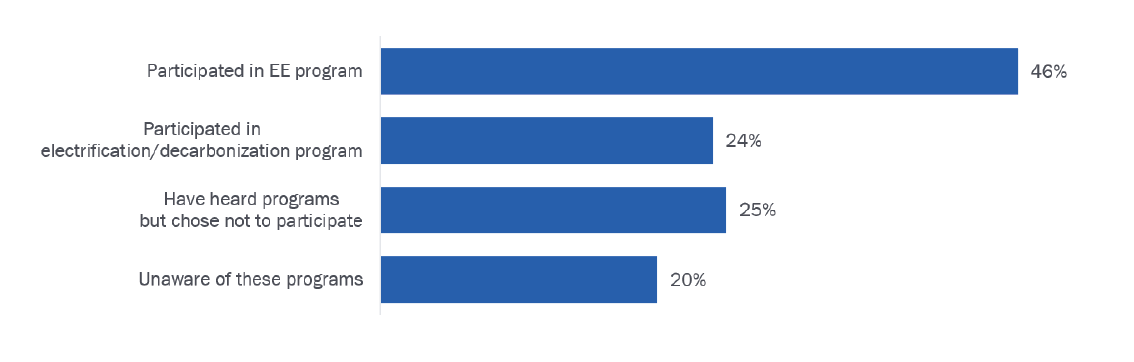
[39] Respondents can fall into multiple groups
We compared EE and electrification/decarbonization program participation and awareness across respondents’ business characteristics. Notably, we found that respondents whose company installs HPWHs were more likely (67%, n=44) to say they had participated in EE programs than non-HPWH installers (23%, n=14). Furthermore, HPWH installers were more likely to have participated in an electrification/decarbonization program (37%, n=25 vs 8%, n=5). We display these differences in Figure 57 below.
Figure 57. Experience with EE and Decarbonization Programs for Water Heaters—HPWH vs. Non-HPWH Installers
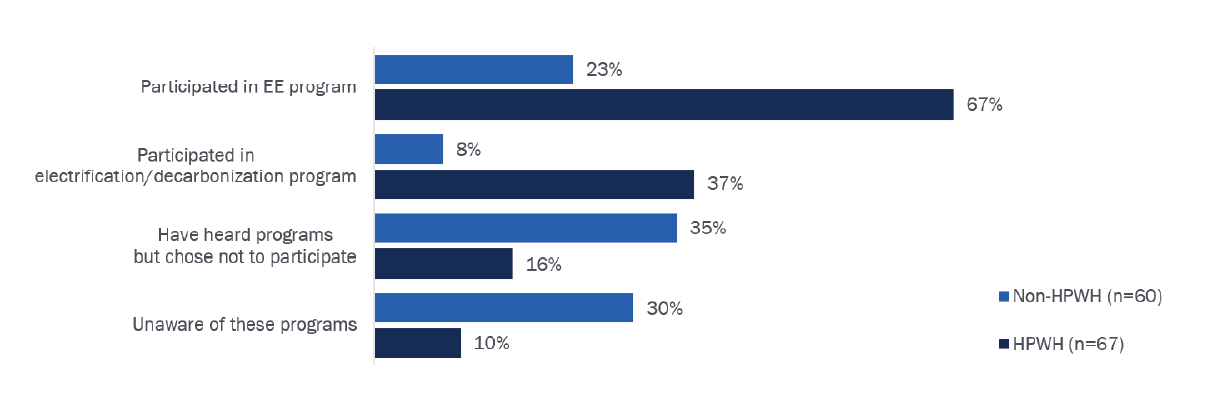
We also found differences based on staff size of respondents’ companies. Survey-takers whose companies have fewer than ten employees were less likely (16%, n=12) to have participated in an electrification/decarbonization program for water heaters than respondents with ten or more employees (35%, n=18). Similarly, respondents who work for companies with smaller staff sizes (41%, n=31) were less likely to report participating in EE programs for water heaters than those with larger staff sizes (53%, n=27. Relatedly, respondents from smaller companies (25%, n=19) were more likely to report being unaware of EE or electrification/decarbonization programs for water heaters than their counterparts (12%, n=6). These data are presented in Figure 58.
Figure 58. Experience with EE and Decarbonization Programs for Water Heaters—Staff Sizes Compared
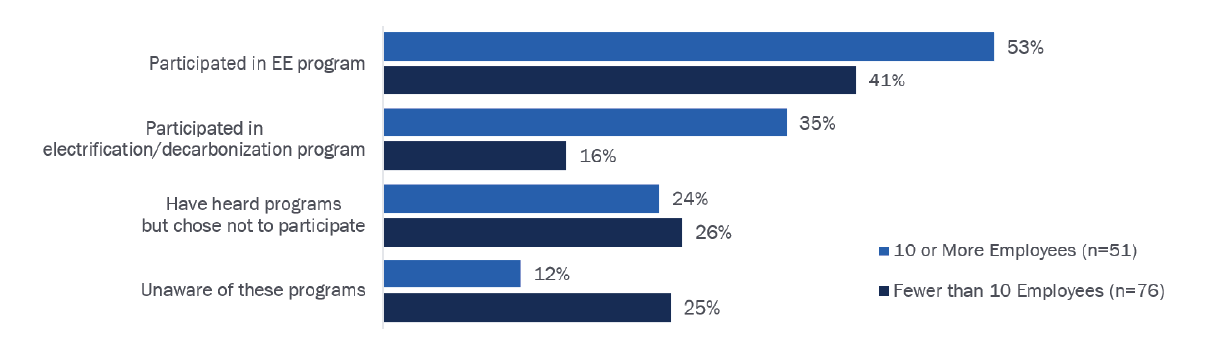
We asked participants to indicate their level of familiarity with the role that HPWHs can play in demand response programs. Nearly half of the participants (47%, n=59) said they were either not at all or only slightly familiar with this concept, while only 12 respondents (9%) said they were highly familiar. Figure 59 displays the full results.
Figure 59. Familiarity with Demand Response Programs (n=127)
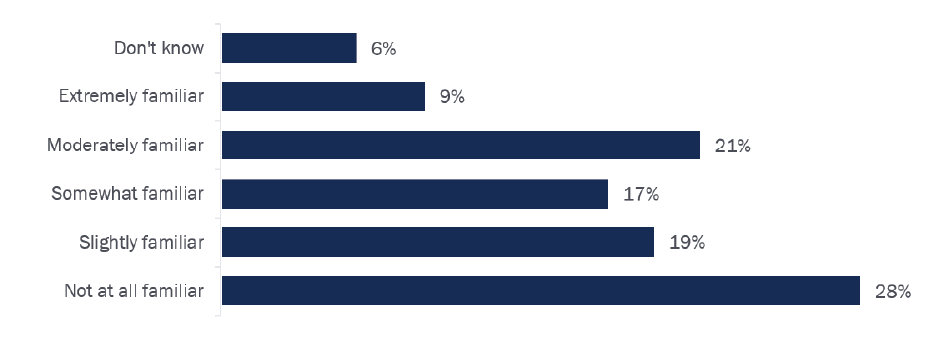
To estimate disadvantaged installer participation in EE and decarbonization programs, we compared respondents’ answers regarding participation in these programs, the firmographic data provided by non-sole operators, and the demographic data provided by sole operators.
For non-sole operators, we generated a variable to indicate respondents who reported that at least 50% of their company’s employees belong to an underrepresented group. There were 104 such non-sole operators, 43% (n=45) of whom said they had participated in an EE program. A smaller share of these respondents (26%, n=27) reported participating in an electrification/decarbonization program. Less than a quarter (23%, n=24) reported that they had never heard of these types of programs.
Four sole operators identified as a member of an underrepresented population. All four respondents reported that they had heard of EE and electrification/decarbonization programs related to water heating. Three reported having participated in an EE program, and two said they participated in an electrification/decarbonization program.
5. Key Findings & Recommendations
This section presents the essential findings and recommendations based on the detailed findings described above.
A wide range of individuals install water heaters in California, including contractors registered with the CSLB, unlicensed handypersons, and Do-It-Yourselfers (DIYers).[40] Approximately one-third of the 149 surveyed California homeowners who recently replaced a water heater in the past two years hired a licensed contractor for the installation. As seen in Table 18, most respondents who did not hire a licensed installer installed the system on their own (DIYers).
[40] The Contractors State License Board (CSLB) provides licenses to construction contractors in California. These include 1) General Engineering Contractors (A Licenses), 2) General Building Contractors (B Licenses), 3) Specialty Contractors (C Licenses), and Limited Specialty Contracts (D Licenses). Currently, there are 42 specialty contractor license classifications, including C-36 plumbing contractors and C-20 warm-air heating, ventilating, and air-conditioning (HVAC) contractors. Anyone who contracts on projects with a combined labor and material cost in excess of $500 is required to hold a current valid license with the CSLB. https://www.cslb.ca.gov/About_Us/Library/Licensing_Classifications/
Table 18. California Homeowner Water Heater Installers
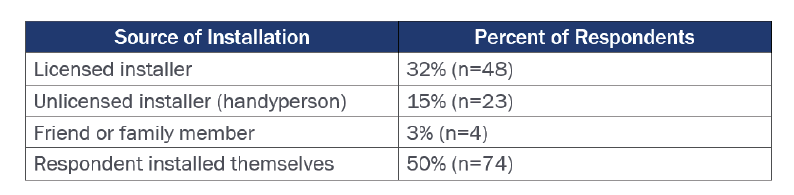
Recommendation: Fifty-two percent of homeowners who recently replaced a water heater installed the water heater themselves or used a friend or family member. In the TECH Clean California Time 1 Market Assessment, we also found that 36% of homeowners indicated they installed the water heater themselves or a friend or family member installed the new equipment.[41] DIYers indicated they chose this pathway to save money and time. This trend poses a significant challenge for transforming the water heater market, yet it has not been widely addressed. Given the nascent stage of the market, heat pump water heater programs are currently predominantly focused on plumbing contractors. However, as the market evolves, it will become crucial to engage unlicensed handypersons and DIY enthusiasts to drive market transformation to meet California’s climate objectives.
Due to safety reasons, we do not want to encourage DIYers to install heat pump water heaters, with the potential exception of the 110-volt HPWHs. One potential strategy is to develop a program that targets communities interested in electrification. This program would involve collaborating with homeowners associations (HOAs), community-based organizations (CBOs), and/or energy champions to make homes in these neighborhoods electrification ready as part of a comprehensive effort. In working with targeted neighborhoods, each home would receive an audit to determine what is needed to make the home electrification ready. Options include identifying panel optimizations— like circuit pausers and circuit splitters, panel upgrades, panel replacements, or even smart panels, which are costly but, when paired with DR programs and other interventions, might prove viable from a grid-resources perspective. Such a program would make a HPWH DIY installation safer and help meet DIYers’ motivations for cheap, quick, and easy installations. A second recommendation is to increase investment in technology solutions, such as 110-volt HPWHs, to improve efficiency and performance across a wider range of applications and then to develop programs to market, educate, and incentivize this equipment utilizing calls-to-action that will speak to DIYers.
Many licensed contractors installing water heaters in California work in multiple trades. When installation jobs involve a licensed contractor, we found that installers often work in multiple trades. For instance, most water heater installers who completed the online survey reported that their company does heating, ventilation, and air conditioning (HVAC) and plumbing work. Moreover, we found various licenses among surveyed water heater installers, including C-36 plumbing contractors, C-20 HVAC contractors, B general building contractors, B-2 residential remodeling contractors, C-10 electrical contractors, and C-46 solar contractors.[42]
Water heater installers indicate that, on average, 46% of their work is emergency replacements, and 43% is planned replacements. Other reports have found that the proportion of water heater installations that are emergency replacements can be as high as 90%.[43] The immediate need to reinstate hot water in a household often places a premium on speed, leaving minimal room for considering alternatives such as replacing a gas appliance with a heat pump.
Recommendation: Barnett Plumbing, which has provided residents in the California Tri-Valley area[44] with plumbing and water heating service over the past 15 years, received a Quick Start Grant through the Technology and Equipment for Clean Heating (TECH) Initiative to develop a water heater loaner program. To account for the immediate need to replace hot water systems, Barnett Plumbing offered customers the option to install a gas water heater on loan at no cost while the retrofit work took place to install a HPWH. Barnett Plumbing increased its rate of customer conversion from gas water heaters from less than one percent to 17.1 percent and installed 149 HPWHs during the program period (January – December 2022), including 127 gas loaners. The Quick Start Grant funds provided a supplemental contractor payment of $975 to cover the added cost of installation and removal of the loaner water heater. We suggest that the IOUs establish a statewide loaner program and provide a course for installers to learn best practices for running such a program as part of their business.[45] Lessons learned from Barnett Plumbing and other loaner pilots can be used as a basis for the course content.[46]
HPWH adoption is a relatively recent and growing phenomenon in California’s residential plumbing sector. Most installers reported they began installing HPWHs in the last several years, as 52% (n=35) reported that their HPWH installations started in or after 2019 (see Figure 1). Furthermore, fewer than a quarter (22%, n=17) said they had been installing HPWHs for a decade or longer. Most respondents (79%, n=53) whose company currently installs HPWHs expect more installations next year than in the last 12 months. The median number of HPWH installations respondents reported completing over the last year was 15, while the median number of installations these respondents expected to complete over the next year is 25. Additionally, nearly one-third of participants who indicated that they do not install HPWHs currently plan to do so within the next year (32%, n=19).
[41] https://www.calmac.org/publications/TECH_Time_1_Market_Assessment_Final_Report_4.22.24.pdf
[42] C-36, C-20, B, B-2, C-10, and C-46 are all licenses distributed by the California State Licensing Board (CSLB).
[43] Barnett_Plumbing_-_Final_Report_230810.pdf (apppack-app-tech-reporting-prod-privates3bucket-z0onruvirqb2.s3.amazonaws.com)
[44] The Tri Valley Area refers to the region in Northern California near the San Francisco Bay Area consisting of the San Ramon, Livermore, and Amador Valley.
[45] 3C-REN has offered an online course entitled “Gas Water Heater Loaner Program – How to Make it Work for You! However, we could not find any mention of the learning objectives or the curriculum content online.
[46] For key findings, see pages 6-9 of the Barnett Plumbing Bridging the Gap to Heat Pump Adoption: Water Heater Loaner Program. Barnett_Plumbing_-_Final_Report_230810.pdf (apppack-app-tech-reporting-prod-privates3bucket-z0onruvirqb2.s3.amazonaws.com)
Figure 60. Percentage of Respondents that Install HPWH by Decade of First HPWH Installation (n=127)
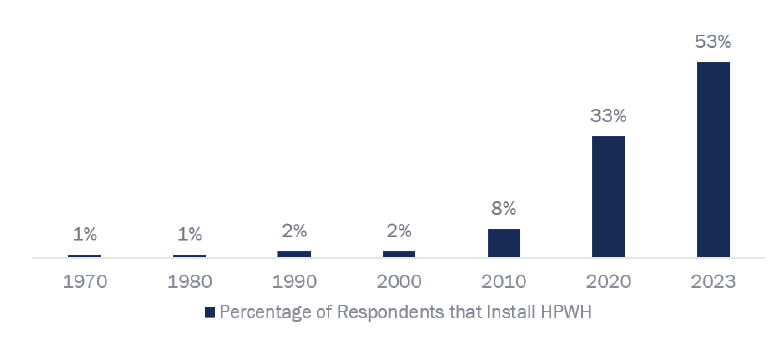
Recommendation: As of April 2023, the IOUs sponsored 22 unique courses that address water heating. However, on average, each course only covers 11 of the 80 KSAs identified in the WE&T Deliverable 30: Knowledge, Skills, and Abilities Market Studies: HVAC Rooftop Package Units and Heat Pump Water Heaters report published in 2020.[47] Given that HPWH adoption is a growing phenomenon, developing a standard curriculum for experienced plumbers to learn how to install HPWHs and a standard curriculum for HVAC installers (who are legal to install HPWHs in the state of California) to learn how to install HPWHs based on the validated KSAs from the 2020 study would support market transformation and faster attainment of California’s climate goals. The next finding and recommendation include specific topic areas that would be beneficial to include in a standardized HPWH training curriculum.
Installers reported needing additional training on electrical components of HPWH installations, HPWH service topics, and plumbing codes and regulations. However, we found limited instances where training offerings addressed these areas. By assessing KSAs coverage in HPWH-related training offerings and the responses to questions on the online survey regarding training needs, we found several examples where the training may not cover the topics that online survey respondents feel are important. More than a quarter of HPWH-installing respondents said understanding and working with electrical components were the aspects of HPWH installations that required the most training. Table 3 displays five training topics that would benefit installers in learning to begin installing and servicing HPWHs and the percentage of the 34 trainings that referenced these topics. As seen in the table, a few trainings reference important electrical concepts and HPWH tank maintenance topics. Six of the 34 trainings discussed codes in some capacity, one of which was an IOU-sponsored training.[48]
[47] California Public Utilities Commission (CPUC), “WE&T Deliverable 30: Knowledge, Skills, and Abilities Market Studies: HVAC Rooftop Package Units and Heat Pump Water Heaters,” January 17, 2020, prepared by Opinion Dynamics Corporation. https://www.calmac.org/publications/WET_KSA_Deliverable_6_12_2020.pdf.
[48] It is important to note that the training offerings we examined did not include any courses dedicated to codes and regulations such as Energy Code Ace training offerings.
Table 19. Percentage of Trainings that Reference Topics Desired by Surveyed Installers

Water heater installers report being motivated to pursue training to learn about new technologies, acquire new skills, and better serve their customers. They view manufacturers and distributors as trusted sources for professional learning and, as such, were the primary avenues through which they identified upcoming training opportunities. Among respondents in management roles, 66% (n=69) preferred training from manufacturers, and 55% (n=57) preferred training from distributors.
Recommendation: The IOUs should consider using these insights regarding contractor motivations, interests, and preferences to inform how they position and promote training opportunities. For instance, promoting HPWH training opportunities in the context of electrification/decarbonization may limit the appeal to specific audiences. However, framing the opportunities in the context of cutting-edge technology taps into humans’ natural curiosity and desire to stay updated with the latest technological innovations. Additionally, highlighting how acquiring new skills can enhance contractor revenue streams and help companies stand out from competitors will likely increase the value and attractiveness of training opportunities.
Recommendation: The IOUs should develop partnerships with manufacturers and distributors to promote and provide training opportunities related to plumbing and HPWHs, including potentially increasing access to hands-on lab opportunities. For example, on the HVAC side, TECH Clean California has partnered with Daikin to provide a mandatory 4-day Train the Trainer event for faculty at Riverside Community College, College of the Desert, Cypress College, Dehard Technical School, and San Bernardino Valley College on Daiken heat pump equipment donated to these schools.
Recommendation: The IOUs should develop more training opportunities that address the electrical components involved in HPWH installations, as well as service topics, plumbing codes, and regulations related to HPWHs. These could be new course offerings or additional topics added to existing courses.
Contractors who do both plumbing and HVAC install more heat pumps than contractors who work exclusively in plumbing. Respondents whose company does HVAC and plumbing work were more likely (55%, n=46) to report installing HPWHs than non-HVAC contractors (48%, n=21).
Contractors who do both plumbing and HVAC report marketing HPWHs more than contractors who exclusively do plumbing work. They report advertising HPWHs through their company websites (84% compared to 53%), social media (75% compared to 38%), and direct advertisements (67% compared to 11%).
Installers report that key barriers to HPWH customer adoption include many water heater installations occurring in emergency replacement scenarios, the higher upfront cost of HPWH equipment, and consumer awareness of HPWHs.
Recommendation: Considering the influence of consumer demand and general lack of awareness of water heater equipment, the CPUC and IOUs should identify strategies to build utility customers’ knowledge about HPWH equipment. Existing interventions include marketing regarding financial incentives via rebates or tax credits at the federal, state, and municipal levels.[49] While financial incentives are crucial in increasing consumer demand, investing in programs to raise awareness of HPWH technology and capacity-building opportunities to ensure a trained workforce are also essential. Such programs could include bill inserts on customer utility bills, marketing campaigns using online advertising, educational opportunities through trade ally engagement, and point-of-sale information efforts at big box retailers.
Despite contractor concern about HPWH costs, evidence suggests that HPWHs can be profitable for installers. Nearly one-third (32%, n=40) of installers reported HPWHs are the most profitable equipment their company installs. Installers without experience working with HPWHs perceive them to be the third most profitable, with gas conventional storage tank water heaters as the most profitable, followed by gas tankless systems.
Recommendation: Training developers, such as IOUs, manufacturers, and third-party training organizations, should use their platform to address concerns over equipment cost and illustrate how HPWH installations can be profitable to contractor’s businesses. In our training landscape analysis, we found that the discussion of HPWH cost typically focused on how to talk to customers about the higher upfront expense of the equipment. For instance, training addressed calculating the payback for a customer (i.e., how HPWH’s higher efficiency will result in lower operating costs that will pay for the equipment over time). However, we found no examples where training materials addressed how HPWH work can be profitable for contractors’ businesses and how to integrate HPWHs into existing contractor business models. While calculating payback is an essential skill to develop, it is also crucial for installers to see that HPWHs make financial sense for their businesses.
Almost half (46%) of installers indicated they had participated in an EE program, and about a quarter (24%) reported participating in an electrification/decarbonization program. A quarter of respondents say they are aware of these programs but never participated and one-fifth of respondents (20%) indicated they were unaware of programs altogether.[50]
Recommendation: Program implementers should consider focusing an effort on reaching contractors who are not currently participating in electrification/decarbonization programs. The CPUC should consider directing the IOUs to develop in-language outreach materials and workshops with free food targeted to installers who have participated in EE programs but are not participating in decarbonization programs and installers who have not participated in either. Such outreach material should cover opportunities to participate in programs as well as educational opportunities.
Nearly 60% of installers (59%, n=61) reported difficulty hiring technicians/installers over the last year. When asked about the sources of hiring challenges, 52% (n=32) of those who experienced difficulty said they could not find qualified applicants. Additionally, almost one-third of these respondents (30%, n=18) said they hired a candidate, but the new employee’s work ethic did not meet their expectations.
Recommendation: Developing standard curricula as referenced above and potentially offering a certification that could become a requirement for participating in EE and decarbonization programs would likely help businesses identify and hire qualified candidates as well as ensure a qualified workforce. Typically, a certification is an official recognition that an individual has met specific qualifications or standards in a particular field or profession.
Recommendation: IOUs should consider partnering with CBOs to offer a short water heating installation boot camp. The objective would be to help job seekers determine if a career in the plumbing field is right for them. For individuals still interested in pursuing a career in water heating after the boot camp, IOUs should work with CBOs to match them with paid internship opportunities.
According to the ACS, a substantial portion of the state’s plumbers and water heater installers meet one or more of the CPUC’s criteria to be considered a Disadvantaged Worker (DW).[51] Although our exploration of ACS data did not result in the total of disadvantaged plumbers, we found indications that a considerable share of California plumbers may meet one or more of the CPUC’s DW criteria. For instance, we learned that over 10% (7,336 of 66,939) of Californian plumbers received Supplemental Nutrition Assistance Program (SNAP) benefits, a form for public assistance, in 2022. In the same year, the ACS identified that approximately 23% (n=15,728) of plumbers did not possess a high school diploma or an equivalent, such as a General Educational Development (GED) certification, another DW criterion.
Recommendation: The CPUC should consider additional research regarding DW participation in the plumbing workforce that may not be available through existing channels such as the ACS. Considering the linguistic diversity of the plumbing workforce in California, Opinion Dynamics also recommends that program outreach material be offered in multiple languages.
[49] The Inflation Reduction Act included federal income tax credits for up to 30% of HPWH installation costs and up to $2,000 for Energy Star-certified HPWHs (Department of Energy 2022). Specifically in California, the CPUC offers incentives for HPWH installation for its customers. Single-family residential customers that classify as low-income are eligible for up to $4,885 in incentives. All other single-family residential customers qualify for up to $3,800 (CPUC 2022). The cities of Alameda, Anaheim, Burbank, Glendale, Lodi, Lompoc, Palo Alto, Pasadena, Riverside, Roseville, Santa Clara, Los Angeles, Modesto, Sacramento, San Diego, and Turlock offer HPWH incentives ranging from $50 to $1,500 for account holders installing new HPWHs (Department of Energy 2023).
[50] Respondents can fall into multiple groups.
[51] A Disadvantaged Worker, as defined in D.18-10-008 (October 11, 2018), “Decision Addressing Workforce Requirements and Third Party Contract Terms & Conditions”, defines a disadvantaged worker as “an individual that meets at least one of the following criteria: lives in a household where total income is below 50 percent of Area Median Income; is a recipient of public assistance; lacks a high school diploma or GED; has previous history of incarceration lasting one year or more following a conviction under the criminal justice system; is a custodial single parent; is chronically unemployed; has been aged out or emancipated from the foster care system; has limited English proficiency; or lives in a high unemployment ZIP code that is in the top 25 percent of only the unemployment indicator of the CalEnviroScreen Tool.”
Appedix
A. ANNOTATED BIBLIOGRAPHY
This appendix contains an annotated bibliography of the sources used in this study.
“2021 National Standard Plumbing Code.” 2021 NSPC. International Association of Plumbing and Mechanical Officials, 2021. https://epubs.iapmo.org/NSPC/2021/.
- The International Association writes the National Standard Plumbing Code of Plumbing and Mechanical Officials and is the federal-level installation standard for American plumbers. Each installation of water heaters must follow all protocols as written in this doctrine.
“2022 California Plumbing Code”. State Government of California 2022. https://epubs.iapmo.org/2022/CPC/.
- The California Plumbing Code is like the NSPC above but has specific caveats for installation procedures in California. For example, the California plumbing code requires installing water heaters to include earthquake straps due to California’s higher rate of seismic activity than the rest of the United States.
“Best Water Heater Buying Guide.” Consumer Reports, 2021. https://www.consumerreports.org/appliances/water-heaters/buying-guide/.
- As a guide for property owners to purchase new water heaters written by Consumer Reports, this piece details water heater capacity and its effect on costs and efficiency, along with a comparative analysis of different water heater types. According to their analysis, because of complex installation procedures, gas storage tank and HPWH cost more upfront than electric storage units.
Bickel, Stephen et. al. “Swimming to Midstream: New Residential HVAC Program Models and Tools.” ACEEE Summer Study on Energy Efficiency in Buildings, 2016, 1–12. https://www.aceee.org/files/proceedings/2016/data/papers/7_888.pdf.
- Bickel describes how the Energize CT and Efficiency Vermont programs utilized midstream market interventions. These programs offered HPWH incentives to distributors, as opposed to end-users. These distributors could sell HPWH at marked-down prices, increasing HPWH adoption.
Botelho, Jeff. “Learn How Much It Costs to Install a Water Heater – Compose: Seo.” How Much Does Water Heater Replacement & Installation Cost in 2023? HomeAdvisor, Inc., July 28, 2022. https://www.homeadvisor.com/cost/plumbing/install-a-water-heater/.
- Written by a licensed journeyman plumber, this piece shows the total cost of replacing a water heater. Botelho first describes the upfront cost differences between HPWH, Electric and Gas Storage, and tankless water heaters, finding HPWH to be more expensive upfront but more affordable to run. He also factors labor costs into his calculation of costs, determining that specific alterations needed for installation (electric panel updates, drywall movement, etc.) can cause prices to fluctuate. He also includes an analysis of cost variation by major U.S. cities, along with a high-level description of cost savings due to energy efficiency.
“Building Your Career as a Licensed Contractor.” CSLB.gov. California State Licensing Board, 2022. https://www.cslb.ca.gov/Resources/GuidesAndPublications/BuildingYourCareerAsContractor.pdf.
- This piece is a flyer from the California State Licensing Board and answers frequently asked questions about the licensing process for contractors in California. It describes the process for becoming licensed, including qualifications, examinations, experience required, and education needed. According to the flyer, all businesses that want to conduct construction alterations to any form of physical infrastructure in California must be licensed in some classification. Specific to plumbing, the classification is C-36. To become C-36 certified, contractors must have at least four years of journey-level experience and pass the C-36 exam.
“Business Model and Core Strengths.” Ferguson Company, 2022. https://www.corporate.ferguson.com/about-us/business-model-and-core-strengths/.
- This page on Ferguson’s website details their business plan and its strengths. They detail their understanding of market demands as their primary business driver, and that their expansive global supply chain meets this demand. Ferguson also prides itself on having experienced and knowledgeable customer associates.
California Contractor’s State Licensing Board. “CSLB Licensed C-36 Contractor Data.” Sacramento: California, United States, 2023.
- To track license status of contractors in California, the Contractor’s State Licensing Board stores a running dataset on their website that can be accessed by the public at any time. Data used in this report involving percentage of license types, percentage of contractors considered small businesses, etc. are all found in this dataset.
“California Heat Pump Residential Market Characterization and Baseline Study.” Opiniondynamics.com, Opinion Dynamics Corporation, 2022.
- In an extensive study of the residential heat pump market in California done by Opinion Dynamics, HPWH costs and respective cost-savings are compared to those of other energy-efficient water heaters. Local contractors have a limited supply of HPWH because of their lack of demand, so they frequently come with higher installation costs and less understanding of the installation process by technicians. Regarding installation, electric supply and space ventilation, and plumbing modification, HPWH cost significantly more than tankless electric water heaters.
CEE. Residential Water Heating Initiative. Consortium for Energy Efficiency, 2018.
- This report from the Consortium for Energy Efficiency provides a high-level model of the water heater market structure, starting at the top with manufacturers and extending down to end-users. Through graphics, it displays the flow of water heaters from manufacturers to retail or wholesale distributors, and onward to contractors, property owners, and remodelers. According to the report, wholesalers frequently sell water heaters only to contractors, whereas retailers sell to contractors and end-users.
Ciani, Anthony. Water Heater Market Characterization Report. Neea.org, Northwest Energy Efficiency Alliance, 2018. NEEA Market Characterization Report.pdf
- Ciani wrote this report for the Northwest Energy Efficiency Alliance to paint a clear picture of the plumbing industry’s organizational structure. It begins with Original Equipment Manufacturers (OEMs), who design and engineer water heaters. These products are sold to distributors, who then sell to contractors or end-users directly. This study found that end-users choose like-for-like installations most frequently and select manufacturers they understand and know about. Ciani concludes that the water heater market is demand-driven in response to end-users’ need for fast and affordable replacements.
“Change in Business Entity.” CSLB.gov. Contractor’s State Licensing Board, 2023. https://www.cslb.ca.gov/contractors/maintain_license/change_business_entity.aspx.
- This article from the California Contractor’s State Licensing Board explains the different types of business entities they administer licenses to: Sole Owner, Partnership, Corporation, Joint Venture, and Limited Liability Company. For sole ownership, the study is concerned about the license, which can be qualified for by the owner or a Responsible Managing Employee (RME).
“CPUC Provides Additional Incentives and Framework for Electric Heat Pump Water Heater Program.” California Public Utilities Commission, 2022. https://www.cpuc.ca.gov/news-and-updates/all-news/cpuc-provides-additional-incentives-and-framework-for-electric-heat-pump-water-heater-program.
- This article describes the new funding the CPUC allocated for energy efficiency incentives and rebates in 2022. Specifically, it references the rebates available for installing HPWH for both low-income and non-low-income single-family homes.
CPUC. “WE&T Deliverable 30: Knowledge, Skills, and Abilities Market Studies: HVAC Rooftop Package Units and Heat Pump Water Heaters,” January 17, 2020, prepared by Opinion Dynamics Corporation. https://www.calmac.org/publications/WET_KSA_Deliverable_6_12_2020.pdf.
- This study conducted by Opinion Dynamics explored the knowledge, skills, and abilities of water heater installers. This study was used to create a metric for the ability of reviewed water heating training to cover these KSAs in their curriculum.
Crail, Chauncey. “Heat Pump Water Heaters: Complete Guide, Pros and Cons and More.” Forbes. Forbes Magazine, November 2, 2022. https://www.forbes.com/home-improvement/plumbing/heat-pump-water-heaters/.
- This article by Forbes gives a technical breakdown of HPWH technology and a comparative cost analysis across different types of water heaters. According to the piece, a HPWH costs between $500 and $2,000 more than a storage tank heater in upfront costs. The article finishes with pros and cons regarding HPWH, with the pros being that they are more efficient, environmentally friendly, and eligible for rebates, whereas the cons included the inability to operate in cold weather and higher upfront costs.
Crandall-Hollick, Margot and Molly Sherlock. Residential Energy Tax Credits: Overview and Analysis. Fas.org, Congressional Research Service, 2018. Residential Energy Tax Credits: Overview and Analysis (fas.org)
- Crandall-Hollick and Sherlock’s report details the history and development of residential energy tax credits in the United States. The researchers examine the effects of the Energy Policy Act of 2005, which promised tax credits for homes that made energy-efficient improvements. This policy is an early example of government influence and incentive structures for adopting efficient technologies like HPWHs.
“Commodity Product.” dictionary.cambridge.org, Cambridge Dictionary Definitions, 2023. COMMODITY PRODUCT | English meaning – Cambridge Dictionary
Dun & Bradstreet. “D&B Hoovers is Your Sales Accelerator.” D&B Hoovers, Dun & Bradstreet, accessed November 7, 2023. D&B Hoovers is Your Sales Accelerator – Dun & Bradstreet (dnb.com).
“DBE/MBE/WBE Directory.” bca.lacity.org, City Government of Los Angeles, 2023. DBE/MBE/WBE Directory (lacity.org)
- This directory provided insight into how many plumbing contractors in Los Angeles were owned by minorities, women, or disabled persons. The search resulted in four total contractors falling into these categories out of 4,300 C-36 licensed plumbing contractors in Los Angeles.
DNV GL Energy Insights USA, Inc. Impact Evaluation of Water Heating Measures – Residential Sector – Program Year 2019. June 16, 2021. https://www.calmac.org/publications/CPU0233.02.Impact.WaterHeatingRes2019.DNVGL-NMR.2021.pdf
- This document contains responses to recommendations from four California IOUs from an impact evaluation of water heating measures in California. The evaluation found that many water heater replacements happen when the heater is either at least 10 years old or at the end of its effective useful life.
New Buildings Institute. “Central Heat Pump Water Heaters for Multifamily Supply Side Assessment Study.” NEAA.org, 2023, Plumber Project – 04.A. NEEA 2023 Market Characterization Report (full report).pdf – All Documents (sharepoint.com)
“Energize Careers Evaluability Assessment.” opiniondynamics.com. Opinion Dynamics Corporation, 2022. https://www.calmac.org/publications/CPUC_Energize_Careers_PTLM_Development_and_Evaluability_Assessment_FINAL_1_22_2022.pdf.
- This report from Opinion Dynamics describes the effectiveness of the CWR Energize Careers program to train disadvantaged workers to join the workforce of the energy efficiency industry. The key findings from this report explain that to understand and track the status of disadvantaged workers in the field of energy efficiency, further data are needed from program participants and hiring firms alike. The report concluded that currently, there is not enough data available to measure the effectiveness of such a program.
“Energy Efficiency Rebates in California.” Which utility companies in California have energy efficiency rebate programs. U.S. Department of Energy, 2023. https://rebates.energy/CA/.
- This website lists all the California utility companies that offer incentives for energy efficiency programs, including HPWH installations. These links provide information on incentive amounts, qualifications, and other useful information.
“Explore Census Data.” United States Census Bureau, last modified July 1, 2023, https://data.census.gov/.
- The United States Census Bureau created this online database to make census data available and accessible to the public. The site contains census data from all 50 states and tracks variables like age, income, and household residents.
Ferguson. Ferguson PLC reports fourth quarter and year end results. Ferguson, 2022. https://s201.q4cdn.com/465729859/files/doc_news/2022/09/ferguson-q4-and-year-end-results-press-release-final.pdf
- This report from Ferguson details their growth over Q4 of 2022. According to the report, their sales grew over 20%, and operating profit grew 23%. Their net sales in FY22 exceeded $28 million, indicating how profitable distributors can be in the plumbing market. This report speaks to the expansiveness of Ferguson’s business operations and its position in the distributing industry.
“Gas Vs Electric Water Heaters: 6 Advantages & Disadvantages.” Snell Heating & Air Conditioning. Snell Heating & Air, October 27, 2021. https://www.snellheatingandair.com/blog/gas-vs-electric-water-heaters-6-advantages-disadvantages/.
- This piece is written by staff from Snell, a plumbing, HVAC, and electrical contractor in Virginia. It begins by giving the average lifespan of water heaters: 8-15 years. It then provides information that helps consumers compare types of water heaters and how to minimize costs using any type of heater. It finds that gas water heaters require more maintenance than electric and that when installations are not like-for-like (gas to gas, electric to electric), they can be complicated and increase costs installations can be complicated and increase costs when installations are not like-for-like (gas to gas, electric to electric).
“Heat Pump Water Heaters.” Rheem Manufacturing Company, 2023. https://www.rheem.com/products/residential/water-heating/heat-pump-water-heaters/.
- This webpage provides a catalog of Rheem’s line of HPWH offerings. According to the site, Rheem was the first major water heater manufacturer to sell 240V HPWH in 2009. They have now crafted a 120-V plug-in HPWH. These units can be plugged into wall outlets, saving significant installation costs and time.
“Heat-Pump Water Heaters from Bradford White.” PM Engineer RSS. PM Engineer, February 8, 2019. https://www.pmengineer.com/articles/93721-heat-pump-water-heaters-from-bradford-white.
- This article is from major water heater manufacturer Bradford White, which introduced its first line of HPWH in 2018. They claim that the efficient unit can save households up to $300 per year in energy costs. Further, the HPWH has four different modes, including heat pump (regular), hybrid (energy-efficient), standard electric (high-performing), and vacation mode.
“HPWHs CA Company Search.” D&B Hoovers. Dun & Bradstreet, 2023. https://app.dnbhoovers.com/.
- The Dun & Bradstreet online database shows information on different businesses in specific locations and industries. It was utilized specifically to research plumbing contractors and distributors in California to find the biggest players in the market. The largest plumbing contractors in California that sell water heaters are Rush Plumbing Heating and Air and A.O. Reed & Company, grossing over $400 million in sales in 2021. The largest distributor is Fergurson, with 147 total locations in California.
“How Much Do Plumbers Make? (Statistics, Facts & FAQs).” Alpha Tradesmen Academy, September 22, 2021. https://alphatradesmenacademy.com/how-much-do-plumbers-make/#:~:text=A%20wide%20variety%20of%20factors%20can%20affect%20a,percentage%20typically%20falls%20between%2018%25%20and%2020%25.%20.
- This piece by online trade school Alpha Tradesman Academy breaks down wages for plumbers in the United States. It first gives each state’s hourly rate for plumbers, with California plumbers making on average $22.77 per hour. 6 of the top 10 cities for highest-paid plumbers are in California. The article states that the average commission rates for plumbers are between 18% and 20%. Wages and commissions are determined by experience, training, and the difficulty of the project completed.
“Impact Evaluation of Water Heating Measures.” Prepared for California Public Utilities Commission by NMR, INC, calmac.org, June 1, 2021. 2019 Water Heating Evaluation (calmac.org)
- This impact evaluation by NMR, INC discovered the effects of rebates and program incentives on HPWH adoption in California. The evaluation found ample evidence of rebates and program incentives promoting HPWH adoption, as many households that pursued HPWHs said they would have installed the systems without incentivization. Further, the report found that fuel switching was rare and that Californians are shifting toward tankless water heaters.
“Inflation Reduction Act of 2022 – What It Means for You.” Energy.gov, 2022. https://www.energy.gov/energysaver/articles/inflation-reduction-act-2022-what-it-means-you.
- This article from the U.S. Department of Energy describes the additional energy efficiency incentives included in the Inflation Reduction Act. Specifically, it references the rebates for HPWH that residential customers receive for installation in the tax years 2023-32.
Khanolkar, Amruta, Mischa Egolf, and Noah Gabriel. “Plug-In Heat Pump Water Heater Field Study Findings & Market Commercialization Recommendations.” New Buildings Institute, newbuildings.org, Jul 2023. Plug-In Heat Pump Water Heater Field Study Findings (newbuildings.org)
- This study reviews the efficacy of 120-volt plugin HPWHs in a residential setting. The New Buildings Institute installed 32 of these systems in multiple climate zones across California and monitored the units for water temperature, flow rates, and power consumption. The 120-volt plugin HPWHs saved customers more money on power and overall operating costs than 240-volt HPWHs, and 30 of the 32 customers were satisfied with the operation of the systems.
“Local Unions.” California State Pipe Trades Council, calpipes.org, 2019. http://calpipes.org/local-unions.aspx
- This website has a list of the U.A. local unions for plumbers and pipefitters in the state of California. We used this data to compare the online survey sample’s union contractor population to the actual population of contractors in the state.
“Location Finder.” Ferguson. Ferguson Industries, 2023. https://www.ferguson.com/branchResults?searchKey=california&kob=PP&distance=50&_requestid=2605769.
- This online feature of Ferguson’s website allows users to search for branches near their desired location. The tool also allows users to specify which types of products these locations sell, as not all Ferguson locations have plumbing. This tool was used to determine that 83 total Ferguson branches sell plumbing equipment in California.
McCabe, Liam. “Buying a Heat Pump Could Get You Thousands in Federal Tax Credits and State Rebates.” Consumer Reports, 2022. https://www.consumerreports.org/appliances/heat-pumps/heat-pump-federal-tax-credits-and-state-rebates-a5223992000/.
- Consumer Reports details the benefits of adopting heat pump HVAC systems and HPWH due to the Inflation Reduction Act. According to the article, homeowners are eligible for a 30% tax credit on the total pump cost, including labor costs, up to $2,000. Eligible installers can earn up to $1,750 for HPWH, which would be given through a state-administered rebate. One qualifies for all rebates if their household income is less than 80% of the state’s median household income. Only 50% are available if household income is between 80% and 150% of median income, and above 150% are not eligible.
Mills, Evan. Market spoiling and ineffectual policy have impeded the adoption of heat pump water heating for US buildings and industry. Energy Efficiency; Springer. 2021
- Mills’ study into the HPWH market is an in-depth analysis of the history of HPWH technology and implementation, along with a description of market structure. Mills found that HPWH technology has been on the market for as long as 50 years in the United States, but lower demand and questions about the efficacy of these systems caused their production to fluctuate over that period. Manufacturers and distributors view water heaters as commodity products and are not incentivized to adopt new technologies, as people don’t buy water heaters for their innovation or appeal. Instead, consumers find the cheapest option that is the simplest to install, which is rarely a HPWH.
Nevius, Monica, Jared Powell, and Lauren Abraham. “Northwest Heat Pump Water Heater Initiative Market Progress Evaluation Report #5.” NEEA.org, 2019. https://neea.org/resources/northwest-heat-pump-water-heater-market-progress-evaluation-report-6.
- Nevius et al. wrote this report for the Northwest Energy Efficiency Alliance to describe successes and shortcomings of water heater incentivization and market fluctuations. The most important findings from this piece described plumbing contractors’ opinions of HPWH through interview data. According to the report, plumbers claimed “half the time” their HPWH installations have complications or challenges that wouldn’t exist with other heaters. Further, only 30% of technicians installing HPWH received proper commission for the projects. These findings indicate that contractors have multiple incentives to avoid HPWH installations.
Opinion Dynamics. California Heat Pump Residential Market Characterization and Baseline Study. May 17, 2022. Waltham, Massachusetts, United States, Opinion Dynamics Corporation. OD-CPUC-Heat-Pump-Market-Study-Report-5-17-2022.pdf (calmac.org).
- This study conducted by Opinion Dynamics researched the implementation and use of heat pumps in residential settings in California. The study explores heat pump HVAC units, as well as HPWH, and their current place in the residential market in California. The study found that overall market absorption of HPWHs is low, and the upfront cost of the unit is an inhibiting factor for adopting the technology.
“Plumbers, Pipefitters, and Steamfitters.” U.S. Bureau of Labor Statistics. U.S. Bureau of Labor Statistics, March 31, 2022. https://www.bls.gov/oes/current/oes472152.htm#st.
- The Bureau of Labor Statistics posts this employment data by state every year, and this page specifically contains information regarding employment rates and wages of plumbers, pipefitters, and steamfitters in 2021. California had the most plumbers, pipefitters, and steamfitters employed in 2021, with 40,400. They also had an hourly mean wage of $34.62 and an annual mean wage of $72,000. Specifically, these employees made an annual mean wage of $94,580 in the San Jose metropolitan area.
“Premier 150 – Top PHCP Wholesalers and Distributors.” Supply House Times RSS. American Supply Association, 2019. https://www.supplyht.com/premier-150-top-phcp-wholesalers-and-distributors.
- This list from the American Supply Association’s Supply House Times publication ranks the top 150 plumbing wholesalers and distributors based on their reported sales in 2019. Sitting on top is Ferguson Enterprises, followed by HD Supply, Watsco, MRC Global, and Winsupply. Further research indicated that only Ferguson and Winsupply distribute plumbing equipment in California.
“Plumbing Industry Outlook: Trends and Opportunities.” bbb.org, Better Business Bureau, 2022. Industry Report_Plumbers-US.pdf (bbb.org)
- This article characterizes the plumbing industry and its market activity up to 2022. According to the report, the industry is still highly competitive for contractors, but is aging. Licenses are aging and expiring, indicating a decline in the number of contractors in the future.
“Product Finder – Energy Star Certified Water Heaters.” ENERGY STAR Certified Water Heaters | EPA ENERGY STAR, 2022. https://www.energystar.gov/productfinder/product/certified-water-heaters/results.
- This online catalog lists all the major water heaters currently on the market that are Energy Star Certified. There are filters to discern between water heater type, fuel, brand name, and storage volume. Both Rheem and AO Smith had the most HPWH available.
“Reduce Hot Water Use for Energy Savings.” Energy.gov. U.S. Department of Energy, 2024. Reduce Hot Water Use for Energy Savings | Department of Energy
- This article from the U.S. Department of Energy explains how different household appliances affect water bills, water heating efficiency, and water flow efficiency. Some of the appliances that affect water heating capability include low-flow showerheads and faucets and energy-efficient dishwashers and clothes washers.
“Residential Full Line Catalog (AOSRB80000) | Hot Water.” AOSmith.com. AO Smith, 2022. https://www.hotwater.com/resources/literature/catalogs/residential-full-line-catalog-(aosrb80000)/.
- This online catalog details all of AO Smith’s residential water heater offerings for 2022. AO Smith offers significantly more gas heaters than electric ones and only had two HPWH models on the market last year.
“Residential Plumbing Supply.” Ferguson, 2023. https://www.ferguson.com/industry-solutions/residential-plumbing.
- This webpage gives a high-level description of Ferguson’s role in the plumbing industry. They produce wholesale plumbing products and solutions for contractors, and their associates help interested parties determine which products are best for their projects. They also offer information on the trade of plumbing itself, including valuable skills training and business model training.
Ryan, Steve. “Energy Star Water Heater Update .” ACEEE.org. American Council for an Energy-Efficient Economy, 2017. https://www.aceee.org/sites/default/files/pdf/conferences/hwf/2017/Ryan_Session1D_HWF17_2.27.17.pdf.
- In a 2017 presentation to the ACEEE Hot Water Forum, Steve Ryan provided an overview of distribution data for residential water heaters using the EPA’s Energy Star shipment data. Plumbers (43%) and homeowners (43%) represent the largest customer populations for water heater distribution. 17% of all homeowner sales were reportedly used for plumber installations, compared to 26% of homeowner sales reported for DIY installations. Plumber installations account for 60% of all water heaters sold through both distribution channels.
“Slash Energy Use by 50 Percent or More with A. O. Smith’s Voltex Hybrid Electric Water Heater.” aosmith.com, A.O. Smith Water Products Company, 2010. Plumber Project – Voltex.pdf – All Documents (sharepoint.com)
- A press release from A.O. Smith’s headquarters in 2010, this document announces the company’s launching of a new line of HPWH. They followed Rheem’s footsteps as one of the two largest water heater manufacturers to begin HPWH production again.
“Step 1: General Renewal Information.” CSLB.gov. California Contractor’s State Licensing Board, 2023. https://www.cslb.ca.gov/Contractors/Maintain_License/Renew_License/General_Renewal_Information.aspx.
- California’s Contractors State Licensing Board gives tips in this online article on how to renew a contractor’s license. Active licenses expire every two years, and inactive licenses expire every 4 years. The CSLB sends renewal applications out approximately 60 days before licenses are due to expire, and renewal costs a fee based on the qualifier type.
“Table CE4.5: Household Site End-Use Consumption by Fuel in the West Region, Totals, 2009.” Eia.gov. U.S. Energy Information Administration, Office of Energy Consumption and Efficiency Statistics, 2009. ce4.5.xlsx (live.com)
- This table from the U.S. Energy Information Administration lists the total energy consumption across the western United States by space and water heating appliances across fuel types. In total, electric water heaters used 19 billion kWh of electricity in 2009, while natural gas water heaters used 299 billion cubic feet of natural gas.
Thormundsson, Bergur. Residential water heater market share by vendor in the United States from 2018 to 2021. Technology & Communications, Household Appliances; Statista. 2022
- This graph by an expert in AI technologies and smart cities displays the market share for residential water heater manufacturers between 2018 and 2021. Each year, AO Smith and Rheem each share between 33 and 39% of the market share, with 20% belonging to Bradford White and 7% belonging to other vendors.
“Table of Small Business Size Standards.” sba.gov. U.S. Small Business Administration, 2022. https://www.sba.gov/sites/default/files/2022-09/Table%20of%20Size%20Standards_NAICS%202022%20Final%20Rule_Effective%20October%201%2C%202022.pdf.
- This online table states the standards for businesses to be considered “small businesses” by the U.S. government. Specific to plumbing contractors, the standard size of the company cannot exceed $19 million to remain a small business.
“Supplier Clearinghouse Directory.” cpuc.ca.gov, California Public Utilities Commission, 2021. https://www.cpuc.ca.gov/about-cpuc/divisions/news-and-public-information-office/business-and-community-outreach/supplier-diversity-program/supplier-database.
“The Supplier Clearinghouse Certified Directory.” supplierclearinghouse.com, Supplier Clearinghouse, 2023. The Supplier Clearinghouse.
- This database is what the CPUC recommends utilizing for searching information on women-owned and minority-owned businesses in California. It was used to research plumbing contractors in California that are either women-owned, minority-owned, LGBTQ-owned, veteran-owned, or disabled-owned.
United States Census Bureau. “Explore Census Data.” United States Census Bureau, last modified July 1, 2023, https://data.census.gov/.
United States Department of Energy. “Reduce Hot Water Use for Energy Savings.” Energy.gov. https://www.energy.gov/energysaver/reduce-hot-water-use-energy-savings.
- This page on the U.S. Department of Energy’s website summarizes information about average water heating in the United States.
U.S. Energy Information Administration. “2020 Residential Energy Consumption Survey: Consumption and Expenditures Detailed Tables, Table CE4.5 – Water Heating Characteristics by Type of Housing Unit, 2020.” Accessed March 29, 2024. https://www.eia.gov/consumption/residential/data/2020/c&e/pdf/ce4.5.pdf.
- This table from the U.S. Energy Information Administration presents annual household site and end-use consumption by fuel in 2020.
U.S. Energy Information Administration EIA. “Highlights for water heating in U.S. homes by state, 2020.” Eia.gov. U.S. Energy Information Administration, March 2023. State Water Heating.pdf (eia.gov)
- This table from the U.S. Energy Information Administration lists out the percentages of water heater fuel sources by state in the United States. A total of 46% of water heaters were fueled by electricity and 48% by natural gas as of this research from 2020.
“Water Heater Manufacturing in the US – Market Size 2002–2027.” IBISWorld.com. IBIS World, 2021. https://www.ibisworld.com/industry-statistics/market-size/water-heater-manufacturing-united-states/.
- IBIS World provides market statistics on the water heater manufacturing industry in this report. Their main points include a projected $3 billion market size in the U.S., a 0.5% decrease in market size, and 2.7% annualized market size growth between 2018 and 2023.
“Water Heaters for Residential, Commercial & Industrial Applications.” Bradford White, 2023. https://s3.amazonaws.com/bradfordwhitecorp/wp-content/uploads/pocket_catalog_residential_bwc_rpc.pdf
- This online catalog details all of Bradford White’s 2023 offerings. They offer two heat pump models, compared to 24 gas and 15 electric models.
“What Kind of Contractor Do you Need?” cslb.ca.gov, California State Licensing Board, 2024. https://www.cslb.ca.gov/consumers/hire_a_contractor/What_Kind_Of_Contractor.aspx#:~:text=In%20California%2C%20anyone%20who%20contracts,321%2DCSLB%20(2752).
B. INCIDENCE SURVEY INSTRUMENT
This appendix contains a link to the finalized survey instrument for the incidence survey.

Incidence Survey Instument