
By: Jordan Folks
California is known for many things: Hollywood movie sets, delicious tacos, surf and sand, sweeping mountain ranges, and, unfortunately, sky high electricity rates. Customers of the state’s three largest investor-owned utilities (IOUs)—Pacific Gas & Electric (PG&E), Southern California Edison (SCE), and San Diego Gas & Electric (SDG&E)—currently pay roughly double the US average for electricity. I encourage non-California readers to look up their electricity rate and compare that to what many Californians pay. Table 1 shows some example prices from all three IOUs.
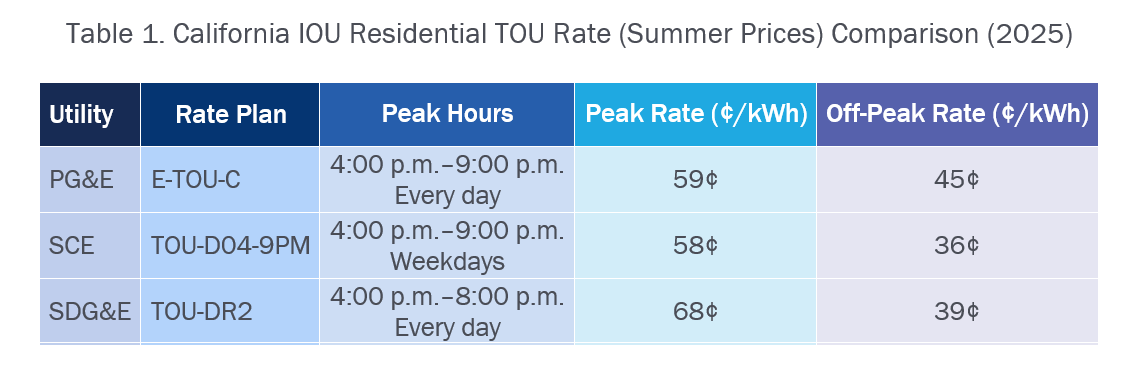
As seen in the table above, California IOUs focus on time of use (TOU) pricing plans that charge different rates at different times of day. Although most American utilities offer a TOU option, historically, few households outside California have been on them (though that is beginning to change as some utilities outside of the Golden State make TOU rates the default rate in their service territories). To put these California IOU prices in perspective, their off-peak rate is higher than many on-peak rates throughout the rest of the country (and their off-peak rates are also higher than many flat kWh pricing rates nationwide). With rates this high, it is no surprise that nearly one-fifth of California IOU customers are behind on paying their electric bills, according to a recent 2025 report from state regulators.
There are many reasons why electricity prices in the state are so high: rising transmission and distribution costs, wildfire-related expenses, much-needed grid modernization upgrades, and a litany of other arguably unavoidable costs. Fortunately, many of our industry colleagues have dedicated their careers to addressing the electricity affordability crisis in California. Through a variety of rate-based and other tactics, they have found ways to exert downward pressure on rates and provide much-needed bill relief to California households, especially for financially disadvantaged customers and others who need it most. Their work deserves a closer look, not only because it helps their fellow residents but also because it offers a ratemaking road map for the rest of the country.
Mitigating Impact: Rate Discounts and Programs for Income-Qualified Households
First and foremost, California is a leader in providing rate discounts to low-income customers. The California Alternate Rates for Energy (CARE) program provides a 30%–35% discount on electric bills and a 20% discount on natural gas for income-qualified IOU customers. Non-IOUs in California have similar programs. For instance, Sacramento Municipal Utility District’s (SMUD) Energy Assistance Program Rate (EAPR) provides income-qualified customers a 48% discount on all electricity usage, with a maximum monthly discount cap of approximately $40. Enrollment in these programs is impressively high, with prior estimates reporting that over 80% of eligible IOU households were enrolled in CARE.
Flipping the Script: Default Time of Use Rates
Simple income-based rate discounts are not the only strategy California employs to ease the energy burden of its customers. By 2019, California IOUs and SMUD transitioned most of their residential customers to default TOU rates. With peak prices exceeding historical tiered kWh prices, initial public outcries of “price gauging” were common. But illogical as it might seem, charging more at certain times of day can save customers money in the long run. For one, TOU prices can lower peak demand, reducing the utility’s capacity needs, resulting in downward pressure on rates—or at least, helping prevent further rate increases to accommodate spendy peak loads. According to Charlie Buck, who was interviewed for this article and leads load flexibility strategy on SMUD’s distributed energy solutions team, “[TOU has led to] like mid to high 10s of megawatts that we actually were able to take off our peak because of the time of use rate impact. It’s quite significant actually in terms of the way it’s modified our load. So certainly that does result in capacity savings and you know, every bit of capacity obviously helps with the affordability of it all.”
And despite expensive peak pricing periods, the extensive off-peak hours allow customers ample behavioral opportunity to save on their bills by concentrating their use of electric devices during off-peak times. Additionally, many customers will reap natural bill savings before making any behavior changes, simply thanks to tariff math that favors them. These customers are often called “structural benefiters” because they immediately save money once transitioning to TOU rates, as their natural load profiles tend to better align with TOU pricing signals. Low-income customers are often most likely to be structural benefiters, given their disproportionately flatter load profiles, which can result from living in smaller homes with fewer energy-intensive appliances, creating an opportunity for well-designed TOU rates to enhance energy equity.
Additionally, even though ratepayer advocates have expressed concerns about how low-income customers will handle TOU rates, research has found that when provided with the right information and support (through effective education campaigns and behavioral tools), these customers are not only able, but willing to make behavioral changes. In fact, low-income customers might be more motivated to implement changes to their routines to save on their bills. TOU rates can give them a new way to save money, beyond just cutting back on energy use, and without costly energy efficiency upgrades, which many cannot afford.
Designing Equitable Rates for Decarbonization
As electricity rates continue to climb in California, how can the state promote cost-effective decarbonization of residential homes and simultaneously establish safeguards to prevent affordability crises for the state’s most economically vulnerable customers?
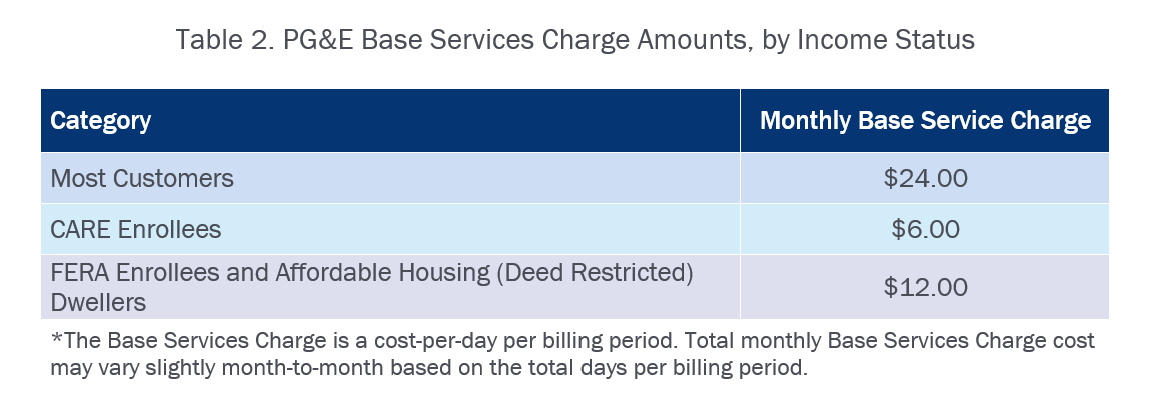
The California legislature has proposed a radical solution: income-graduated fixed charges, dubbed by the IOUs as a “Base Services Charge.” With implementation imminent, the California IOU electricity bills will include a fixed charge that operates on a sliding scale based on household income, with lower-income households paying a lower fixed charge than non-low-income households. The fixed charge is independent of electricity consumption. For example, a vacant home with an active electric account had the breaker totally turned off for an entire month and didn’t consume any electricity will still incur and be responsible for the fixed charge. Table 2 shows the initial Base Services Charge that PG&E will be using:
Customers will pay proportionately less for each kWh they consume in exchange for the fixed charge, effectively moving some of the tariff math to a different side of the equation. According to Erika Wasmund, was interviewed for this article and serves as a Principal Strategist for Residential Rates in PG&E’s Solutions Marketing Organization, “All customers will see about a five to six cent decrease on their electric kilowatt pricing once this is implemented for PG&E.” Wasmund stresses that “it won’t be a new charge; it’s for services customers are already paying for through PG&E’s kilowatt pricing.” Wasmund also acknowledges the equity and decarbonization benefits that the new Base Services Charge brings:
“[L]ow income customers will not continue to bear a burden of paying for these services more than others because of the way that they use electricity. So the goal is two-fold really. It’s to make electricity costs more fair for all customers and it also in the long term is meant to encourage more electrification by bringing the kilowatt prices lower for all customers.”
The California IOUs’ Base Services Charge is groundbreaking for several reasons.
- The fixed charge socializes the cost of electricity: more affluent customers will pay slightly more, whereas those who can least afford this basic need will receive a much-needed break in their electricity costs.
- The reduced $/kWh price will make electrification of natural gas end uses more affordable, paving the way for increased decarbonization in California. While this approach is unprecedented and not without its fair share of controversy, it will undoubtedly be interesting to see the net result.
Another way PG&E is seeking to make electrification more affordable is through its relatively new Electric Home Rate Plan (E-ELEC), which is offered to residential customers with electric vehicles, battery storage, or heat pumps for water heating or space conditioning. E-ELEC also includes a $15-per-month Base Services Charge and $/kWh prices lower than PG&E’s other rate plans. E-ELEC includes both peak and partial-peak prices, as well as a substantial discount on off-peak prices (Figure 1).
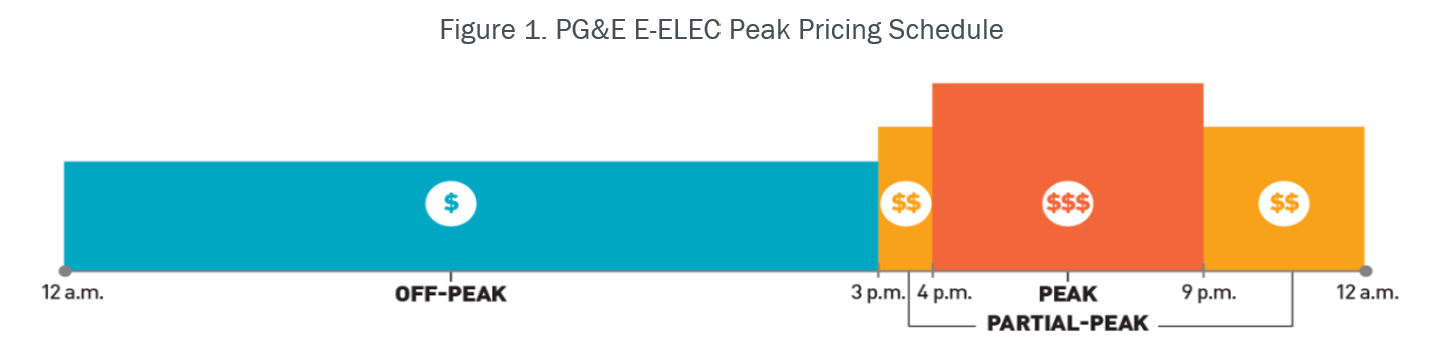
Wasmund explains that E-ELEC provides “an opportunity for customers who have adopted electric technologies to be on a rate plan that offers potential for the most savings if they are able to do things like run these high usage electric appliances during the off-peak hours between Midnight and 3:00 PM, [such as] charging their electric vehicle or running their heat pump water heater during the off peak hours.” With approximately 20,000 customers enrolled since the rate launched in 2023, E-ELEC is gaining traction with smart energy users across PG&E’s territory.
Final Thoughts
California faces an electricity affordability crisis, with customers of the state’s three major IOUs paying roughly double the national average for electricity, with peak rates exceeding 50 cents per kWh. Despite unavoidable cost drivers like wildfire expenses and grid modernization, California has pioneered several innovative approaches to address affordability challenges, including low-income discount programs, electrification-friendly rates, capacity-shaving TOU rates, and income-graduated fixed charges. These interconnected strategies demonstrate how progressive rate design can simultaneously address affordability concerns for disadvantaged communities while promoting decarbonization goals. California’s comprehensive approach of combining targeted discounts, time-differentiated pricing, income-based fixed charges, and electrification incentives provides a roadmap for other states grappling with rising electricity costs and climate goals, showing that equitable rate design can protect vulnerable customers while advancing clean energy adoption.
Be in the know first!
Get in-depth insights delivered right to your inbox! We understand your inbox and time are valuable, and we only want to provide content that speaks to you on the topics you’re most interested in. We’ve got some incredible projects in the works; join our mailing lists to be in the know first about our findings!