
Looking Beyond the Peaks to See the Full Resource Potential of EVs
By Hilary Polis
As electric vehicle (EV) sales increase, utilities, regulatory bodies, and other key energy industry stakeholders are grappling with how to prepare their existing infrastructure for the anticipated influx of charging on the grid and harness demand flexibility from EVs. Many utilities are taking a traditional demand response (DR) approach to EV load management by calling “events” to minimize EV charging during times of peak demand. However, evaluation results from several EV DR pilots show that the average per-participant load shift from EVs represents a fraction of the per-participant load shift we expect to see from traditional residential DR resources. It is becoming increasingly apparent that leveraging EVs as solely a peak load reduction resource underappreciates the multifaceted value of the resource and jeopardizes the viability of future EV load management programs when EV adoption scales. The future of EV load management requires thinking holistically about using EV batteries to support new and emerging grid needs, including mitigating distribution system impacts and supporting renewable energy integration.
Full of Promise: EV batteries represent a New, rapidly growing flexible peak load shift resource
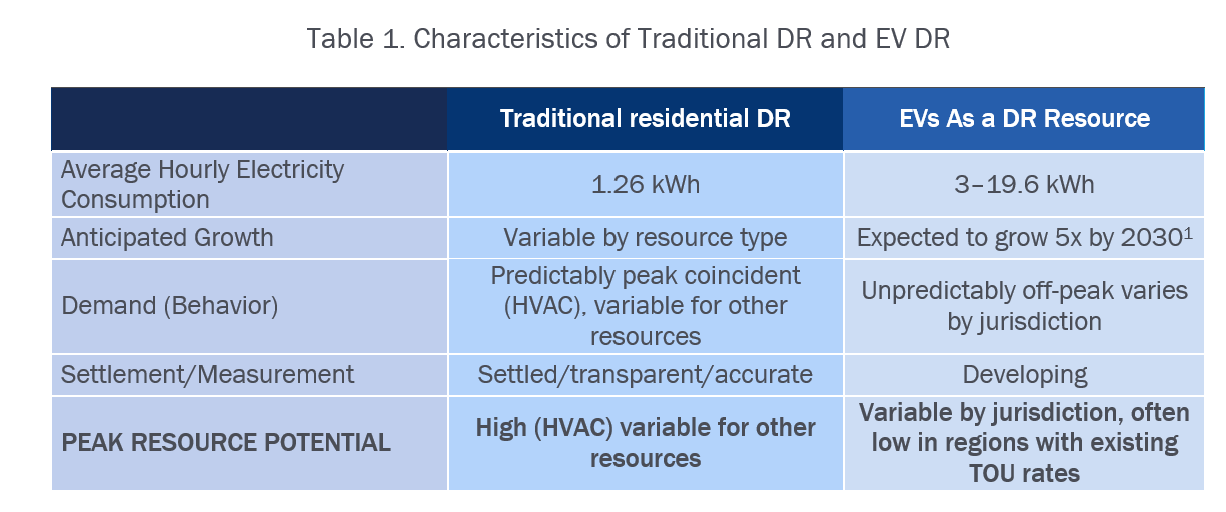
The potential resource value of EVs differs from traditional DR resources across several dimensions (Table 1). Our research estimates that around two-thirds of EV owners charge using level 2 (240V) chargers, which generally consume 3–19.6 kWh per hour when they are charging. By comparison, the average household hourly consumption in the US is roughly 1.26 kWh. Moreover, unlike more traditional DR resources, EV adoption is forecasted to grow dramatically in the coming decades, further increasing resource potential. If we focus on purely technical potential, EVs represent a tremendous make-or-break opportunity to solve (or exacerbate) many of our emerging grid challenges. To understand the total potential value of this resource, however, we must also consider behavioral factors—and EV drivers are a unique case.
Failure to Launch: What factors are driving lower performance?
Our research has shown that in some utilities’ service territories, much of the EV driver population includes early adopters who already tend to charge during off-peak times and therefore have little charging load to shift during peak-time DR events. Existing TOU rates likely influence these charging habits, along with other load management efforts, and the general convenience factor of scheduling charging to begin overnight, which is an off-peak period in many jurisdictions. Furthermore, in contrast to traditional DR resources like thermostats that heat and cool frequently and predictably, a large segment of EV owners charge their vehicles when they need to top off their battery, which varies by make and model in addition to household driving habits and needs. Consequently, EVs are less frequently and less reliably available for load shifting. Technology factors and participation criteria also impact performance. Across most event-based EV DR programs, a customer’s EV or charger must be online, have some battery capacity left to charge, be plugged in, charging, and be successfully curtailed when the event is called if the customer is to receive credit for “participating.” We have seen that these criteria for participation, combined with EV drivers’ propensity for variable and off-peak charging, reduce DR event participation and performance to a negligible amount for peak period DR events across multiple jurisdictions.
Looking to the Future
It may seem disappointing that EVs are not currently meeting our peak load reduction resource needs; however, EVs represent a ballooning flexible load resource too promising to ignore. Maximizing the grid value of EVs will require us to think differently and strategically about how and why to use this resource. There are several promising use cases for EVs in addition to peak load management around which utilities are increasingly designing programs.
- Beyond Early Adopters: EVs are expected to make up 50% of global car sales by 2035. As EV adoption grows, EVs will inevitably become more of a peak-period resource and, if done right, a flexible-anytime resource. The charging patterns of early adopters might look different than the next generation of EV owners. We should continually monitor aggregate EV charging load curves and segment customers to understand and optimize the value EVs can provide to the grid.
- Mitigating Distribution System Impacts: A level 2 charger can consume as much electricity as an entire house or more. What happens if most people in the same neighborhood adopt EVs and start charging simultaneously? Our grid infrastructure is aging and was not built for the rapid adoption of EVs. As EV penetration increases, there is a growing risk that the poles and wires supplying electricity to households with EVs (the distribution system) may not be able to handle the increased capacity needs of communities with large numbers of EVs charging simultaneously. According to a recent study, charging an EV requires a 70% to 130% increase in the electricity-transmitting capacity of the wires and transformers serving an EV-owning household. Upgrading the grid system could cost $10 billion nationwide through 2030, and the new revenue from EV users will not be enough to cover the necessary upgrades to local power grids. As such, utilities will increasingly look to EV load management programs to stagger customer charging and accommodate more EVs onto the system with fewer upgrades.
- Supporting Renewable Energy Integration: Some areas of the US, including California, have an excess supply of renewable energy during certain periods of the day. In these areas, utilities can benefit from encouraging EV drivers to charge when renewable energy is most plentiful to help smooth out the load on the grid and integrate more renewable energy into the system.
- EVs as a Resiliency Resource: Utilities, aggregators, and automakers can work together to help transform a customer’s dependence on an EV during an unforeseen event, such as a natural disaster, from a risk to an opportunity. Emerging managed charging program designs can use direct load control technologies to pre-charge customers’ EVs before extreme weather events or forecasted power outages. Moreover, more automakers and technology providers are developing vehicles and chargers with bidirectional charging capabilities. While this technology is expensive and in the early days of deployment, it will enable customers to power their homes with the vehicle battery during extended power outages.
Where do we go from here? Leveraging EVs at Scale
There are several emerging solutions practitioners are starting to deploy, which can help put these use cases into practice to support the optimal deployment of EVs to manage the grid:
- Deploying Dynamic Managed Charging Programs: Dynamic managed charging programs help utilities capture additional value streams from EV load management beyond peak period reductions. These programs can optimize a customer’s charging schedule based on customer preferences, vehicle type, state of charge, real-time capacity needs, TOU rate structure, indicators for high renewable generation periods, weather conditions, and desired departure times. Dynamic optimization programs can also offer a more satisfying customer experience, if they can help customers avoid thinking about events or when it is best to charge.
- Building Supportive Policy Frameworks: Many EV load management programs are currently housed under demand side management umbrellas. Consequently, their key success metric is peak load shift or load shed. Utilities and regulators can help maximize the value of EVs as a grid resource by advocating for supportive policy frameworks that adequately appraise the multiple value streams of EV load management, including avoided distribution system upgrades and grid resiliency services as well as societal and environmental impacts such as greenhouse gas emissions reductions, improved health outcomes, and increased access to mobility. This may require collaboration between distribution system planners, clean transportation teams, and demand-side management teams.
- Target Customers for EV Load Management Programs Based on Their Charging Patterns: As EV load management gains traction, utilties may offer a variety of programs with different desired grid impacts (e.g., peak load reduction, distribution system impact mitigation, renewable electricity integration). Utilities can maximize the value an EV driver provides to the grid by identifying or predicting customers’ charging patterns prior to program enrollment and then channeling them into the program where the customer offers the most significant load shift potential.
- Thinking Holistically About How EV Load Management Interventions Are Layered Together: Customers will have different willingness and comfort levels with enrolling in TOU rates vs. a dynamic program that remotely adjusts their charging schedule daily. The best practice is to offer multiple managed charging program designs to meet varying customer needs. Utilities should map out how each program fits together and the ideal customer journey across and through programs to avoid customer confusion and optimize grid outcomes. EV drivers already on a TOU rate may become confused if asked to enroll in a DR program that credits them for being plugged in and charging directly prior to or even during the period their rate incentivizes them to avoid. There may be opportunities to transition these customers to dynamic programs or pay them a bonus to prevent charging off-peak during grid emergencies.
The practice of EV load management is evolving quickly, and it is hard to pinpoint precisely how it will look in the future. Regardless, we know EVs are a rapidly growing resource, and our industry needs to be prepared to harness their power as a grid resource through thoughtful program design, policies that foster innovation and integration with other grid resources, and strategic thinking about the value that each type of EV driver provides to the grid.
References:
1 – According to Atlas Public Policy EV Hub, 10% of new light-duty vehicles purchased in the US in May 2023 were EVs; Bloomberg New Energy Finance forecasts the EV market share will grow to 50% by 2030.
2 – According to EIA, average US household electric consumption is 11,000 kWh annually/8760 hours per year, which equals 1.26 kWh.
About the author:
Hilary Polis is an Associate Director of Transportation Electrification at Opinion Dynamics where she leads Opinion Dynamics’ work in the transportation electrification space. Hilary leverages her expertise in vehicle grid integration to help clients understand the intersection of the EV owner and the grid. She provides advisory services to utilties and automakers across the country that are looking to building or scale EV load management offerings including PG&E, ComEd, and Puget Sound Energy. Hilary also has a depth of experience directing research projects to understand the performance of large-scale TE initiatives including SCE’s Charge Ready Light Duty Program, NYSERDA’s Clean Transportation Prize Program, Xcel Energy Colorado’s Transportation Electrification Plan Pilot’s, and Portland General Electric’s TE pilots.
For more information regarding the article, Contact:
Hilary Polis: hpolis@opiniondynamics.com
More from this author and the topic of Transportation Electrification!
Podcast
EV Managed Charging Primer
Blog Article
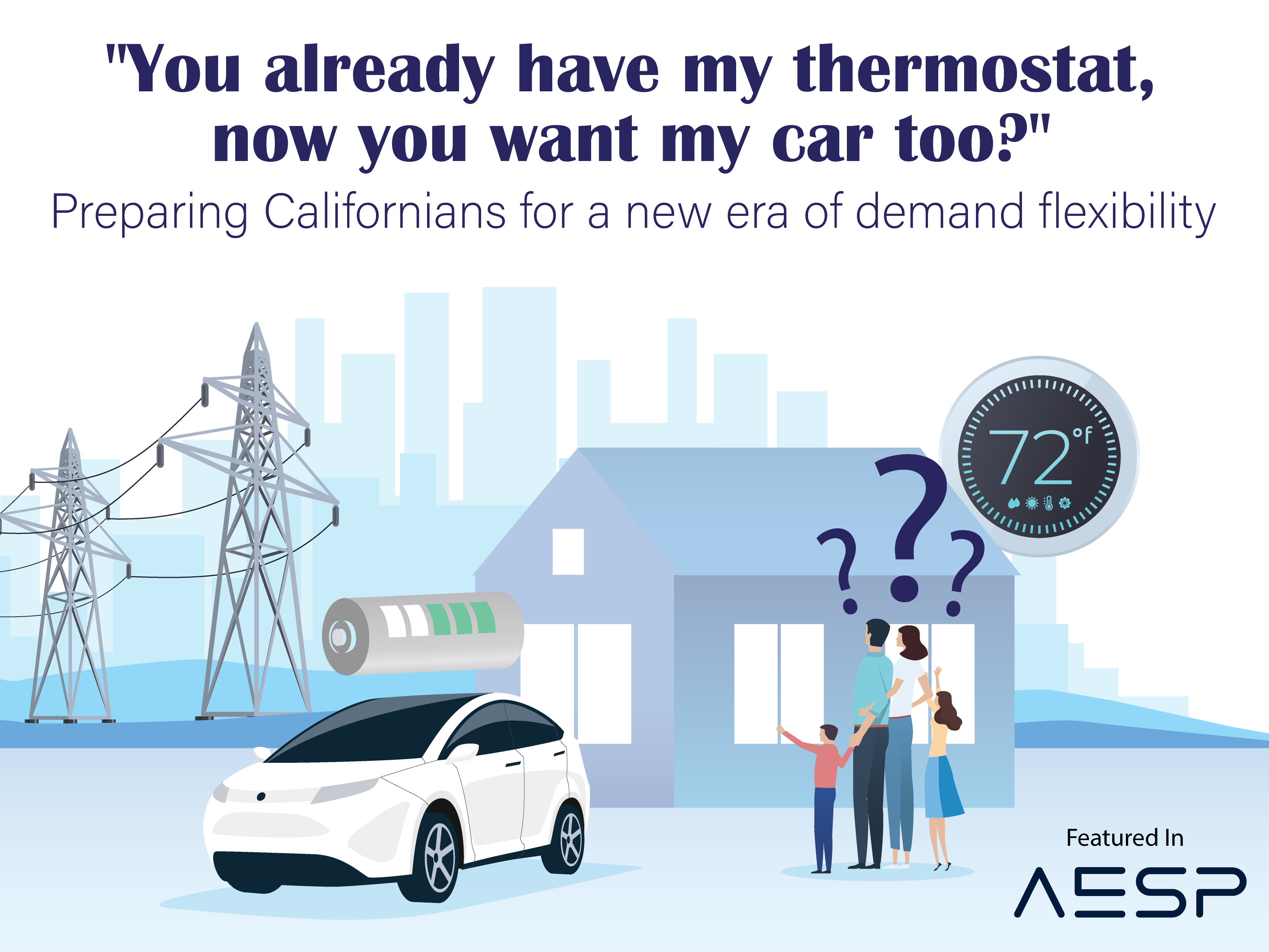
You have my thermostat, now you want my car too?
Presentation
Designing EV DR Incentives
Insights Highlighted
Customers’ Perceptions
Insights Highlighted
Grid Resource Potential
Insights Highlighted
Revelations and the Road Ahead
Be in the know first!
Get in-depth insights delivered right to your inbox! We understand your inbox and time are valuable, and we only want to provide content that speaks to you on the topics you’re most interested in. We’ve got some incredible projects in the works; join our mailing lists to be in the know first about our findings!