
TECH CLEAN CALIFORNIA WIKI
Reduced TECH Incentive Applications in 2023 Compared to 2022
Contractor Interview Findings Memo
Introduction
The TECH Initiative (TECH) is a midstream market transformation program that engages contractors to offer incentives to California homeowners to install space-conditioning and water-heating heat pumps. TECH launched in December 2021 and saw rapid growth in the number of enrolled contractors and incentive applications. The uptake was so dramatic that TECH ran out of incentive funds in most gas Investor-Owned Utility (IOU) territories in May 2022. TECH incentives for HVAC equipment were unavailable across all service territories for nearly a year after TECH’s initial funding ran out in May 2022; until April 2023 when incentives were reinstated. TECH 1.0 incentives for water-heating equipment remained available in Southern California Gas (SCG) territory for more than a year after funding ran out in Pacific Gas and Electric (PG&E) and San Diego Gas and Electric (SDG&E) territories. The new incentives for water-heating equipment were launched in October 2023 across all service territories as part of the Self-Generation Incentive Program (SGIP) Heat Pump Water Heater (HPWH) Program. Incentives for both equipment types were available statewide as of November 2023.
Figure 1 displays a timeline of TECH incentive availability by IOU service territory and equipment type, highlighting when TECH launched each round of incentives and when, if applicable, the incentives 12 were exhausted.
Figure 1. TECH Funding Timeline by IOU Service Territory and Equipment Type
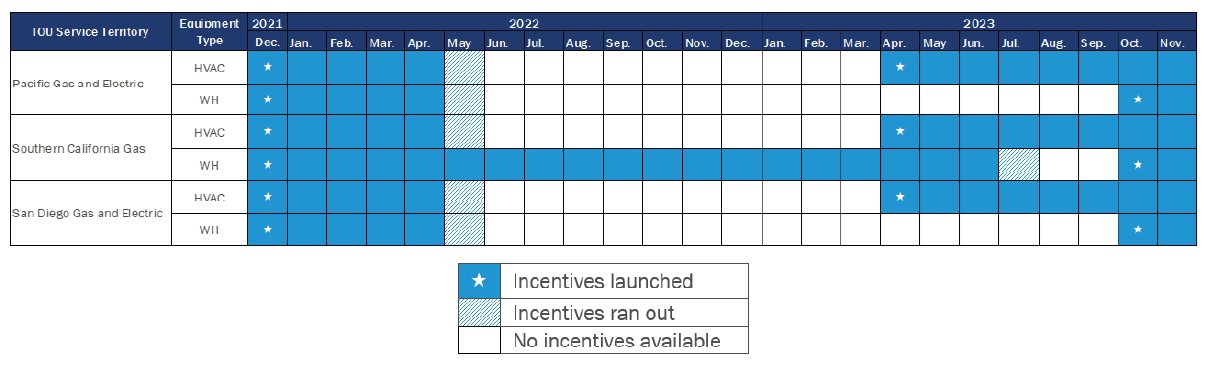
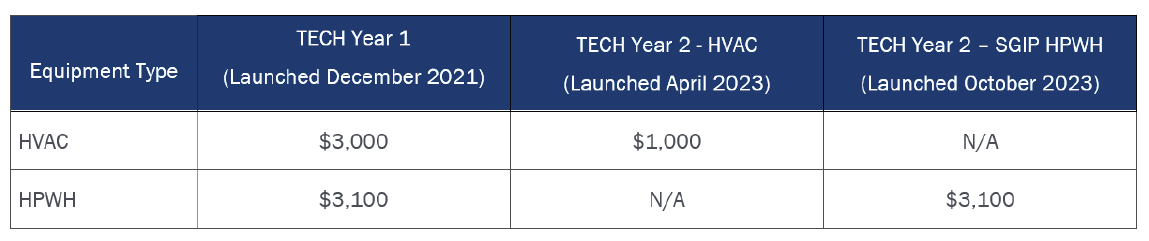
Table 1 outlines TECH’s incentive structure by equipment type.
Table 1. TECH Incentive Amounts by Equipment Type
Once incentives were offered again in 2023, the TECH Initiative did not experience the same rapid uptake that it saw in 2022. This was concerning because, as a contractor-driven program, the provision of incentives to encourage heat pump adoption depends upon contractors offering the incentive to their customers. Our goal for this research was to understand why contractors who were very active in TECH’s first year were not as active in TECH’s second year.
Methods and Objectives
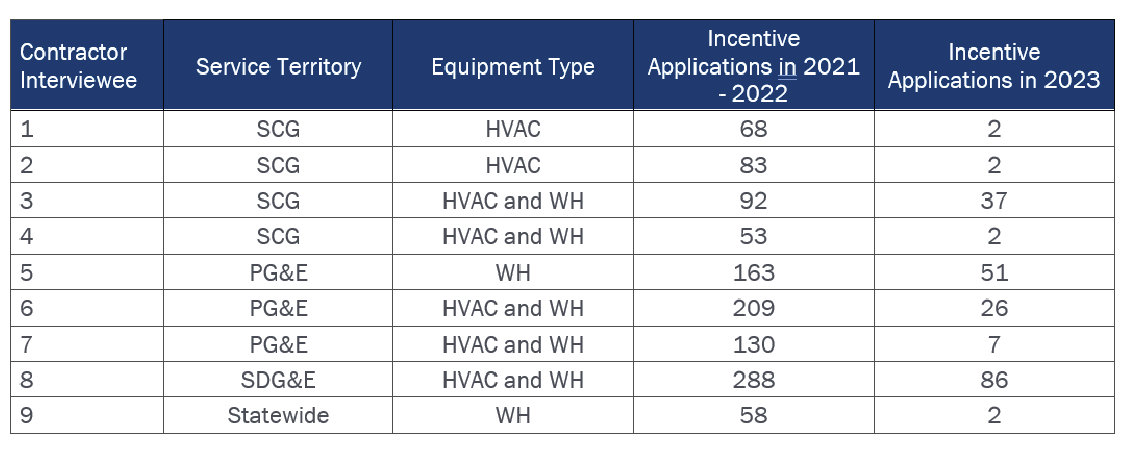
The TECH implementer, Energy Solutions, provides Opinion Dynamics with a list of TECH projects and the associated contractor on a bi-weekly basis. We used a list dated August 29, 2023, to identify contractors that 1) submitted a high number of TECH projects in 2022 and 2) submitted few projects in 2023. To ensure we spoke with a representative sample, we prioritized selecting contractors distributed across the three IOU territories eligible for incentives in the first year of TECH (i.e., PG&E, SCG, and SDG&E). Using these guidelines, we identified a list of 45 contractors who sold water heating (WH) and/or HVAC heat pump equipment. We invited these contractors to participate in a confidential 30-minute interview between November 8th and December 6th 2023, sending one email invitation and up to two email reminders. We offered contractors a $50 e-gift card for their participation. We completed a total of nine interviews. We had initially planned to conduct up to 20 interviews. However, data collection was stopped at nine due to reaching data saturation.[1] The qualitative results are informative of marketplace dynamics and are not intended to be generalizable. Table 2 lists the service territory and equipment sold by each of the contractors we spoke with. Five of the nine contractors served Southern California Edison’s (SCE) territory.
[1] In qualitative research, saturation refers to a situation where the same themes and information are emerging in subsequent interviews and new information is not appearing. It is used as a criterion for discontinuing data collection.
Table 2. Contractor Interviewees’ Service Territory and Equipment They Sold
We sought to understand the dynamics behind the decline in heat pump incentive applications submitted by contractors via the TECH Initiative. In particular, we investigated whether the following factors influenced their TECH application volume:
- Level of customer interest in heat pumps
- Supply chain dynamics
- TECH’s reduced incentive amounts in the second year compared to the first year
- Influence of incentives available through the federal Inflation Reduction Act
- Experience with TECH in its first year
- Company’s priorities
- Title 24 permitting requirements
- Cost of electricity
- Gas company marketing
The next sections summarize our findings from the interviews with contractors.
Findings
Contractors said that their smaller number of TECH incentive applications in 2023 was largely due to three factors:
Table 2. Contractor Interviewees’ Service Territory and Equipment They Sold
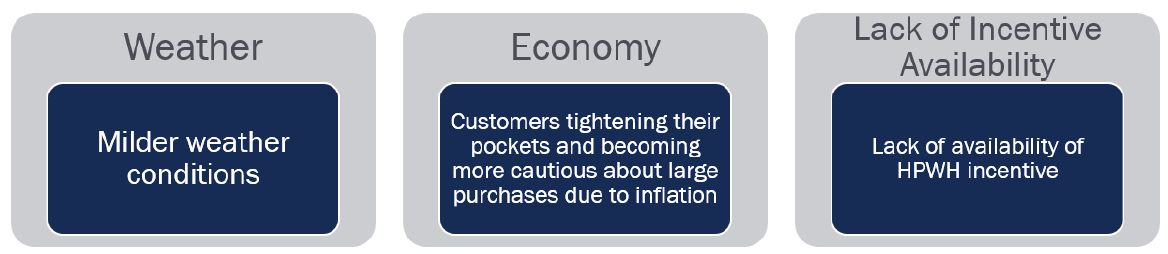
We provide additional context below about these three factors, along with other feedback we heard from contractors related to HPWH sales, the SGIP HPWH incentive requirements, and suggestions to improve contractors’ experience with the TECH Initiative.
Customer Interest in Heat Pumps
All contractors agreed that customer interest in heat pumps has not waned. In fact, two contractors mentioned that interest in heat pumps is trending up. One contractor noted that in Southern California, there is a high penetration of rooftop solar, and those customers are very interested in converting to a heat pump to optimize the use of their solar system. Another contractor in the Bay Area said interest in heat pumps is high because customers there tend to be environmentally conscious and have higher household incomes compared to other areas of California. Two contractors acknowledged that electricity rates remain a concern among some of their customers but that this concern has not hindered interest in purchasing a heat pump. One of these two contractors added that due to the ban passed by the California Air Resources Board (CARB) that will prevent the sale of gas furnaces beginning in 2030, it is becoming more difficult to sell gas furnaces as customer awareness of these future requirements grows:
“[Customers] kind of know the requirements will be enforced at a particular point in time, everything’s going to have to switch over to [electric]. So, if you have a gas furnace now, it’s almost 10 times harder to pitch or sell that, just because they’re being phased out”
~ Contractor in SCG territory
Reasons for Decrease in TECH Participation
In this section, we present findings related to reasons contractors have had lower TECH participation in 2023.
Weather and the Economy
Half of contractors interviewed reported a drop in their company’s HVAC sales due to mild weather conditions in 2023. Four contractors noted the late onset of summer temperatures and lack of extreme weather conditions, particular over the summer months, prevented them from seeing the normal seasonal uptick in HVAC replacements this year. One additional indicator of this, is the fact that the California Independent System Operator (CAISO) did not call any Flex Alert events in 2023, which are used to prevent power outages during extreme heat events when power demand is expected to surpass the amount of electricity available on the grid. One contractor elaborated by sharing that customer interest in upgrading HVAC equipment generally peaks after three consecutive days of very hot or very cold weather, which did not occur in 2023:
“The summer didn’t start until a lot later this year, so that missed a big boom. The tendency of people needing HVAC work done when you have three or more consistent days of excessive cold or heat hasn’t occurred because [temperatures] haven’t been excessive so far this year.”
~ Contractor in SCG territory
All four of the contractors who mentioned weather as a factor shared they observed a decrease in all HVAC equipment sales, and that the trend is not specific to heat pump installations. All of these contractors served Southern California, within SCG and SDG&E service territories.
Due to inflation and increased costs of living, contractors said customers have been more selective with their purchases of large home equipment in 2023. All nine contractors we spoke with acknowledged a decrease in overall HVAC sales and a greater push from customers to repair equipment rather than replace. Interviewees sensed customers have been more cautious about making large investments in their homes due to the uncertainty in the economy, resulting in customers taking actions to delay the replacement of their equipment (e.g., using extra blankets for supplemental warmth) or selecting cheaper equipment options.
Availability of Program Incentives
Water heating contractors have submitted fewer TECH applications due to a lack of HPWH incentives and uncertainty about where the incentives were available in 2023. Three contractors, two of whom worked only with water-heating equipment and one who worked with both HVAC and water-heating, noted that the biggest reason they submitted fewer TECH incentive applications in 2023 was because the incentives were not available (one contractor from each service territory). This was unsurprising news from the two contractors located within the PG&E and SDG&E territories as HPWH incentives were unavailable for most of the year in both regions before being reinstated on October 31, 2023. Although HPWH incentives were still available in their area, the third contractor who noted in their interview that they have a nationwide focus and serve a variety of regions throughout California, said they have had trouble understanding when and where HPWH incentives have been available this year. This contractor explained that their uncertainty of where incentives were available made them reluctant to offer the incentive because they had little confidence that it will be approved:
“I don’t know what zip codes or what jurisdictions the rebate is still available for, so that’s the biggest problem. [We] don’t know where money is available for customers so we don’t want to sell a customer on [the incentive] and then them not get it.”
~ Statewide Contractor
Program Incentive Amounts
Changes to the incentive amount have not strongly influenced contractors’ participation in TECH. When talking specifically about the incentive amount, six of the seven water-heating contractors said this has not been a factor in the lower volume of TECH applications they have submitted this year. Instead, one SCG contractor noted the $3,100 incentive offered through TECH, which remained available in their area through July 2023, was actually higher than any they have seen the gas company (SCG) offer in the past for efficient gas water heaters. Another contractor also mentioned that the new SGIP HPWH offering launched in October is the highest HPWH incentive they have ever seen. This contractor went on to share that they believe this new incentive, starting at $3,100 with the potential to earn additional kickbacks, is helping motivate customers to replace their water-heater earlier than they may have in the past:
“So usually, when it comes time [to replace equipment] a water heater takes the back burner. What’s changing that dynamic now, and I’ve already noticed, is the [new SGIP HPWH] incentive because it’s such an incredibly large amount of money.”
~ SCG Contractor
The single water-heating contractor who said the incentive amount has factored into their level of TECH participation noted that the cost of a HPWH increased between TECH’s first and second year. They reported that in year one of TECH, a HPWH typically had cost $4,000, but that in 2023 the average cost had increased to closer to $5,000. On top of this, the contractor also highlighted that the new SGIP HPWH offering requires the installation of a thermostatic mixing valve (TMV), which adds about $300 to the cost of each project. As a result of these changes, the TECH incentive now covers less of the equipment cost and according to this contractor, makes it harder to get customers to purchase a HPWH.
On the HVAC side, although many contractors acknowledged that the larger $3,000 incentive amount in TECH’s first year was definitely a draw for customers, six of the seven HVAC contractors said they did not feel the decreased incentive influenced the number of applications they submitted this year. Only one contractor, located in SDG&E territory, said their reduced participation was in part due to the decrease in the incentive. They reported that the $1,000 incentive was not as influential for customers because it covered a smaller amount of the project cost. One interviewee shared that they actually preferred the lower incentive amount, as they see it as a more sustainable and reliable approach for the Initiative:
“I like that it’s $1,000 and not $3,000. $3,000 was never going to last. That’s a money grab, right? It’s not sustainable and we need consistency. I don’t need a huge amount, that will only sell to people who are just in it for the money. We need to not have to worry about the program running out of funds so quickly because that’s when the damage is done.”
~ PG&E Contractor
So far, IRA tax credits or upcoming incentives have not influenced interviewed contractor sales or TECH participation. Five of the nine contractors used the same term to describe how the IRA offerings have affected their business: “no impact.” Seven contractors had not taken advantage of IRA tax credits at all so far. One contractor who had, said they include information about IRA tax credits with each heat pump sale and that they have been an effective way to compensate for the lower HVAC TECH incentive. This interviewee added that pairing IRA tax credits with those offered by TECH in 2023 has allowed them to bring the total customer discount back up to the same level it was in the first year of TECH.
TECH processes
Although four contractors mentioned challenges with the application submission and approval process, none felt this negatively impacted their level of involvement with TECH this year. Two of these contractors noted how many components they have to provide for the application, including the permit number, the picture of a capped gas line, and the HERS report. If an installer forgets a picture, they have to return to the site, which extends the approval process. One noted that waiting on the HERS report also lengthens the time before an incentive application is approved. One of these contractors had to develop their own tracker to know the status of each incentive application:
“I feel like I’m constantly babysitting. I have created a spreadsheet to know which one is in which stage. It’s not just like we can just input the information and send it off like most other rebates.”
~ SDG&E Contractor
One contractor reported they only receive a notification from TECH once a month regarding applications that require revisions and by that time many have already been rectified causing confusion:
“I’ll get a notification like once a month. That’ll give me, I don’t know, 10 to 20 projects that are flawed or need a correction. A lot of times they have already been patched and paid out, so it gets kind of confusing.”
~ PG&E Contractor
New restrictions that prevent retroactive project applications contributed to this year’s lower volume of submissions for a couple contractors. Two contractors shared that when the incentives became available in April 2023, they already had an extensive pipeline of contracted projects. Since the customer already signed the contract without the TECH incentive on it, they could not re-submit these projects for an incentive. One of these contractors explained that their company usually books projects out three to seven months in advance, which resulted in months of projects that they were unable to submit for a TECH incentive. The contractor acknowledged that this was understandably a learning point for TECH staff around past budget issues, but that this prevented them from participating in the program until September 2023.
One contractor noticed a decrease in TECH’s marketing efforts this year. An SCG contractor who primarily serves the Coachella Valley, shared that in the first year of TECH they noticed a lot of promotional efforts in the communities they serve, but that they had not seen much, if any, this year after incentives were re-instated in April. Although customer interest in heat pumps has remained high, they felt the community marketing in the first year had helped to initiate awareness and prompt customers to seek out heat pump equipment themselves.
Other Market Factors
Contractors agreed that consumer marketing by gas companies had not influenced customer demand for gas water heaters or HPWHs. A PG&E contractor hypothesized that SCG still offered incentives for gas tankless water heaters and thought that could be an attempt to maintain gas customers. The statewide water-heating contractor noted that funding for TECH’s incentives in the first year came from SCG so they did not think SCG was making separate efforts to push people away from HPWHs. Other contractors in Southern California said that the rebates for gas water heaters were not as strong as those for HPWHs, so did not have the sense that SCG was intentionally trying to capture customers for gas water heating.
No contractors reported supply chain issues with obtaining necessary equipment or issues with Title 24 permitting requirements. Two of the nine contractors noted they hire a third party to complete Title 24 permitting requirements for their projects as part of their normal process, and that has worked well for them.
Changes in company priorities have not influenced TECH participation. Eight of the nine contractors enthusiastically reported their company has continued to promote heat pumps in 2023, at least as much as they did during TECH’s first year. The one exception was a contractor who worked solely with water-heating equipment that said their company still promotes HPWHs but transitioned their priorities to focus more on EV chargers, solar, and battery storage in 2023.
Two contractors reported business competition has grown. These contractors said that there are now more contractor companies out there, giving customers more options to choose from and increasing the competition for business. One of these contractors suggested that with more options, some customers opt to go with a cheaper option, which may be a smaller company that does not participate in TECH.
HPWH Sales & Incentive Requirements
This next section presents findings related to HPWH sales, including differences observed across various regions of California and contractor feedback on the new SGIP HPWH incentive requirements.
HPWH Sales
Some contractors had theories, but none were confident about what might be driving the lower usage of TECH HPWH incentives in SCG territory. Considering the original HPWH incentives from TECH’s first year were exhausted in PG&E and SDG&E territories within months of being launched but have yet to run out in SCG territory, we were interested to hear if contractors had insight into what may be driving differences in customer demand or contractor participation. When probed about differences between the regions, most water-heating contractors said they were not sure and had no strong theories on the matter. One contractor who served the SCG territory responded that from their experience, customers in the region are aware of the push to all-electric appliances and future legislative requirements, but for water heating, “if they can stick with gas, they will.”
SGIP HPWH Requirements
As the SGIP HPWH incentives were launched just weeks before we conducted interviews, we asked water-heating contractors about their initial feedback on the new requirements.
All water-heating contractors’ companies have participated in the SGIP HPWH incentive required training. These contractors reported at least one person from their company had already completed the training required to offer SGIP HPWH-related incentives. Most contractors said their understanding was that only one person from the company was required to complete the training before submitting an incentive application, but one received conflicting information. This interviewee explained they first received an email that stated only one person from each company needed to attend the training, but shortly after they received a second email that instead instructed that every installer at each company would need to complete the training prior to submitting an application. To ensure all contractors are clear on the correct requirements, TECH should consider sending another email for clarification.
In addition to this feedback, contractors mentioned a few other issues they encountered as they began to utilize these incentives. We describe each of these issues below.
- New Requirements Complicate HPWH Sale
- One contractor reported the new incentive requirements call for significantly more sales training for their technicians. As they usually promote heat pumps at the customers’ home, this interaction has become more complicated considering the documentation and additional conversations they must have related to rate plans, program enrollment, and heat pump operational schedules. The contractor noted they feel this additional training is worthwhile to achieve the extra energy savings but said this would be problematic for a smaller company business model with less administrative support.
- Requirements are Outdated or Conflict with Other Incentive Programs
- One contractor highlighted how TECH’s SGIP HPWH incentive’s “first hour” requirement is based on an outdated plumbing code that has led to their company installing equipment that is larger than necessary and resulted in additional costs to the customer. They added that to meet TECH’s incentive requirement, they generally need to upsize the equipment, regardless of whether upsizing is necessary to meet the needs of the customer’s home. This contractor also emphasized how this requirement conflicts with the Golden State rebate requirements, which are based on the existing equipment’s size compared to the size of the new equipment (i.e., encouraging smaller equipment sizing).
- Complications with Time-of-Use (TOU) and Demand Response (DR) Program Enrollment
- In general, contractors have found the new TOU and DR program enrollment requirements to be cumbersome and much more complicated on the administrative side. One contractor reported running into an issue when signing customers up for the demand response program because customers were unaware if they were already enrolled. They further elaborated that they received a referral link from OhmConnect only days before the new incentives launched that was supposed to verify whether the customer was already signed up for the program. The provided link was also intended to assist contractors with connecting the equipment to the customer’s account. Unfortunately, there were issues with the initial link they received, which further complicated this process.[2]
- One contractor had experienced problems on the manufacturer side, specifically with AO Smith and Bradford White equipment. They noted these manufacturers did not have their user application set up until just a few days before the SGIP HPWH incentives were launched. As a result, they were unable to conduct thorough testing beforehand and subsequently experienced several operational issues while trying to connect their equipment to Wi-Fi and set up the user app.
- Increased Project Cost Due to TMV Installation
- One contractor noted that the new incentive qualification requiring a TMV to be installed with each HPWH increases the total customer cost by about $300. This, along with the year-over-year increase in the upfront cost of HPWH systems has made it more difficult to get customer buy-in.
Suggestions for Improvement
Overall, contractors expressed high satisfaction with TECH and plan to continue promoting and participating in the Initiative. Without prompting, most contractors shared their appreciation for the TECH Initiative, with many highlighting how wonderful the staff members are. A couple of contractors mentioned they find it easy to get in contact with TECH staff and have experienced quick response times when they reach out with questions. One contractor praised how accessible TECH staff have been to contractors, even smaller companies that may not be bringing in the same volume of projects, emphasizing how necessary this is for their line of work:
[2] The contractor did not elaborate on the issues beyond saying that the first link did not work and they had to request a new link.
“I think the TECH team has done a great job at being accessible to contractors, and not just me because I know we install a lot of heat pumps so they’re probably a little bit more inclined to be accessible. I’ve even heard from friends who work for really small plumbing companies that say anytime they have a question they get it answered immediately. I think that’s a huge plus and goes a long way because if it was like a typical customer service line where you put in a help ticket and then someone answers you like 3-4 days later, that wouldn’t work for a contractor.”
Although contractors were generally very pleased with TECH, they did have a few suggestions to improve the Initiative and contractor experience:
- Throughout interviews, multiple contractors mentioned specific instances where faster or clearer communication could improve their TECH experience, including:
- Three contractors said they had experienced issues with notifications regarding submitted applications that may need additional information or that were otherwise not approved by TECH staff. As mentioned earlier, one contractor reported they usually receive these notifications from TECH once at the end of the month with a list of applicable projects. They made a direct comparison to BayREN, another heat pump incentive program they participate in, where they receive status updates on applications immediately following each new step in the process (e.g., emailed when submission is received by the program, when reviewed with any action items needed from the contractor, when approved, and when incentive has been mailed).
- Some contractors had a different understanding of the SGIP HPWH incentive training requirements, with one noting he received two emails that provided conflicting information about the requirement. Clearer communication about incentive requirements may help encourage stronger and earlier contractor participation.
- One contractor requested clearer communication around which zip codes are eligible for available incentives, as they serve multiple service territories and found this information difficult to confirm when HPWH incentives were limited to the SCG territory.
- Two contractors proposed TECH put more effort into marketing and customer education about heat pumps.
- One contractor suggested TECH incorporate an equipment model lookup function, similar to other incentive programs they participate in, that would allow them to upload a photo of the equipment nameplate and submit for TECH staff to do the eligibility check on the backend. They said TECH is currently set up so that contractors must manually do material lookups on their end, sharing that this can become time-consuming, particularly when looking up HPWH equipment.
- One contractor mentioned that operationally, the TECH application process can get quite complicated. They suggested TECH look into a software application (Rock Rabbit AI mentioned as an example) that both contractors and customers could have access to in order to upload required information and stay up to date on the status of the incentive.
Conclusion
The reduced volume of TECH activity among contractors in the second year of the Initiative was largely due to the pause in incentive offerings and reduced customer demand for high-priced home appliances. The milder weather conditions California experienced this year, paired with the status of the economy, and higher-than-normal inflation rates have driven customers to be more cautious about their spending. Customers have demonstrated a strong and growing interest in heat pumps this year as awareness and knowledge about the equipment continues to spread. Contractors have continued to promote heat pump equipment in 2023 as much or more than they did during the first year of TECH, and despite some minor suggestions for improvement, remain enthusiastic about participating in the Initiative moving forward.
These findings suggest that contractors’ experiences in the first year did not negatively impact their willingness to promote and use TECH incentives. Our results propose no significant changes to the program or contractor enrollment are warranted at this time to increase contractor participation, though the application submission and approval process remains lengthy and somewhat challenging.