

By Ellen Steiner and Kessie Avseikova
When we discuss the future of demand response (DR), the conversation often jumps straight to kilowatts, controls, and capacity. But let’s not forget that the success of every DR program depends on a single, often overlooked variable—people. If customers don’t know what DR is, don’t understand how it works, or don’t see a reason to engage, even the most sophisticated program design won’t deliver results. Yet despite decades of DR evolution—from switch-based load control to managed EV charging—we still lack a shared, industry-wide framework for understanding the residential customer journey to participation. This is a problem, and it’s one we’ve set out to solve.
Bringing Theory to the Frontlines of Engagement
In our recent research presented at ACEEE, we introduced a Demand Response Customer Engagement Model based on behavioral science and marketing theory. At its core, it is a deceptively simple idea: enrolling in a DR program involves not one decision but two. First, a customer must decide to participate, as DR programs are typically opt-in by design. Second, they must choose to respond actively, engage, and maintain consistency over time. We recognize, however, that in certain program designs, participation is automatic or inherently included, as seen in device integration designs. Our team at Opinion Dynamics, in partnership with Xcel Energy Colorado, set out to map that journey and build a customer engagement framework grounded in theory, not just instinct.
We began with the Hierarchy of Effects model, a marketing framework that outlines how people progress from awareness to action. But DR is more complex than just a single purchase. Participation involves not just one decision but two: enrollment and engagement.
To enhance our understanding, we incorporated the Theory of Planned Behavior, which introduces sociopsychological factors such as intention, perceived control, subjective norms, and attitudes. Additionally, we referenced energy literacy research, behavioral science, and cognitive engagement studies to capture the nuances of how people think about, feel about, and interact with energy in everyday life.
Hierarchy of Effects Model
The result? A theory-driven but practical DR Customer Engagement Model that doesn’t assume a single linear path but reflects the non-linear, emotional, and contextual nature of residential decision-making. The model captures the dual decision-making process by mapping seven critical stages of the customer journey, each grounded in theory but tailored to the reality of residential energy behavior.
Backing Theory with Empirical Proof
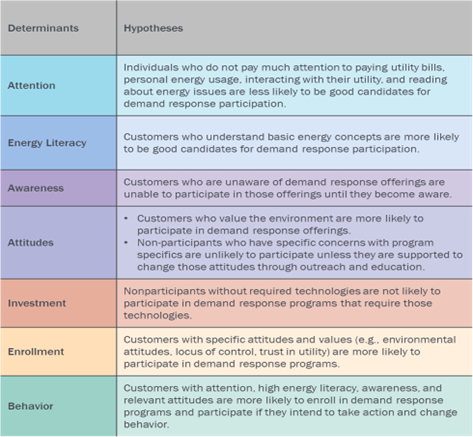
Each stage offers a potential leverage point and a potential barrier. That’s why a framework that connects the dots and supports smarter segmentation, messaging, and program design is needed. Our framework sets the stage and makes it easier to understand those leverage points. However, we did not stop at just theory. We tested this framework with original research targeting DR nonparticipants across Colorado. We developed an empirically grounded survey instrument to explore seven key determinants of engagement:
- Attention
- Engagement starts with noticing. Many customers spend fewer than 10 minutes a year thinking about their electricity usage. Before assessing awareness, we ask: Are they even paying attention?
- Energy Literacy
- Without a baseline understanding of how energy is used, when it costs more, or what demand response is, customers may be unable (or unwilling) to act, even if they’re interested. The survey tested linkages between literary and other determinants of energy literacy.
- Program Awareness
- Knowing that DR programs exist is a prerequisite. We explored both general DR awareness and familiarity with specific programs.
- Attitudes and Trust
- From environmental concern to control preferences, attitudes can shape intent. We explored a range of attitudes, including trust in the utility, which is essential when asking customers to cede some control over home energy use.
- Investment Readiness
- Many DR programs require enabling technologies, such as smart thermostats or EV chargers. Customers’ openness to new technology and position on the innovation adoption curve are crucial. We examined that in the survey.
- Enrollment and Behavioral Intentions
- We explored the likelihood of enrollment as well as the motivators and barriers to engagement.
Together, these factors paint a much more complete and predictable picture of how to drive enrollment and actual behavior change.
As DR portfolios evolve toward 24/7 grid flexibility, behavioral engagement is no longer a side note—it’s core to capacity planning and clean energy integration. The most successful programs of the future won’t just control load—they’ll co-create value with customers who want to participate.
We believe this model has real value for utilities and program designers; specifically, it:
- Illuminates blind spots in customer targeting
- Facilitates more nuanced messaging, incentives, and design tweaks
- Supports segmentation strategies tied to real behavioral levers
- Enables future tracking through dashboards and longitudinal engagement metrics
And because it’s modular and grounded in theory, it can scale across territories, product types, and customer segments.
What’s Next
We’ll be sharing insights from the primary data collection in an upcoming paper for the International Energy Program Evaluation Conference (IEPEC) and at another conference, and we are eager to share them with you. Subscribe here to get the results first when they are released.
In the meantime, we’d love to hear from you. If your team is rethinking how to build, evaluate, or evolve your DR offerings, we’re always up for a good engagement strategy session.
Because the truth is: customer engagement isn’t a nice-to-have; it’s the whole game.
Dive Deeper
Learn more in the paper about the theoretical foundations underlying our model

Connect with Us
Follow us on LinkedIn to see the latest content updates!

For more information regarding the article, Contact:
Kessie Avseikova: kavseikova@opiniondynamics.com
Be in the know first!
Get in-depth insights delivered right to your inbox! We understand your inbox and time are valuable, and we only want to provide content that speaks to you on the topics you’re most interested in. We’ve got some incredible projects in the works; join our mailing lists to be in the know first about our findings!