
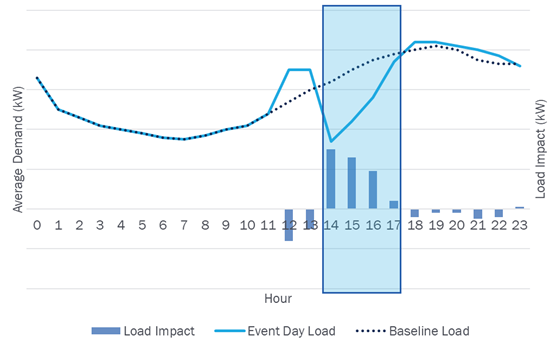
Smart thermostat direct load control programs are popular nationwide, with program participation frequently reaching tens of thousands of residential customers in a single utility program. Traditional load curtailment strategies leveraged by those programs include adjusting thermostat setpoints prior to event start to precondition participating homes in order to minimize override behaviors and ensure participant comfort, followed by a static thermostat setback for the duration of the event, usually 3–4 degrees Fahrenheit. Despite a static setback, hourly load impacts decrease with each subsequent event hour, most commonly a function of HVAC systems cycling back on and participants overriding thermostat setpoints. As such, load impact curves for smart thermostats direct load control events have been historically uneven.
Our evaluations across the country show around 25% load impact loss in hour 2 compared to hour 1, 25% in hour 3 compared to hour 2, and 35% in hour 4 compared to hour 3 of the event. Looking at it another way, hour 4 load impacts likely represent a small fraction, frequently as little as a quarter, of the first-hour load impacts.
Figure 1. Typical Smart Thermostat Event Load Impact
In the meantime, direct load control programs have become a formidable resource supporting forward capacity and resource adequacy markets. While rules for demand response (DR) resource entry and participation in the wholesale markets across the country vary, it is not uncommon for independent service operators (ISOs) to set requirements for DR event duration and varying rewards and penalties for DR resource participation. For example, MISO DR testing protocols require market participants to demonstrate demand reduction capability for a minimum of one hour with an attestation that the DR can continue for a minimum of four consecutive hours. As a result, utilities face a risk due to the declining load impacts from smart thermostat direct load control programs hour by hour. This decreasing performance diminishes the value of the resource because only the load reductions from the lowest performing hour are available for market participation and clearing.
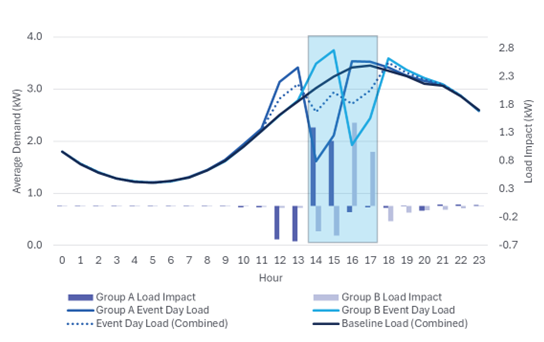
In response, utilities, implementers, and aggregators have been experimenting with different curtailment strategies to flatten and optimize the load impact curve over the course of DR events. The efforts vary in complexity. One such effort includes a creative approach to a four-hour event dispatch wherein the participant population was split into two equal subpopulations, with each undergoing curtailment over two hours staggered one after the other. This type of dispatch meant that half of the participant population’s HVAC load was not curtailed during the first two hours of the event (Group B), and the other half was not curtailed during the last two hours (Group A). This staggered event dispatch aimed to minimize the “hockey stick” of the hour 3 and 4 load increases and test whether average load impacts in the lowest performing hour were higher than under a more traditional dispatch routine.
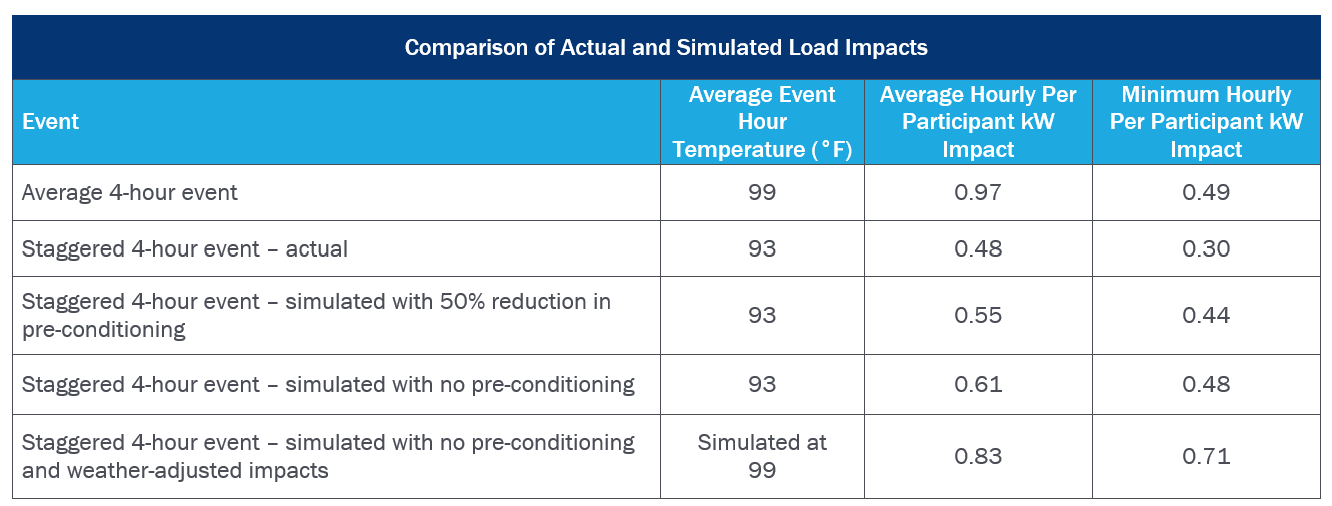
Figure 2. Staggered Event Performance Summary
Our evaluation of the load impacts from this staggered event dispatch revealed interesting learnings, namely:
- Because half of the participant population did not receive a curtailment signal, their load impacts were effectively zero, dampening the overall average per-participant event hour impacts.
- Pre-conditioning routines among participants dispatched during hours 3 and 4 of the event further dampened the load impacts of the participants dispatched during hours 1 and 2.
- Post-event snapback among participants dispatched during hours 1 and 2 of the event dampened load impacts achieved by the participants dispatched during hours 3 and 4.
Using other events dispatched on the same population of participants during the same event season, including two-, three-, and four-hour events, the staggered four-hour event did not perform quite as well as any other event. Average load impacts from the event were considerably lower than for any other event, and so were the minimum hourly load impacts, which is a more important metric of the event’s success than the average or maximum performance, given the purpose of the dispatch. On the surface, a staggered event strategy may not appear to be a viable solution for mitigating diminishing load impacts during longer events. However, a closer and more creative view shows a different perspective.
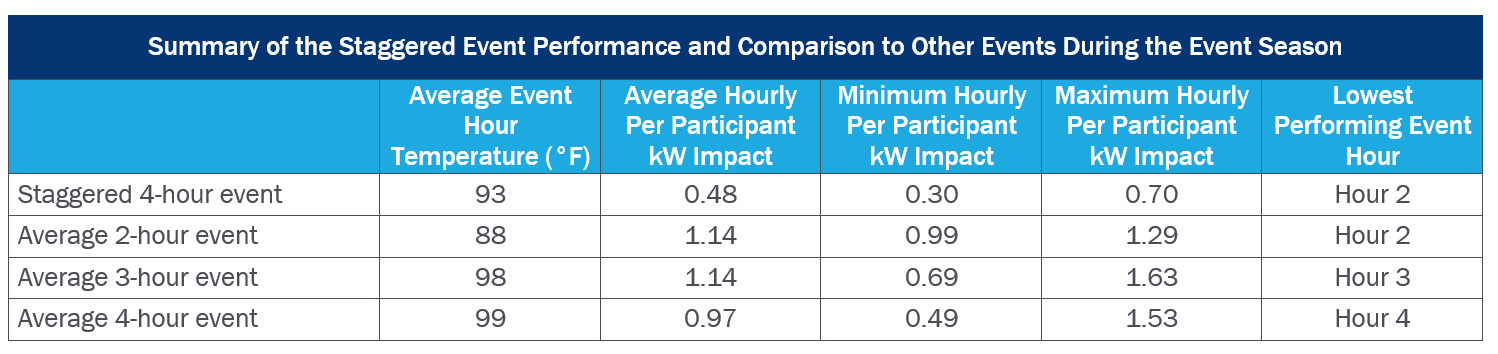
Figure 3. Simulated Changes in Load Impacts Given Pre-Conditioning Changes
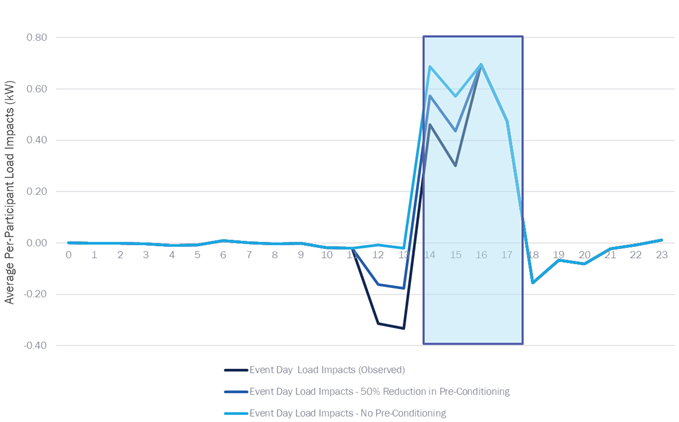
A deeper analysis of hourly load impacts shows that changes in pre-conditioning settings for Group B can result in meaningfully different load impacts. More specifically, we simulated event day load shapes with reduced preconditioning for Group B (reduced in half, staggered earlier in the day, and eliminated scenarios). We found that the load impacts from the lowest performing hour would be on par or better (when adjusted for differences in weather) with what’s been observed during the other four-hour event dispatched during the season. While the overall average load impacts under the simulated dispatch would still remain lower than under normal dispatch (recall that half of the population does not get curtailed at any given event hour and their load impacts for any given hour are effectively zero), the benefit of the staggered event is that NO participant would experience four hours of curtailment, which helps reduce the likelihood of participant discomfort and contribute to overall positive participant experiences during DR events. More importantly, If the goal of the event is to deliver load impacts optimized for capacity market bidding and customer experience, staggered events can present a viable solution. With additional testing and tweaking, staggered events can become a positive addition to a utility’s toolkit of load curtailment approaches.
For more information:
To learn more about the opportunities to optimize your direct load control DR programs and better set up testing and experimentation of the load curtailment strategies, contact Kessie Avseikova, Vice President, Demand Flexibility Innovation, at: kavseikova@opiniondynamics.com
Be in the know first!
Get in-depth insights delivered right to your inbox! We understand your inbox and time are valuable, and we only want to provide content that speaks to you on the topics you’re most interested in. We’ve got some incredible projects in the works; join our mailing lists to be in the know first about our findings!