
TECH CLEAN CALIFORNIA WIKI
TECH Clean California Heat Pump Equipment: Insights into Customer Experience and Satisfaction
September 15, 2023
Executive Summary
The Technology and Equipment for Clean Heating (TECH) Initiative is a $120 million pilot program designed to help advance California’s mission to achieve carbon neutrality by driving the market adoption of low-emissions space- and water-heating technologies for existing single-family and multifamily residential homes. The TECH Initiative, publicly known as TECH Clean California, began in late 2021 and incentivizes the installation of heat pump water heaters (HPWHs) and heating, ventilation, and air conditioning (HVAC) heat pump equipment in existing California homes. As the developmental evaluator, Opinion Dynamics had the opportunity to investigate TECH customers’ satisfaction and experience with the heat pump equipment. With an improved understanding of the customer experience, we can pinpoint what is needed to ensure customer acceptance of the equipment and expand the market for home electrification products.
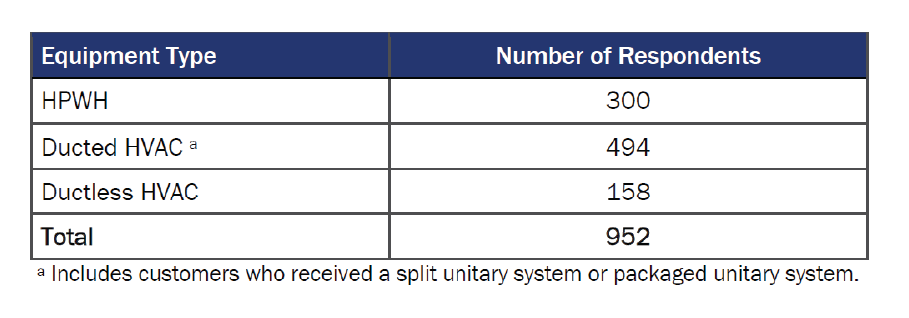
Opinion Dynamics conducted an online survey in November and December of 2022 with single-family homeowners and renters who received a TECH-incented, or subsidized, HPWH or HVAC heat pump. The objectives of the survey were to capture their experience with their new heat pump equipment, understand any issues they may have encountered, and see if they noticed any changes to their utility costs. We invited 4,148 TECH customers and received 952 survey completes for an overall response rate of 23%. Table 1 shows the survey responses by heat pump equipment type.[1]
[1] A small minority of TECH customers (300 of 10,250; 3%) received both a HPWH and an HVAC heat pump. Customers who purchased more than one type of heat pump were asked about their HPWH in the survey because there were many fewer HPWH customers than HVAC heat pump customers. All customers were asked about one type of heat pump in the survey (either HPWH or HVAC heat pump).
Table 1. Survey Completes by Heat Pump Equipment
Here, we share key findings for HPWHs and HVAC heat pumps and then offer conclusions and recommendations.
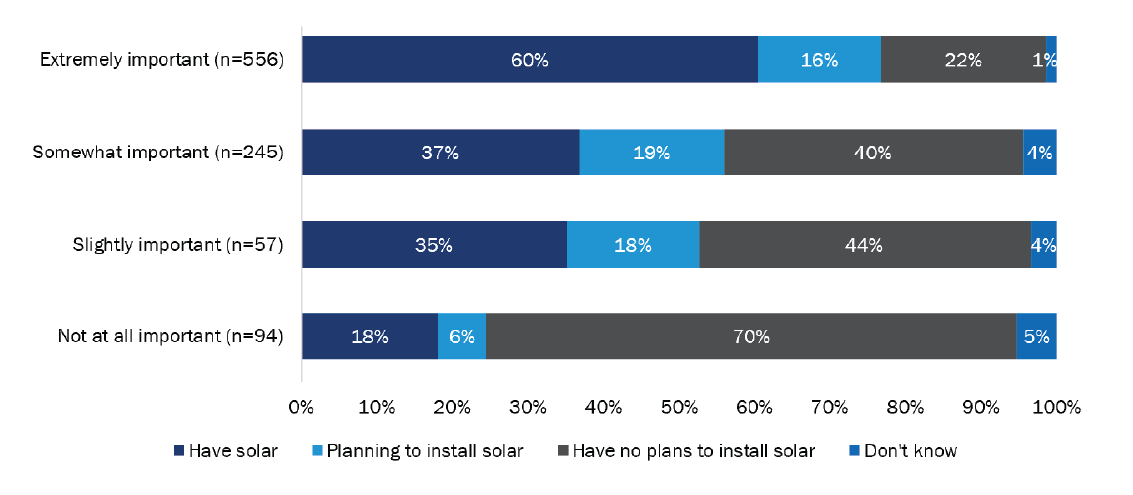
Whether the space-conditioning or water-heating equipment used electricity was an important purchasing consideration for TECH customers with solar PV; for those without solar, it was not that important to them that their new equipment was electric. More than three-quarters (427 of 952; 76%) of respondents for whom it was “extremely important” that their new equipment use electricity already had solar or planned to install it in the near future, while the majority of those for whom it was “not at all important” had no plans to install solar.
HPWH Findings
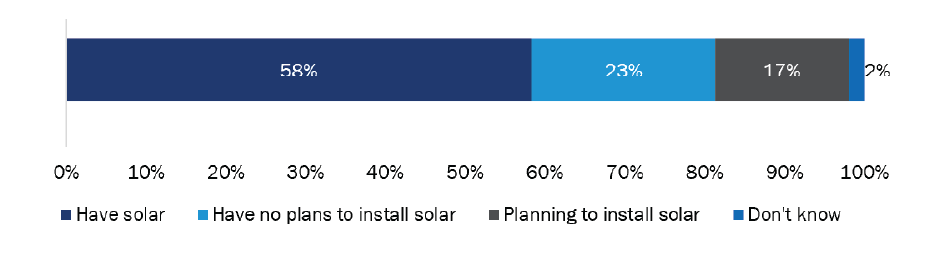
Rooftop solar was commonplace among the TECH customers who purchased a HPWH. Of the 300 respondents, three-quarters either already had a solar PV system (58%) or were planning to install solar in the near future (17%).
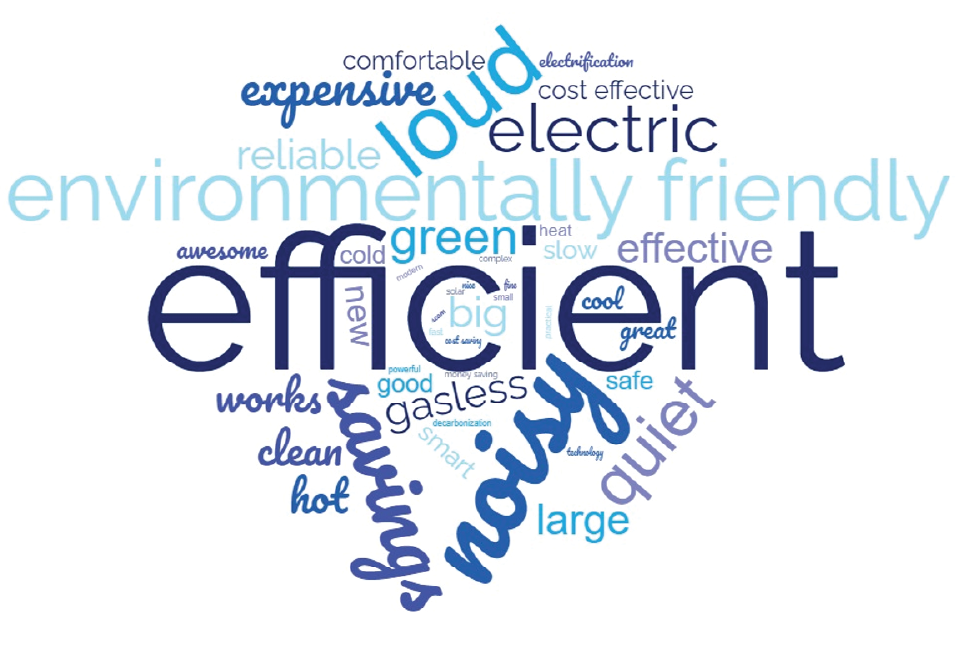
Customers noted a mix of positive and negative features about their HPWHs. The positive features TECH customers mentioned were that HPWHs are efficient, environmentally friendly, and save them money on their energy bills (“savings”). Negative aspects included that the equipment is noisy, expensive, and large.
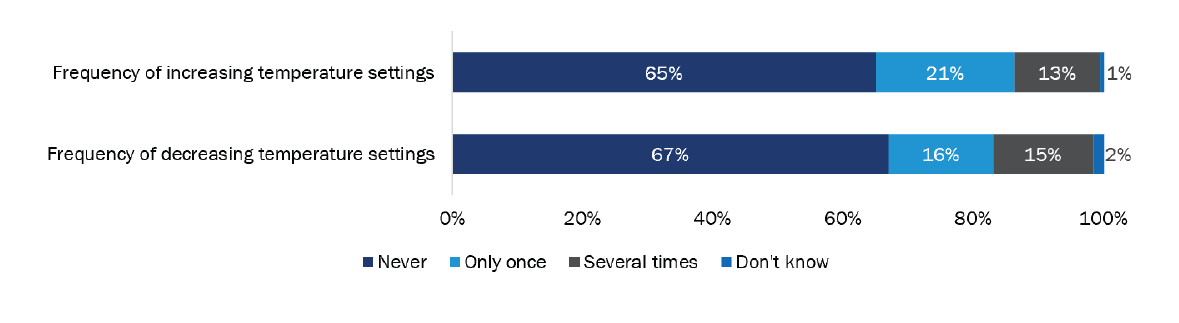
Most customers had not adjusted the HPWH operating mode (60%) or the temperature settings (67%). Nearly one-fifth (23 of 118; 19%) of customers who adjusted their mode did so to avoid running out of hot water. The most common reasons for changing the mode, however, were leaving for vacation or achieving higher operating efficiency. There was no correlation between the operating mode and the frequency of adjustments. About one-fifth adjusted the temperature one time, while about one-eighth adjusted the temperature several times.
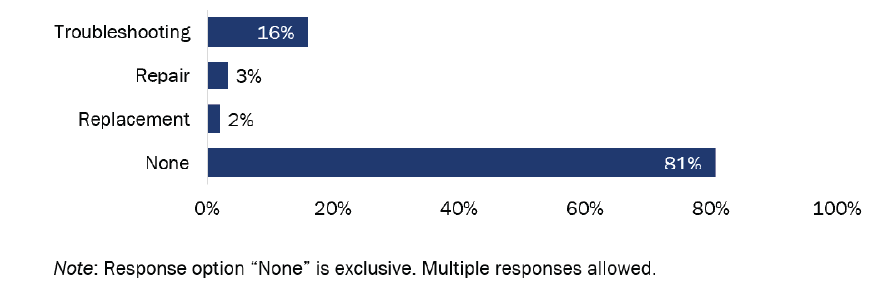
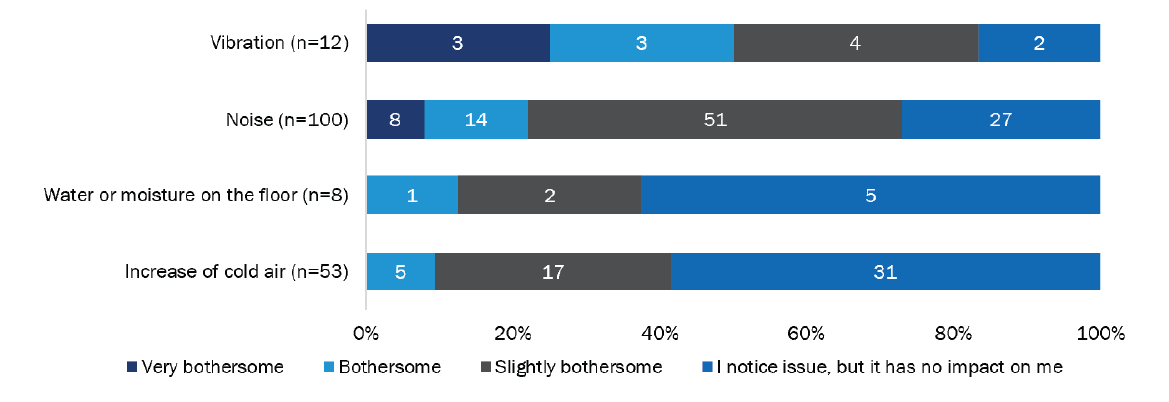
Most HPWH customers (242 of 300; 81%) did not need to repair, replace, or troubleshoot issues with their equipment. However, 16% (48 of 300) had at least one issue that required troubleshooting, and 3% (10 of 300) required repairs. The most common HPWH issues that required troubleshooting were difficulties with the user app or Wi-Fi connection (18 of 58; 31%) or issues with noise and vibration (17 of 58; 29%). Vibration issues were the most bothersome of all issues reported but affected a small number of customers (3 of 12 experiencing the issue rated it as “very bothersome”). While one-third of HPWH customers noted noise issues (100 of 300), it was only bothersome or very bothersome to 22% of them.
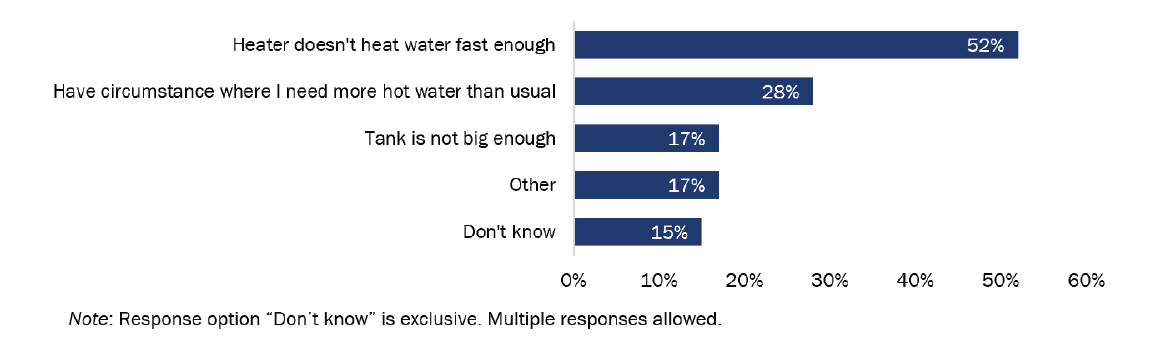
Most customers had enough hot water to meet their households’ needs (245 of 300; 82%). Of those with hot water limitations, 52% (28 of 54) believed the tank size or heating speed of their HPWH caused them not to have enough hot water. Alternatively, 28% (15 of 54) reported circumstances where their home needed more hot water than usual, suggesting no fault of the equipment itself.
Half of HPWH customers’ monthly energy bills went down (152 of 300; 51%), though, most of those perceiving a decrease had rooftop solar (72% of the 152). While 24% said their monthly energy bills stayed about the same when considering gas and electric bills combined, 19% were unsure. Of those who said their monthly energy bills were higher than before the HPWH, their most common reason for the increase was that their electric utility had increased rates. Almost three-quarters (109 of 152; 72%) of HPWH customers whose monthly energy bills went down mentioned they have solar PV.
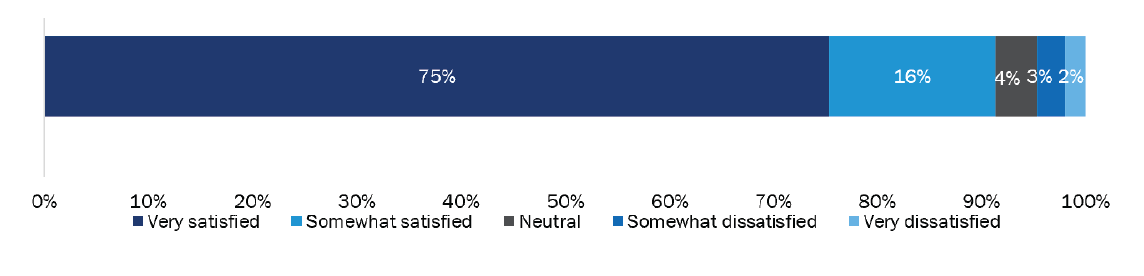
Three-quarters of respondents (226 of 300) chose the highest level of satisfaction with their HPWH. The minority of respondents (14 of 300; 5%) who expressed dissatisfaction with their equipment explained this was due to lack of savings and high operating costs (five respondents), hot water limitations (five respondents), noise from equipment (five respondents), and complicated operation of the equipment (one respondent).
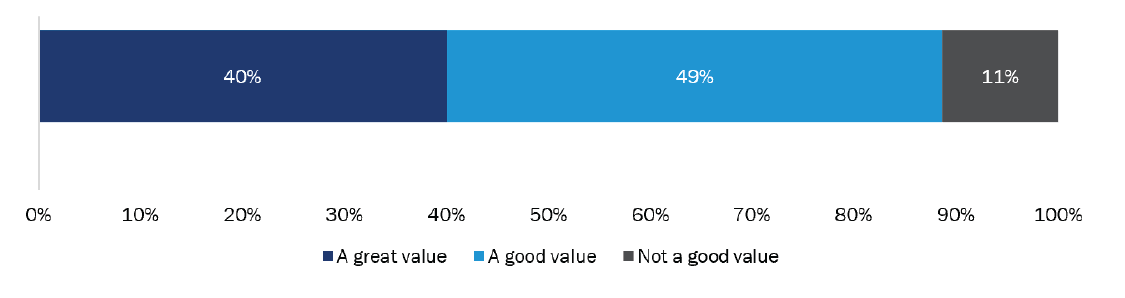
Most TECH customers found their HPWH to be a good investment and are likely to recommend it. Forty percent of TECH customers rated their HPWH as a great value, and 49% rated it a good value. The most common reasons for rating the HPWH as “not a good value” were the high upfront cost (26 of 34), a high electricity bill (17 of 34), or issues with hot water availability (7 of 34). Half (154 of 300; 51%) of respondents were extremely likely to recommend a HPWH to others, answering with a 10 on a scale from 0 to 10. The average “likelihood to recommend” rating across all 300 customers was a 9 of 10.
HVAC Heat Pump Findings
A majority of HVAC heat pump customers had rooftop solar or plans to add it. Just under half of HVAC heat pump customers had rooftop solar on their home (49% with ductless heat pump and 43% with ducted heat pump). Of those without solar, nearly one-third had plans to install it (30% with ductless heat pump and 29% with ducted heat pump).
Customers noted a mix of positive and negative features about their HVAC heat pump. The positive features customers mentioned about their new HVAC heat pump included that it was efficient, quiet, and reliable. In contrast, negative aspects included that the equipment was expensive, noisy, and slow.
Most TECH customers who purchased a ductless system did not have central air conditioning before (95 of 158; 60%), while most who purchased a ducted HVAC heat pump had central air conditioning before (400 of 494; 81%). Half of ductless heat pump customers reported that a comfort-related motivation for selecting the ductless heat pump was to add cooling where previously there was none. One-third of ductless heat pump customers chose that system type for the zoned temperature control capabilities (54 of 158; 34%).
Both ducted and ductless HVAC heat pumps have been effective when heating and cooling customers’ homes. When asked to rate the cooling effectiveness of their heat pump using a scale from zero (not at all effective) to 10 (extremely effective), most rated it an eight or higher for ducted (404 of 461; 88%) and ductless systems (132 of 148; 89%). Using the same 0 to 10 scale, most customers provided a heating effectiveness rating of eight or higher for ducted (310 of 399; 78%) and ductless systems (116 of 140; 83%). Customers with ductless systems were more likely to say their heat pump was “extremely effective” for both heating and cooling than those with ducted systems.
Most HVAC customers received a new thermostat along with their heat pump (582 of 652; 89%), and most found their new thermostat to be similar or easier to operate than their old one. However, a quarter of ductless heat pump customers found the new thermostat more difficult to operate (41 of 158; 26%). These customers may be referring to the remote control, which can be a big departure from a wall-mounted thermostat. Nearly half (237 of 494; 48%) of ducted HVAC customers adjusted their thermostat less often than their prior system, while 17% (84 of 494) said they never adjusted their thermostat.
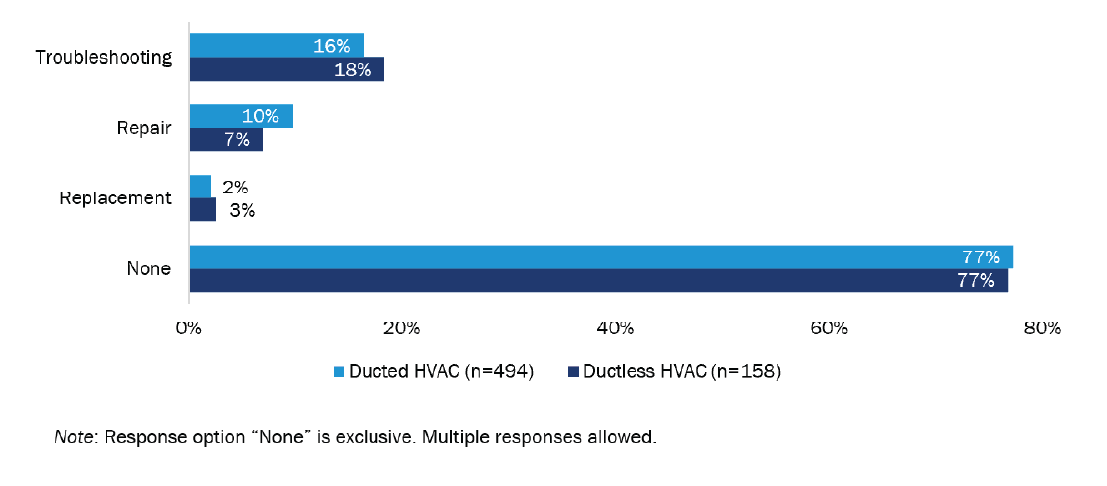
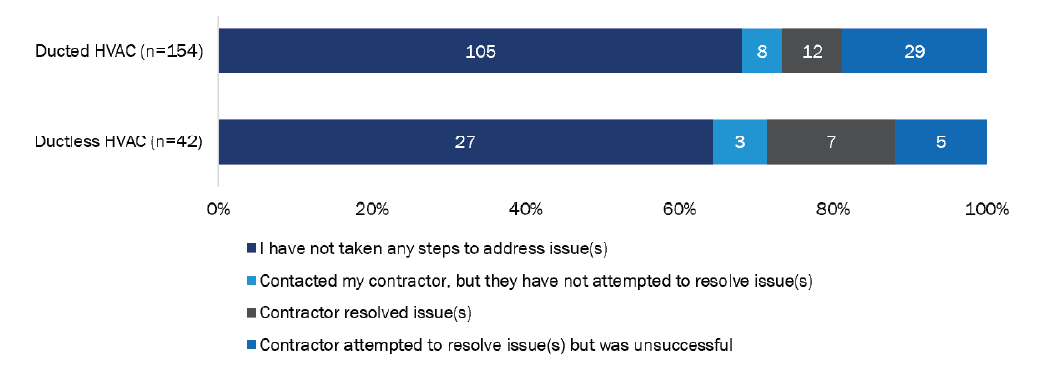
While most customers reported no issues with their HVAC heat pump (502 of 652; 77%), a sizeable percentage (150 of 652; 23%) reported issues. Of those who had an issue, often, the contractor troubleshooted the issue to resolve it: 70% of the issues with ducted heat pumps (81 of 115) and 81% of the issues with ductless heat pumps (29 of 36) required troubleshooting. Issues with the HVAC equipment were so severe for 14 people (2%) that the entire unit was replaced. The remaining cases reportedly required a repair. In cases where the customer contacted a contractor about the problem, there was nearly double the success rate resolving issues with ductless systems (7 of 15; 46%) than ducted (12 of 49; 24%), though these sample sizes are small.
Of the 151 HVAC heat pump customers who experienced an issue, the most common type was an issue caused during installation (n=46, 30%). Heat pumps are new to many contractors, and with more knowledge and expertise, some of the issues can be avoided. Examples included incorrect wiring, improper plastic fitting, not flushing the drainpipe to avoid clogging, incorrect setting of air handler, and errors with ductwork. Other issues included insufficient heating/cooling reported by 35 customers, or an issue with the thermostat reported by 32 HVAC customers.
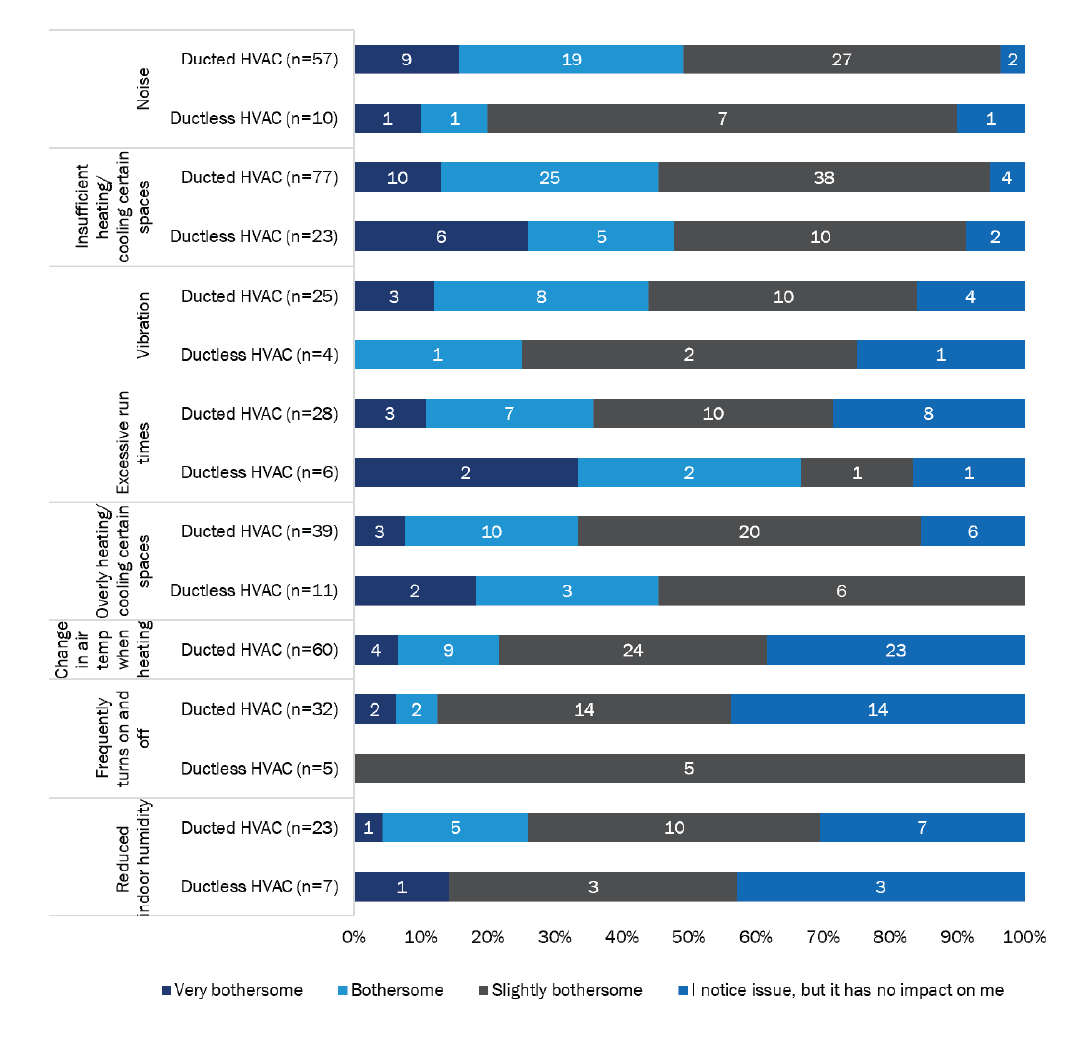
Most respondents’ HVAC issues were noticeable but not bothersome. Respondents were most bothered by excessive run times, and insufficient or overly heated/cooled spaces in their home. For ducted HVAC systems specifically, noise and vibration were also among issues most bothersome to respondents.
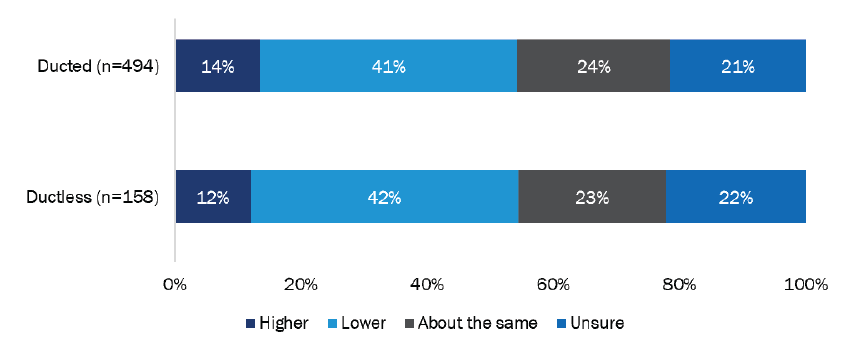
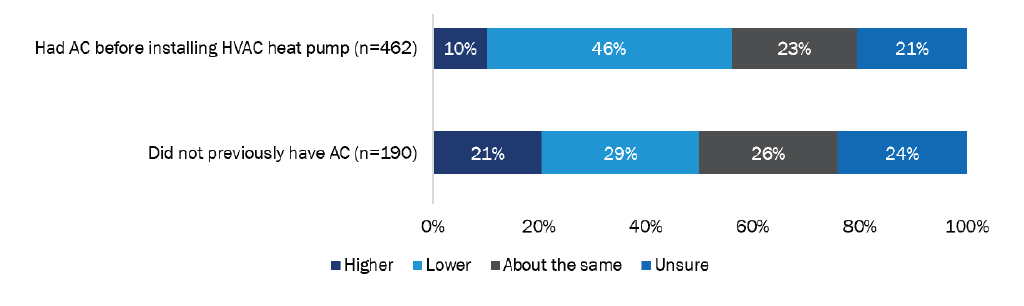
HVAC customers were more likely to perceive a decrease in monthly energy bills if they had air conditioning before the heat pump or if they have solar PV. A minority of HVAC customers (13%) said their monthly energy bills went up, while one-quarter (25%) said their monthly bills remained the same, and two-fifths (41%) said they had decreased. (The remainder (19%) were unsure about bill changes.) Over half (154 of 268; 57%) of customers whose monthly energy bills reportedly went down have a solar PV system that generates electricity for their homes. Those who had air conditioning before the heat pump were also more likely to perceive their bills decreased than those who did not previously have air conditioning. Respondents were instructed to consider both gas and electric utility bills combined, if applicable.
Overall, HVAC customers were likely to recommend a heat pump to others. In fact, half (323 of 637; 51%) indicated they were extremely likely to recommend it, answering with a 10 on a 0 to 10 scale (zero was “not at all likely” and 10 was “extremely likely”). More than a third (232 of 637; 36%) were likely to recommend an HVAC heat pump, providing a rating of 7 to 9. The average rating score across respondents with a ducted system was an 8; respondents with a ductless system was a 9.
Poor performance was the top reason customers were unlikely to recommend an HVAC heat pump (19 of 82), followed by the high upfront cost (15 of 82), and lack of monthly bill savings (9 of 82). Customers who were unlikely to recommend the heat pump (82 of 637; 13%) reported that their system failed to operate as designed or as expected and has not sufficiently heated or cooled the home. In some cases, respondents said their system’s performance is inconsistent, such that either the system operates correctly a portion of the time, or it operates better or worse depending on the space in the home (specific to ductless systems).
Customers were more likely to rate their HVAC heat pump as a “good value” rather than a “great value.” While a minority of customers said their heat pump was “not a good value” (49 of 651; 8%), their reasons were tied to high electricity bills (26 of 49; 53%), the high upfront cost (17 of 49; 35%), and complicated operation or insufficient heating/cooling.
Conclusions and Recommendations
Conclusion: The factors causing the greatest dissatisfaction with the HPWH purchase included the high upfront cost and a high electricity bill. Customers who paid a premium for the equipment may seek to recoup some of that investment via an expectation of reduced monthly energy bills, and if those financial savings are not realized, that can lead to dissatisfaction with the equipment. At the same time, many of those who were “extremely likely” to recommend a HPWH found it to be cost-effective. Notably, most surveyed HPWH customers whose monthly energy bills went down had solar PV, suggesting that those without solar PV may be paying more to heat their water than before due to the relatively lower cost of natural gas.
-
- Recommendation: We suggest TECH contractors inform customers who purchase a HPWH about Time-of-Use (TOU) rates if they are not already on those rate plans because they afford additional baseline allocations for heat pump customers. The CPUC and TECH implementers may also want to consider exploring ways to encourage customers to install solar PV at the same time they are purchasing a HPWH. The PV and HPWH are complementary and, together, can result in higher customer satisfaction with HPWHs and lower utility bills. Pairing incentives for HPWHs with solar PV or developing synergies between HPWH contractors and solar contractors may be fruitful for expanding home electrification.
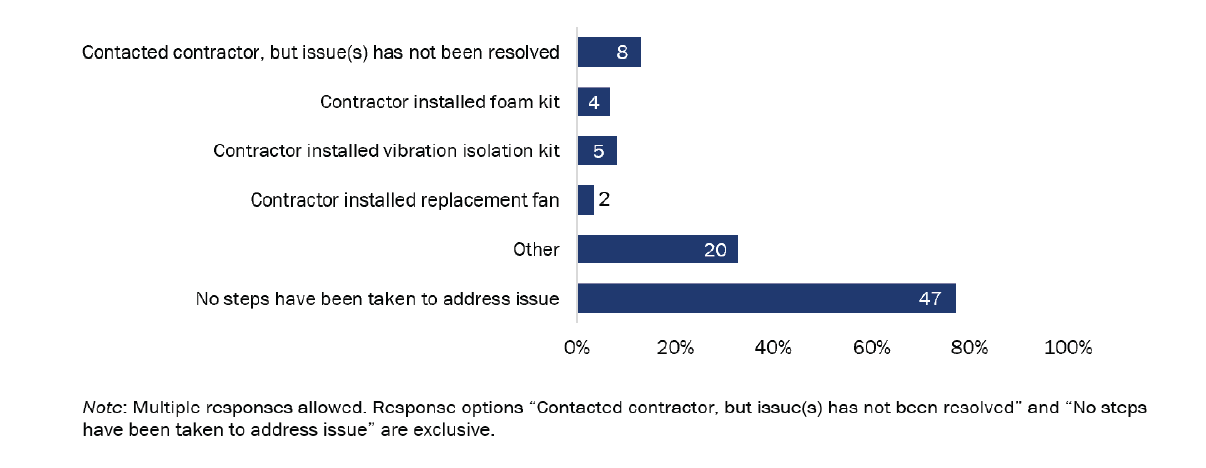
Conclusion: Though representing a minority of cases, the most common HPWH issues surveyed TECH customers reported derived from something that occurred during installation. Noise and vibration issues were common, but surveyed customers also reported plumbing issues, leaks from pipes, and condensate issues. Noise from the HPWH was noticed by one-third of customers (100 of 300), and it bothered most of them (73 of 100). Vibration issues were only noted by 12 customers but were more bothersome to them. Even so, of the 61 customers bothered by HPWH issues, most (47) had not taken any steps to address the issue. For 11 customers, the contractor came back to the home and installed a foam kit, vibration isolation kit, or a replacement fan to address the issue.
-
- Recommendation: The TECH Initiative should ensure the organizations they partner with to provide HPWH training include instruction on how to avoid noise and vibration issues as well as leaks. The training should focus on installation practices that reduce noise and vibration issues such as not installing the HPWH near a bedroom wall or installing a vibration isolation kit.
Conclusion: Some surveyed customers reported difficulty controlling their HPWH via the user app or its Wi-Fi connection. These customers were frustrated that they could not access the functionality to adjust the water temperature, generate the intended reports, or consistently use the app.
-
- Recommendation: The TECH Initiative should take advantage of the relationships made with HPWH manufacturers to provide feedback on the usability of the user app and smart equipment features. We recommend the TECH Initiative staff request manufacturers provide online user manuals in different languages about how to best control the equipment and effectively use the equipment’s app.
Conclusion: Ductless heat pumps were rated as more effective and having fewer problems than ducted equipment, and ductless customers were more satisfied. Surveyed ductless heat pump customers were more likely than ducted heat pump customers to rate the equipment as “highly effective” for both heating (50% vs. 36%) and cooling (59% vs. 46%). Fewer equipment issues were reported by customers with ductless systems than ducted (35% vs. 47%). And, more ductless customers were “very satisfied” with their heat pump than ducted (78% vs. 70%).
Conclusion: Whether a surveyed customer had air conditioning before their heat pump was a stronger predictor of lower energy bills than whether they bought a ducted or ductless system. Nearly half (46%) of those with air conditioning before reported a decrease in their bills, while fewer than one-third (29%) without air conditioning prior experienced a decrease. Surveyed HVAC heat pump customers were more likely to rate their equipment as a “good value” rather than a “great value.” Reasons why the remaining customers said their heat pump investment was “not a good value,” included high electricity bills and the high upfront cost.
Conclusion: HVAC heat pump performance is different enough from furnaces that customers should be advised about what to expect in terms of run times and the air temperature coming out of the vents. Surveyed HVAC customers noticed that the air coming out of the vents was not as hot as it had been with a furnace and that their heat pumps ran longer to heat up the home. About two-thirds of customers who noticed the change in air temperature from the vents were bothered by it (37 of 60). Heat pumps heat the air to about 95°, which is about 30°lower than furnace air.[2]
-
- Recommendation: Contractors should educate their customers about these differences during the sales process. Setting the customers’ expectations in advance should reduce the number of callbacks and hopefully lead to a more satisfied customer.
Conclusion: A sizeable minority of surveyed HVAC heat pump customers needed the TECH contractor to come back and troubleshoot an issue. About one-quarter of surveyed customers experienced an issue with their HVAC heat pumps for which they needed to contact a contractor. In the majority of those cases, the contractor addressed the issue with troubleshooting. The three most common issues were an error during installation (such as incorrect wiring, incorrect setting of air handler, and errors with ductwork), insufficient heating or cooling, and thermostat issues.
[2] Bailes, Allison A. 2022. A House Needs to Breathe… Or Does It? Bright Communications: Hellerton, PA.
1. Introduction and Methods
The TECH Initiative is a $120 million pilot program designed to help advance the state’s mission to achieve carbon neutrality by driving the market adoption of low-emissions space- and water-heating technologies for existing single-family and multifamily residential homes. The Initiative was created as part of California Senate Bill 1477 and is funded by revenues collected through California’s Cap-and-Trade program. Through a combination of market incentives, supply chain engagement, workforce development, consumer education, regional pilots, and Quick Start Grants, the initiative installs low-emissions space- and water-heating technologies in existing California homes. The TECH Initiative officially launched in December 2021 and is publicly known as TECH Clean California. Opinion Dynamics is serving as the developmental evaluator for the TECH Initiative.
To be eligible for TECH incentives, households must reside in one of the gas Investor Owned Utility territories. All incentivized heat pumps must be installed by a contractor enrolled in TECH. To be eligible, California contractors had to meet licensure and insurance requirements. The General B, C20, and C36 licensed contractors are eligible for HPWH incentives, while General B and C20 are eligible for HP HVAC incentives. The TECH Initiative had a complex incentive structure in its first several months, whereby the incentive amount fluctuated based on whether the heat pump qualified for incentives through another program. We detail the incentive structure in an Interim Process Evaluation Report.[3] The incentives for HVAC heat pumps ranged from $3,000 to $4,800 and between $1,000 and $3,100 for HPWH. The Interim Process Evaluation also contains findings about homeowners’ reasons for reaching out to a contractor and their experience with the heat pump installation.
About one year into the Initiative, we had the opportunity to study how well the heat pump equipment was serving the needs of property owners who participated in TECH. This research aimed to capture customers’ experience with their new heat pump equipment, understand any issues they may have encountered, and see if they noted any changes to their utility costs. Our findings support an improved understanding of which factors influence customer satisfaction with heat pump equipment and will allow us to suggest program refinements to ensure customer acceptance of this equipment. We anticipate that broad customer acceptance and satisfaction will lead to positive word of mouth and will support the expansion of the heat pump market in California.
Opinion Dynamics conducted an online survey with single-family homeowners and renters who received a TECH-incented HPWH or HVAC heat pump. In November and December of 2022, Opinion Dynamics invited 4,148 customers who had a TECH-enrolled contractor install new heat pump equipment in their homes to take the survey. We targeted customers who, according to their installation date, were likely to have had the equipment installed for at least six months. This timing would have allowed HVAC heat pump owners to have operated their equipment in both heating and cooling seasons, permitting them to experience the full range of performance of their HVAC equipment.
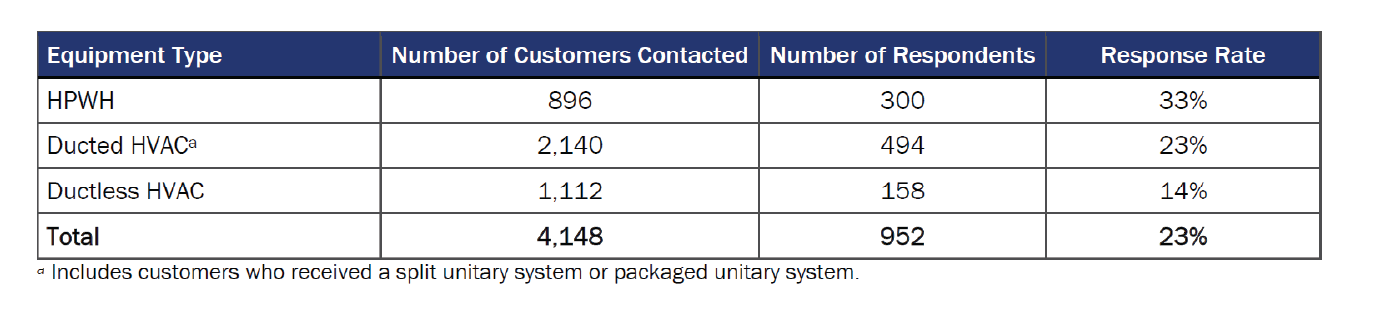
We sent one email invitation and up to two email reminders to each customer. A total of 952 customers completed the survey, resulting in a 23% response rate (Table 2). Respondents received a $15 gift card for completing the survey.
[3] The Interim Process Evaluation can be found here: https://techcleanca.com/documents/991/TECH_Interim_Process_Evaluation_Final_Report.pdf
Table 2. Customers Who Were Invited and Completed the Survey by Equipment Type (n=952)
The survey findings reflect the experiences of customers with heat pump equipment installed between August 27, 2021, and July 6, 2022.[4] Ducted HVAC heat pump survey data includes responses from customers who installed either a split unitary or packaged unitary system. We define the three types of heat pump systems incentivized by TECH below.
-
- Heat pump water heater: These are sometimes referred to as hybrid electric water heaters. They use electricity to extract heat from the surrounding air and transfer it to water in its tank. They can be up to three times as efficient as conventional electric resistance water heaters. They typically have three modes: heat pump mode, electric resistance mode, and a hybrid mode that uses both heating elements (the heat pump and the backup electric resistance element).
- Ducted HVAC, split unitary system: As the most common type of heat pump, these systems look just like air conditioners. The indoor unit connects to the central ducting of the home. The compressor can be single-speed, two-speed, or variable speed, and its efficiency increases in multi-speed systems.
- Ducted HVAC, packaged unitary system: This heat pump system contains all components in a single “package” and connects to the home’s ductwork. Due to the units being installed outside of the home, this is a good option for those with limited indoor space. Although typically installed on the ground, packaged units can also go on rooftops.
- Ductless HVAC: Mini- or multi-split systems are smaller versions of the unitary split system, and each indoor unit usually serves one room or space in the house. The indoor unit can be wall-mounted, which avoids the need for ductwork. Multi-split systems have multiple indoor units connected to a single outdoor unit.
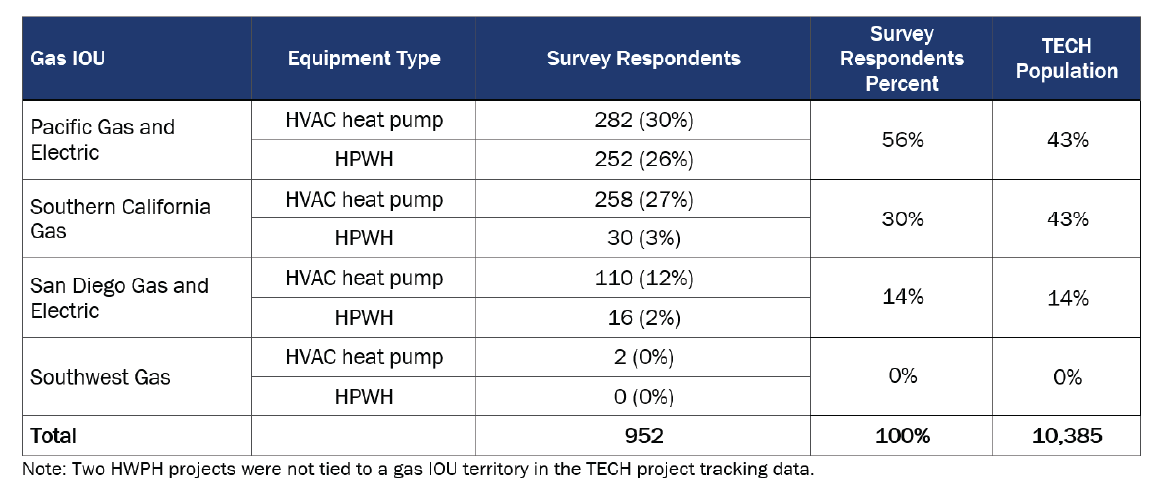
Most surveyed TECH customers were in PG&E’s gas service territory, including the majority of HPWH customers who responded to the survey (252 of 300; 84%) (Table 3). This breakdown is consistent with the population of TECH customers, whereby most HPWH customers were in the PG&E territory and just under half of HVAC heat pump customers were in the SCG territory.
[4] The TECH Initiative allowed contractors who enrolled early to apply incentives to qualifying heat pump projects as early as August 2021.
Table 3. Survey Respondents by Gas IOU
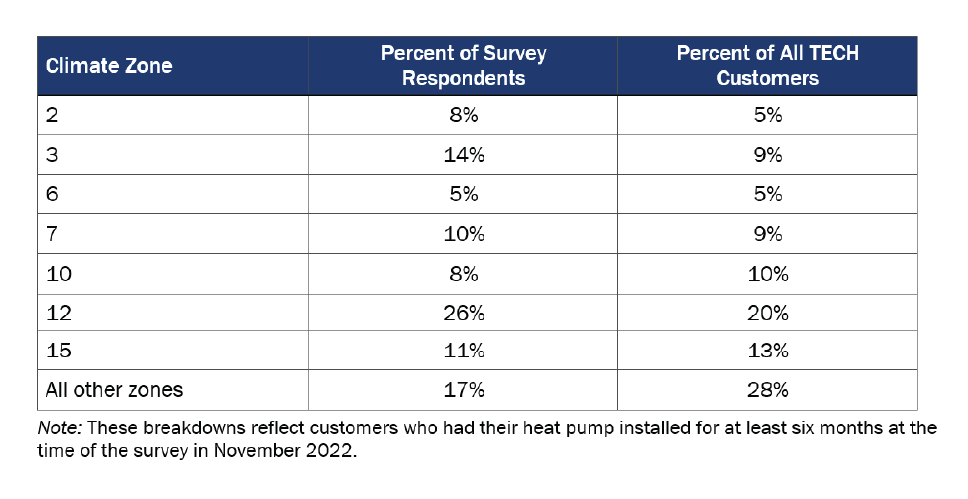
The TECH customers we surveyed were mostly in climate zones 3, 12, and 15 (Table 4). Climate zone 3 is the Bay Area that has moderate temperatures year-round with precipitation in the winter and fog likely in the summer. Climate zone 12 has cooler winters and hotter summers than the Bay Area. And, climate zone 15 is the low desert which has very hot and dry summers with moderately cold winters. A distribution breakdown for all 16 climate zones by equipment type is available in Appendix B.
Table 4. Survey Respondents and TECH Population by Climate Zone
Please keep in mind that the findings we share are reflective of the sample of customers that responded to the survey and TECH participants. The findings are not intended to be extrapolated to the population of California homeowners.
2. Findings
In this section, we present findings about customers’ motivations for selecting heat pump equipment and their experiences using the new heat pump equipment in their homes. We start by presenting motivations overall then split out the experience with the equipment by water-heating heat pumps and space-conditioning heat pumps.
2.1 Motivations for Selecting Electric Equipment
The fact that the heat pump uses electricity was an important decision-making factor for TECH customers. The level of importance varied considerably depending upon whether the customer had solar PV at their house (Figure 1). For most of those with solar, it was extremely important that their new heating equipment used electricity, while for those without solar and no plans to add solar, it was not at all important to most of them that the equipment used electricity. More than three-quarters (427 of 952; 76%) of respondents who reported it was extremely important that their new equipment use electricity already had solar or planned to install it in the future, while the majority of those who found it not at all important had no plans to install solar.
Figure 1. Importance that Equipment Uses Electricity by Customer Plans for Solar (n=952)
We asked respondents to tell us why it was important that their new equipment used electricity rather than natural gas. Table 5 lists their reasons, as provided in open-ended responses.
Table 5. Reasons it Was Important to Customers That New Equipment Use Electricity Instead of Gas (n=853)
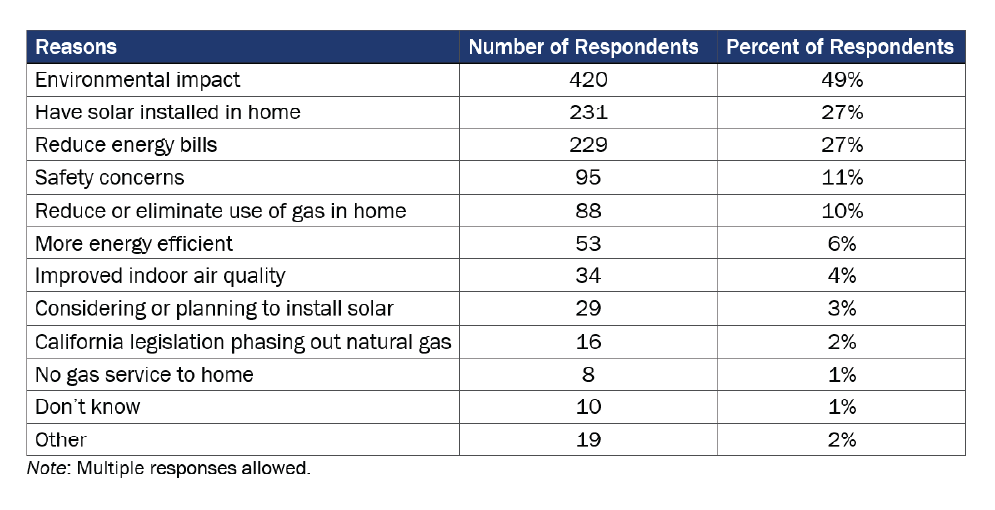
We elaborate and summarize the reasons customers described in the survey below.
-
- Environmental impact (420 of 853): Reducing the use of fossil fuels to power home appliances is a key step in mitigating climate change. These respondents expressed excitement in working towards electrifying their home to decrease their carbon footprint, do their part in reducing pollution, and taking advantage of renewable energy on the electric grid.
- Have solar installed in home (231 of 853): These customers, who run home appliances off self-supplied solar energy, wanted to earn energy independence from their utility. Solar energy was also acknowledged to be less costly than purchasing energy from a utility provider, enabling customers to decrease their monthly energy bills when using appliances powered by electricity. A few customers also mentioned they had battery storage for their solar-generated electricity, allowing them to store electricity surplus until needed.
- Reduce energy bills (229 of 853): This category included responses of customers who were moving to electric appliances as a way to reduce their energy bills specifically because of the rising cost of natural gas.
- Safety concerns (95 of 853): Gas lines and gas-powered appliances can develop leaks that can be dangerous and combustible. Responses coded here included concerns with carbon monoxide exposure and methane leaks. Electric-powered appliances provide these customers with a sense of relief by eliminating this threat in their home.
- Reduce or eliminate use of gas in home (88 of 853): This category includes responses that mentioned a desire to reduce or eliminate gas as a fuel source in the home but did not specify why.
- More energy efficient (53 of 853): These customers appreciated appliances that operate efficiently, generally resulting in less run-time and lower energy bills. In many cases, this category overlapped with answers coded under environmental impacts as customers equated a decrease in energy use with a smaller carbon footprint.
- Improved indoor air quality (34 of 853): This category includes explicit mentions of indoor air quality. Respondents who mentioned this topic identified how electricity does not off-gas particulates into the air the way burning natural gas does.
- Considering or planning to install solar (29 of 853): Customers in this group were already planning to install solar prior to selecting their heat pump, which piqued their interest in selecting all electric appliances for their home, such as a heat pump. Many responses we categorized here also acknowledged how installing solar in the future could be advantageous in helping them gain energy independence and lower their monthly bills.
- California legislation phasing out natural gas (16 of 853): A few respondents recognized that the State of California is phasing out natural gas. These respondents acknowledged that installing an electric appliance now would likely save themselves the trouble of converting before the State bans natural gas as a fuel for home appliances (likely before the end of their new system’s life).
- No gas service to home (8 of 853): A handful of respondents indicated gas service is not available in their location.
- Other (19 of 853): Responses coded here were less common and generally vague, such as greater control over equipment’s operation, mentioning they received a recommendation and/or rebate for equipment, and that their electric heat pump was more convenient than continuing to get propane tank refills. We also categorized responses that did not indicate strong feelings about their system using gas or electricity here.
2.2.1 Home Features
Survey respondents who purchased a HPWH were primarily homeowners (298 of 300; 99%). The two remaining respondents rented or shared their home with a family member. Nearly all of the TECH-incented HPWHs were installed in customers’ primary residences (294 of 300; 98%).[5]
More than half of residences where a HPWH was installed (175 of 300; 58%) have a solar PV system that generates electricity for the home (Figure 2). A minority of HPWH customers reported they had no plans to install solar in the future (69 of 300; 23%).
[5] Those who had the HPWH in their secondary residence or vacation home reported spending between two and six months out of the year in this home. Among these respondents, half (3 of 6; 50%) evenly distributed the amount of time they spend in their secondary residence throughout the year, and the other half (3 of 6; 50%) visit the home most in the winter.
Key Finding
Three-quarters of customers who purchased a HPWH either already had a solar PV system or were planning to install solar in the near future.
Figure 2. Whether Customers Have or Are Planning to Install Solar (n=300)
2.2.2 Description of Equipment
To capture top-of-mind feedback about the equipment, we asked HPWH customers to list the first three words that came to mind when thinking about their HPWH. As displayed in Figure 3, customers noted many positive features, including that it is efficient, environmentally friendly, and saves them money on their energy bills (“savings”). Negative aspects included that the equipment is noisy, expensive, and large.
Figure 3. Customers’ Top Three Words Describing HPWH (n=300)
2.2.3 Equipment Location
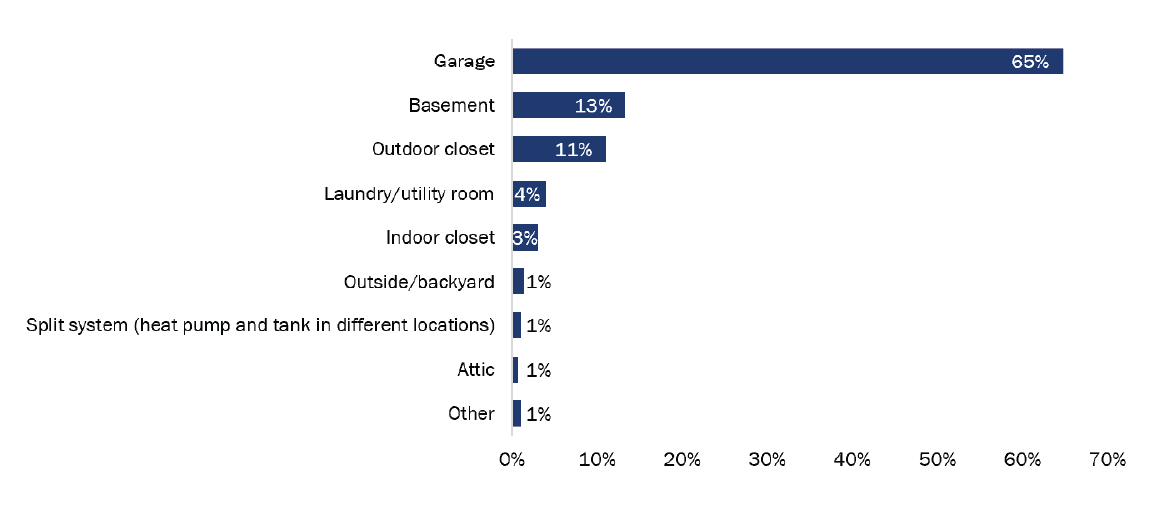
HPWHs were typically located in an unconditioned space in customers’ homes (278 of 300; 93%). The majority (271 of 300; 90%) of HPWHs were located in a space separate from the main living area, such as the garage, basement, or outside of the home in an outdoor closet or backyard (Figure 4).
Figure 4. HPWH Location (n=300)
2.2.4 Equipment Settings
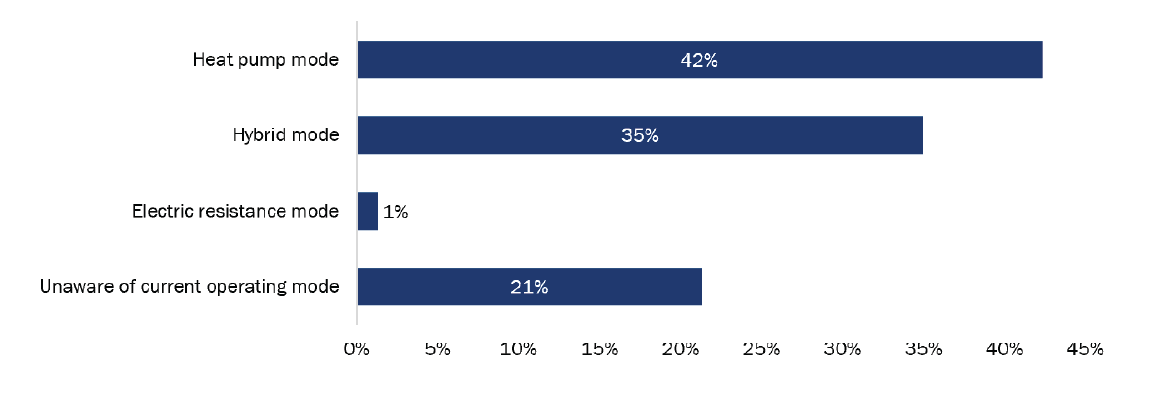
Most respondents knew their HPWH’s current operating mode (Figure 5). HPWHs were most likely to be set on heat pump mode, while just over one-third were reportedly set to hybrid mode. Heat pump mode uses only the heat pump to heat the water (which is the most energy efficient operating mode), while hybrid mode can switch to the electric resistance heater to heat the water faster than on heat pump-only mode (which is less energy efficient). About one-fifth of surveyed TECH customers did not know the current operating mode their HPWH was set to.
Figure 5. Heat Pump Operating Modes (n=300)
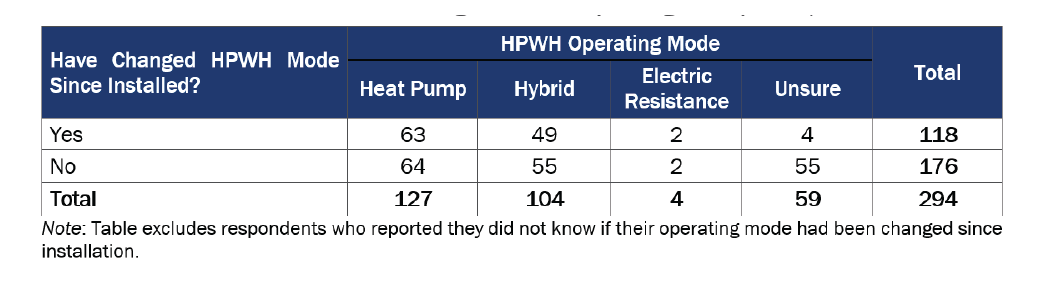
Just over half of respondents had not changed the HPWH operating mode since it was installed (176 of 294; 60%). Those who were unaware of their heat pump mode were very unlikely to have changed the operating mode (55 of 59). Otherwise, those with equipment set to heat pump mode or hybrid mode were about equally as likely to have changed the mode at some point (Table 6).
Table 6. Customer Changes to HPWH Operating Mode (n=294)
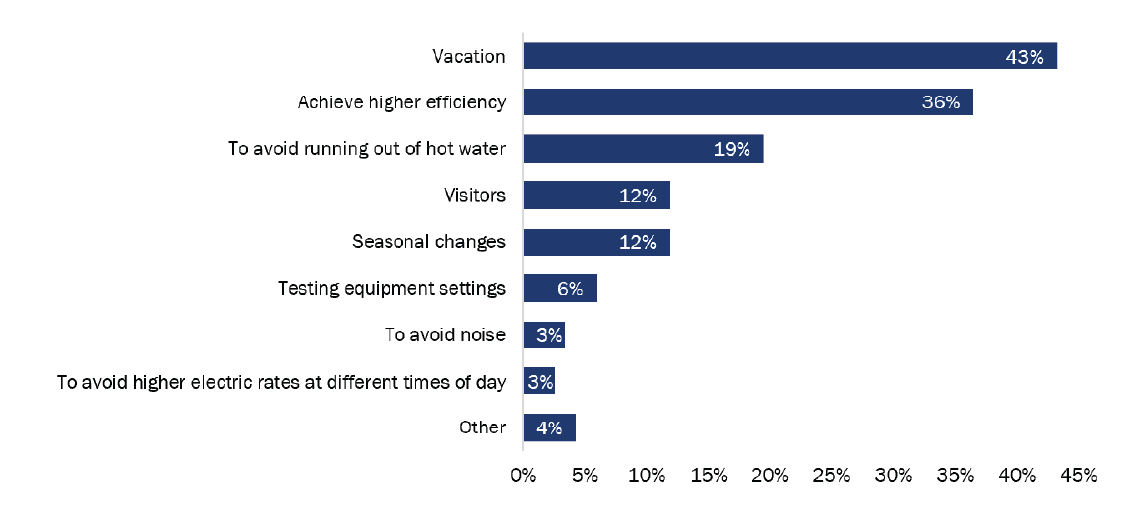
The most common reasons customers had changed the mode included leaving for vacation or to achieve higher operating efficiency (Figure 6). Nearly one-fifth (23 of 118; 19%) of customers adjusted their mode to avoid running out of hot water, suggesting they had already experienced this issue with their new equipment.
Figure 6. Reasons Customers Changed HPWH Operating Mode (n=118)
Most respondents had also not adjusted their HPWH temperature (Figure 7). About one-fifth adjusted the temperature one time, while about one-eighth adjusted the temperature several times.
2.2.5 Issues with Equipment
Most (242 of 300; 81%) HPWH customers did not need to repair, replace, or troubleshoot issues with their equipment (Figure 8). However, 16% (48 of 300) had at least one issue that required troubleshooting and three percent (10 of 300) required repairs.
Figure 8. Work Required on HPWH Equipment Since Installing (n=300)
TECH customers who mentioned needing to repair, replace, or troubleshoot an issue were asked to describe the issue they had. Respondents provided their answers in an open-ended format, which we thematically coded. The most common issues respondents described related to the system’s Wi-Fi connection and online user app, as shown in Table 7.
Table 7. HPHW Equipment Issues (n=58)
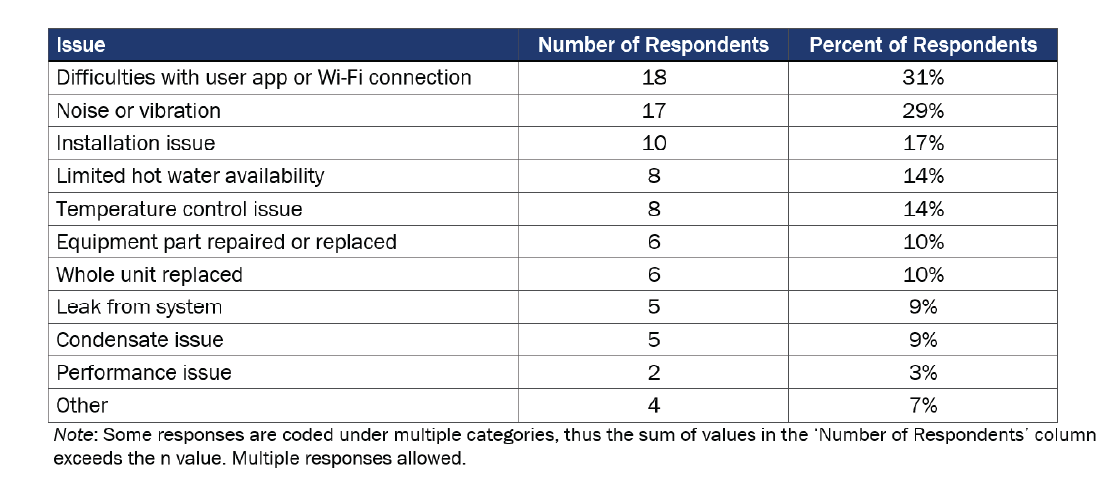
We elaborate on each issue reported by HPWH customers below.
-
- Difficulties with user app or Wi-Fi connection (18 of 58): Across various manufacturers, respondents had difficulty connecting their equipment to their Wi-Fi and controlling their heat pump using the corresponding online app. Responses indicated challenges with apps crashing, producing the intended usage reports, and adjusting water temperature.
- Noise or vibrations (17 of 58): These customers mentioned noisy or vibrating equipment, including shaking pipes, a “loud impeller fan,” a vibrating compressor, and unspecified equipment. One respondent shared that the noise and/or vibration produced by their equipment would escalate in cold weather as the system was working harder to generate heat. More than half of these customers (9 of 17) had a HPWH manufactured by Rheem, and four had a unit manufactured by Ruud.[6]
- Installation issue (10 of 58): HPWHs are advanced water heating systems. Since many contractors have limited experience with HPWHs, it leaves potential for installation errors. As a result, some customers had to schedule follow-up visits with contractors to address issues that could have been avoided if the contractors had adequate knowledge and expertise. Some examples included incorrect plumbing, not aligning with building codes, and installing an incorrect model that prevented its control through the online app.
- Limited hot water availability (8 of 58): Lack of sufficient hot water to meet household needs or inability to get any hot water. One respondent shared their challenges with getting enough hot water:
[6] All product or company names that may be mentioned in this publication are tradenames, trademarks, or registered trademarks of their respective owners.
In the hybrid mode, hot water runs out fairly quickly. If someone takes a bath, we have to wait several hours before we get hot water again. We have to change to electric [resistance] mode which will then raise the energy bill.
-
- Temperature control issue (8 of 58): These issues were with the thermostat or temperature control system, including faulty temperature sensors. One respondent shared that the instructions for controlling the temperature were poorly written and difficult to follow.
- Equipment part repaired or replaced (6 of 58): These customers had a follow-up visit from a contractor who repaired or replaced a specific equipment part. This category excludes full unit replacements.
- Whole unit replaced (6 of 58): These were cases where a full unit replacement was necessary to correct the issue.
- Leak from system (5 of 58): These customers reported water leaking from their equipment or pipes and generally indicated that it was an easy fix during a follow-up visit from their contractor.
- Condensate issue (5 of 58): These five customers had an issue with the condensate leaking or going to an undesirable place and needing to re-route it.
- Performance issue (2 of 58): These were cases where no other obvious issues exist, but the system still fails to operate as designed, such as water temperature varying from set temperature.
- Other (4 of 58): These responses included water temperature issues requiring adjustment or removal of thermostatic mixing valve and general uncertainty operating the equipment, adjusting settings, and knowing who to call for maintenance.
When given the opportunity to share final comments about their equipment, eight respondents spoke up about specific issues they experienced with their HPWH contractor. These comments ranged from poor customer service to lack of contractor heat pump knowledge. In many of these cases, the contractor performed a follow-up visit to correct work done improperly during installation:
“The original installation plumbing that included the existing recirculatory pump was not correct and had to be reworked. The contractor was clearly not experienced and uncomfortable about how the recirculatory pump should be included with the water heater and mixing valve.” ~ HPWH customer
In other cases, contractors demonstrated their resistance to heat pump adoption and went so far as to attempt to talk customers out of the purchase. Four respondents noted difficulty finding a contractor who had the expertise and knowledge to install their HPWH. A couple of these respondents explained they had to reach out to numerous contractors before finding one who had experience with HPWHs and would support their decision to install the equipment:
“My only concerns are with how heat pumps are viewed by installation contractors. I spoke with 5+ companies ranging from large (regional) to local (single person) and they seem to all have relatively low opinions of the technology. Time and time again they suggested a tankless gas water heater and bashed the heat pump for being too many moving parts, not efficient enough, or just not good.” ~ HPWH customer
“We had to actively seek this out. The first two companies we got consultations from had no experience with the technology. If we hadn’t researched it and located a company that specifically offered a hybrid heat pump water heater, nobody locally would have recommended one. A lot of people still treat them as new and risky, even though they’re established, reliable, and efficient.” ~ HPWH customer
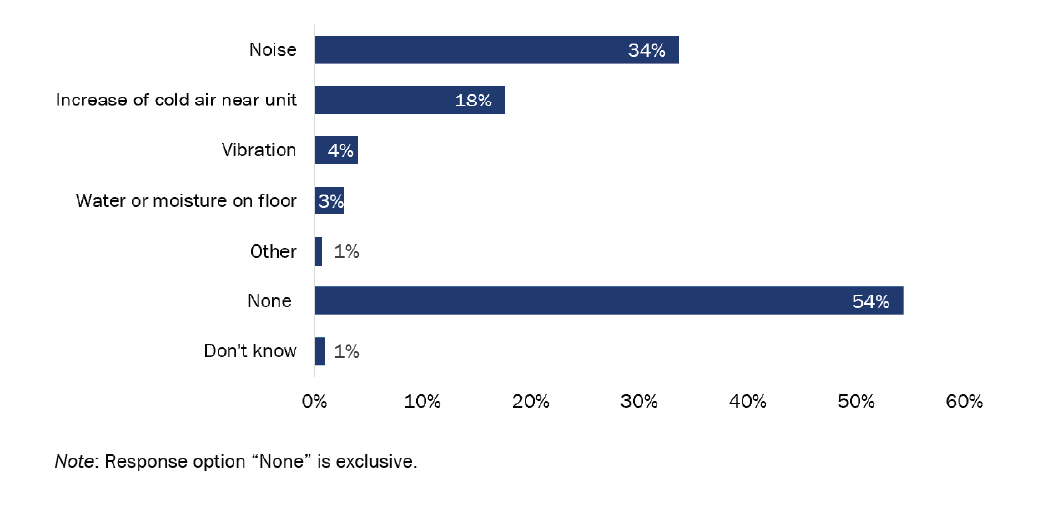
In addition to the equipment issues discussed above, we directly asked respondents about specific issues known to occur with HPWHs (Figure 9). More than half of respondents had not experienced any of these common issues (163 of 300; 54%), although noise was experienced by about one-third of them.
Figure 9. Other HPWH Equipment Issues (n=300)
Key Finding
Vibration issues were the most bothersome to HPWH customers, while cold air near the HPWH was the least bothersome.
We asked customers who had experienced one or more of these issues a follow-up question(s) to gauge how bothersome they found each to be in their home (Figure 10). Most respondents’ equipment issues were noticeable but did not cause disruption in their home. Vibration issues were most bothersome to respondents but affected a small number of them (3 of 12). A majority of those who noticed an increase in cold air near the equipment were not bothered by it (31 of 53; 58%). In fact, noticing cold air near the equipment could be experienced as a positive benefit. With a majority of HPWHs installed in the garage, the exhaust of cold air approximates air conditioning.
Figure 10. Extent HPWH Issues Bother Customer
Of the 61 customers bothered by HPWH issues, most had not taken any steps to address the issue (Figure 11). For 11 customers, the contractor came back to the home and installed a foam kit, vibration isolation kit, or a replacement fan to address the issue. One-third of respondents (20 of 61; 33%), however, attempted to resolve their issue another way. These other actions taken included rerouting the exhaust air, conducting decibel testing, contacting the manufacturer, rejecting the contractor’s offered solution due to cost, resolving the issue on their own with a makeshift fix, and disagreeing with the contractor’s assessment of the problem.
Figure 11. Steps Taken to Address HPWH Issues (n=61)
Hot Water Availability
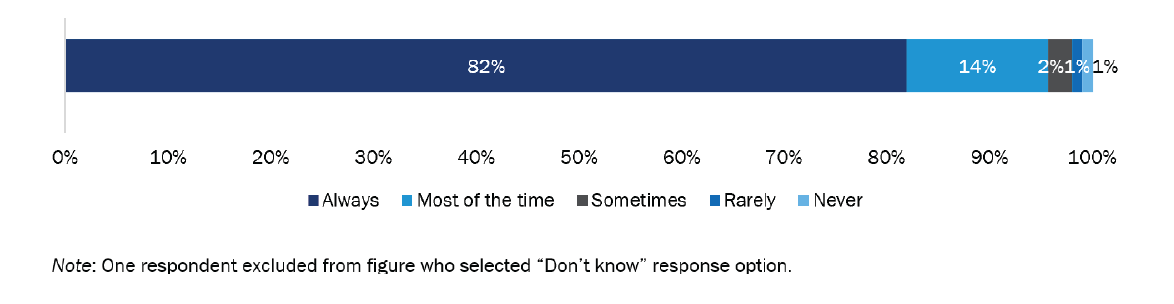
The HPWHs met the hot water needs of most respondent households (Figure 12). Eight-two percent (245 of 300) reported they always have enough hot water to meet their needs. Nearly one-fifth of customers (54 of 299; 18%), though, experienced an issue with hot water availability to some extent in the period since the HPWH was installed.
Figure 12. How Often Customers Have Enough Hot Water to Meet Household Needs (n=299)
We asked those who experienced hot water limitations what they thought could be causing the issue (Figure 13). Nearly a third (15 of 54; 28%) reported circumstances where their home has needed more hot water than usual, suggesting no fault of the equipment itself. Alternatively, 28 of those 54 (52% of those experiencing not enough hot water) believed the tank size or heating speed of their HPWH contributed to running out of hot water. A sizeable minority did not know what could be causing the lack of hot water.
Other potential causes customers mentioned (represented in the “Other” category in Figure 13) were a faulty system timer or temperature schedule, the homeowner adjusting their HPWH settings to avoid high electric rates, participation in energy-saving utility program, use of different operating modes, and extended length of showers in home.
2.2.6 Energy Costs
Since having their new HPWH installed, half (152 or 300; 51%) of respondents’ monthly energy bills reportedly decreased. Almost three-quarters (109 of 152; 72%) of HPWH customers whose monthly energy bills went down mentioned they have a solar PV system that generates electricity for their home. Respondents were instructed to consider both gas and electric utility bills combined, if applicable.[7]
[7] We do not have insight into how the respondents calculated changes in monthly energy bills, therefore this information should be treated as the customers’ perception of any changes. We did not have access to monthly bills or rate plan information.
Figure 14. Change in Monthly Energy Bills Since Installing HPWH (n=300)
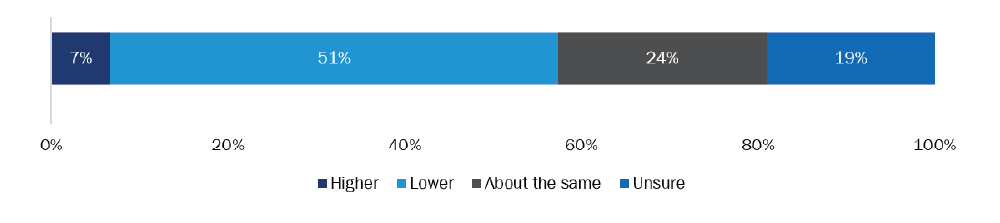
We asked survey respondents who reported higher or lower total energy bills about changes in their home that may have contributed to the difference in their bills other than their new heat pump. Just over half (87 of 172; 51%) reported at least one change. An involuntary change in electric rates had the greatest association with increased energy bills (Figure 15). Interestingly, most customers who reported actions one would expect to increase their energy bills, such as an increase in the number people living in the home, leaving home less often, and acquiring new electronics, nevertheless reported a decrease in their overall monthly energy bills since getting the HPWH.
Figure 15. Additional Changes That Might Impact Energy Bills by Energy Bill Impact, HPWH Customers (n=87)
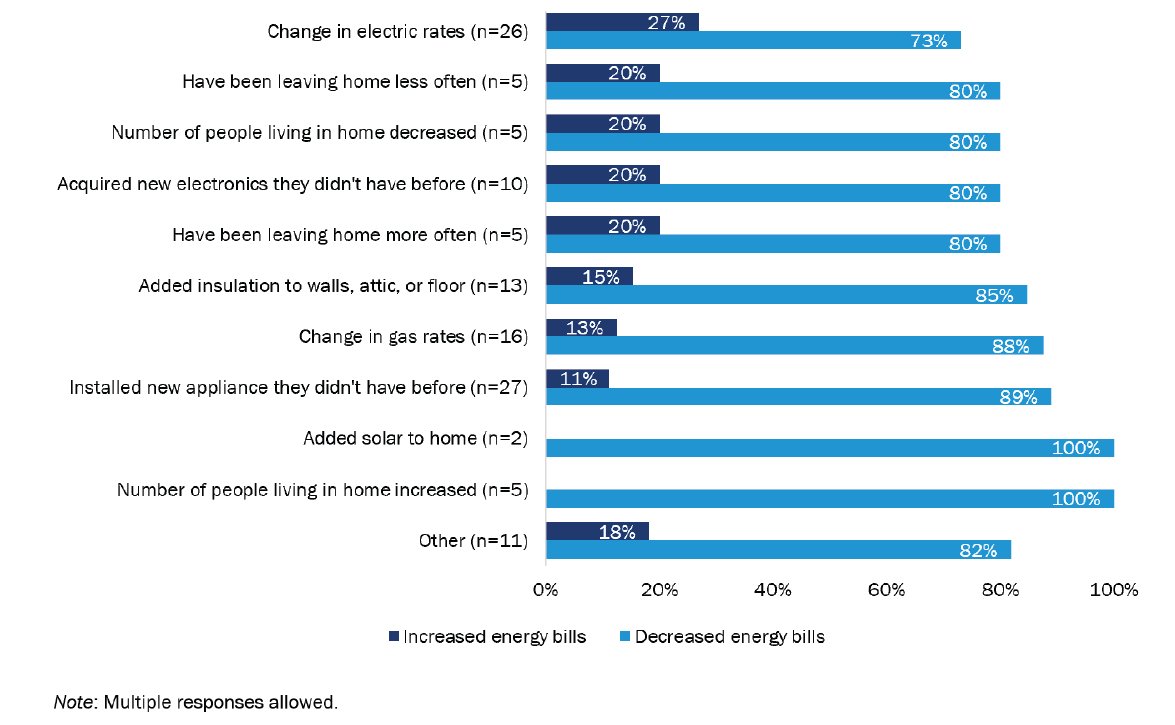
We followed up with respondents who reported a rate change to understand whether it was a voluntary adjustment in their rate plan, or an involuntary increase in fuel cost. Among those who reported a change in their electric rate, nearly all (24 of 26; 92%) shared this was due to their utility involuntarily raising their price of electricity, rather than the customer opting into a new rate plan. Similarly, 81% of those who reported a change in their gas rate (14 of 16) said it was a result of their utility increasing the price.
2.2.7 Satisfaction
Overall, customers were satisfied with their HPWH (Figure 16). Three-quarters (226 of 300; 75%) of respondents indicated the highest level of satisfaction with their equipment. The minority of respondents (14 of 300; 5%) who expressed dissatisfaction with their equipment explained this is due to lack of savings and high operating costs (five respondents), hot water limitations (five respondents), noise from equipment (five respondents), and complicated operation of the equipment (one respondent).
Figure 16. Customer Satisfaction with HPWH (n=300)
Key Finding
The biggest HPWH complaints included increased energy bills, not enough hot water, and noise.
Overall, customers see value in their HPWH investment (Figure 17). A slightly larger proportion of customers rated the investment as “a good value” than “a great value,” suggesting that although customers appreciate the equipment, there may be room for improvement or ways to make the investment more appealing.
Figure 17. Customer Perceived Value of HPWH Investment (n=300)
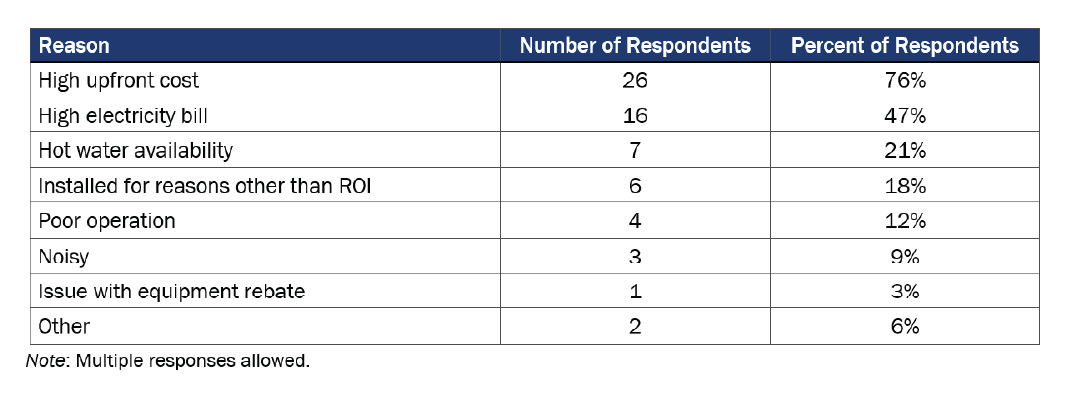
We asked customers who rated their HPWH as “not a good value” to explain why they provided this rating. Table 8 presents reasons given by the surveyed TECH customers.
Table 8. Customer Reasons Why HPWH Investment is Not a Good Value (n=34)
We elaborate on each reason shared by respondents below.
-
- High upfront cost (26 of 34): The initial cost of the HPWH equipment and installation is much higher than that of other water heaters. For these customers, the equipment performance, including reducing exposure of greenhouse gases (GHGs) for some, does not outweigh the burden of the higher upfront cost.
- High electricity bill (16 of 34): Since HPWHs run on electricity, many customers who transitioned from a gas-powered water heater to heat pump equipment have seen an increase in their electric bill. This large appliance now running on electricity, paired with rising electric rates in California, has resulted in unanticipated electric costs. Most of the customers in this group (12 of 16) did not have solar PV. A few respondents mentioned a longer wait to realize a return on investment (ROI). Additionally, as with the high upfront cost, respondents did not feel the various benefits of the equipment outweighed the high cost to operate.
- Hot water availability (7 of 34): Lack of sufficient hot water to cover household needs or inability to get hot water caused the HPWH to not be a good value for them.
- Installed for reasons other than ROI[8] (6 of 34): A couple respondents who rated the equipment as not a good value elaborated that although they do not feel the investment is of good monetary value, they had motivations other than ROI for selecting the equipment. These included environmental impacts and using energy generated by their solar panels.
- Poor operation (4 of 34): Particularly due to the high cost, customers had high expectations for their new, modern equipment. Some reported the performance had fallen short of these expectations, or the operation of the equipment had been more complicated than anticipated.
- Noisy (3 of 34): These three customers complained about loud sounds produced by the heat pump. One customer shared that the noise can be heard day and night, while another mentioned the noise is loud enough to hear inside their home even though the equipment was installed outside.
- Issue receiving equipment rebate (1 of 34): Through the TECH Initiative, customers were offered a rebate to offset a large portion of the high upfront equipment cost, helping to alleviate the cost difference between a HPWH and a gas-powered water heater. One surveyed HPWH customer had still not received this rebate at the time of the survey and thus had paid more money for the equipment than they agreed to pay.
- Other (2 of 34): One of these responses mentioned a long, and still ongoing process for city approval, while the other cited poor manufacturer design resulting in an inability to connect the system to the internet and anticipated a shorter life expectancy due to complexity of the equipment.
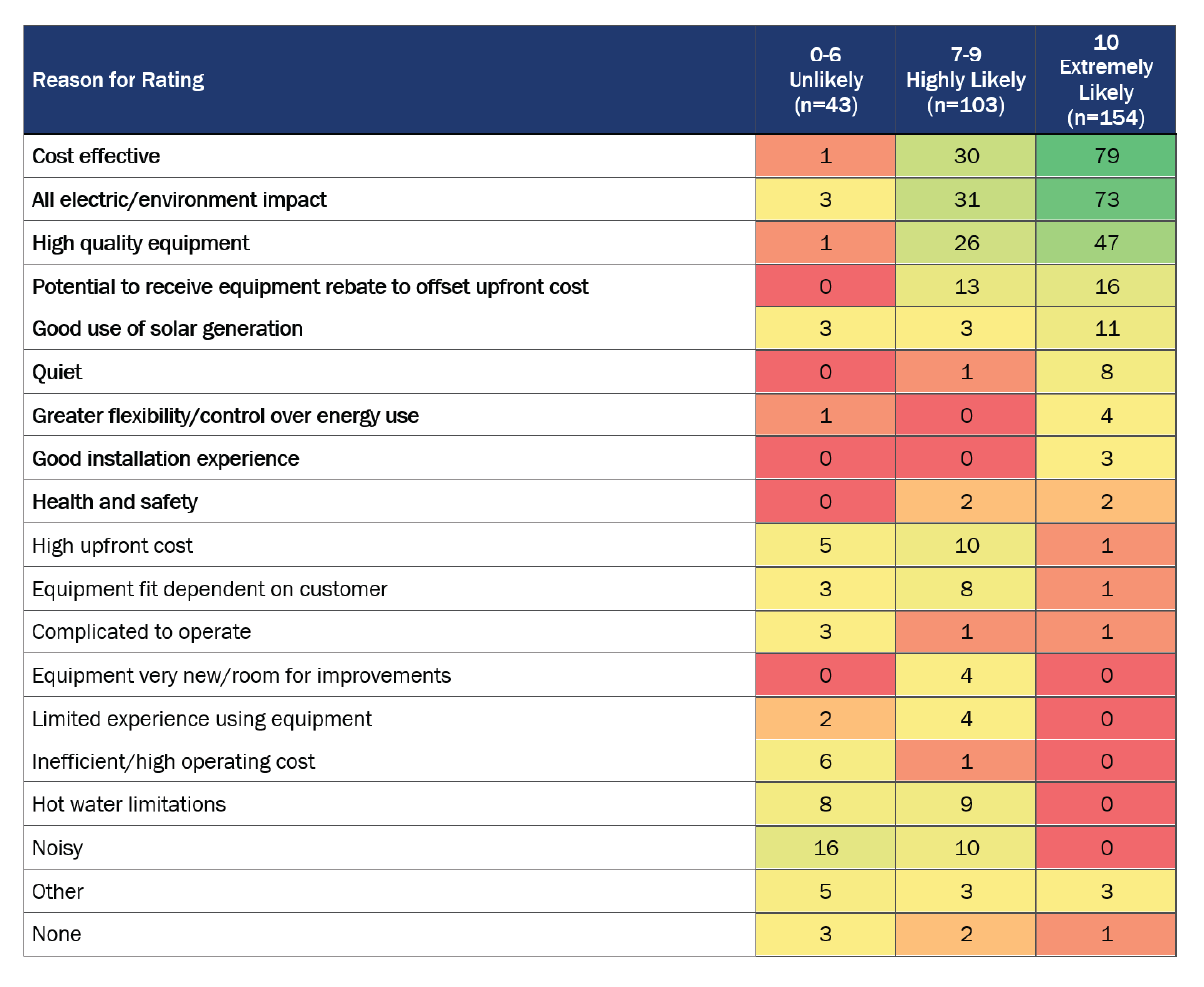
The TECH customers we surveyed were likely to recommend HPWHs to others. To measure customer acceptance of HPWHs, we asked respondents to rate how likely they were to recommend a HPWH to their family and friends using a 0 to 10 scale (zero was “not at all likely” and 10 was “extremely likely”). The average rating score across all 300 respondents was a 9. Half of respondents (154 of 300; 51%) indicated they were “extremely likely” to recommend a HPWH, giving a score of 10. There were 103 respondents who indicated they were “likely” to recommend a HPWH to others, giving a score of 7 to 9.
Table 9 is organized into three columns based on likelihood to recommend; it also includes reasons customers provided in open-ended responses to explain why they gave the rating they did. The reasons in bold font correlate with higher likelihood to recommend a HPWH, while the reasons in normal font are why customers would be unlikely to recommend the equipment. For example, most customers who said the equipment was cost-effective and high quality were likely to recommend it, while those who said it was noisy and experienced hot water limitations were unlikely to recommend it.
[8] The evaluation team does not have insight into how the respondent is estimating their ROI. Due to the heat pump equipment having been installed less than a year prior to completing the survey, we assume these estimations are subjective.
Table 9. Likelihood to Recommend Rating and Reasons for Rating (n=300)
Key Finding
Those likely to recommend a HPWH found it cost-effective, high-quality, and beneficial to the environment. Those unlikely to recommend a HPWH found it noisy, expensive, and not meeting their hot water needs.
We summarize the reasons TECH customers gave for their likelihood-to-recommend rating below. Their answers were provided in an open-ended format, which we categorized. Sometimes respondents gave more than one reason for their rating.
-
- Cost-effective: These customers’ reasons mentioned how HPWHs use less energy, cost less to operate, and provide good value, even when considering the higher upfront cost compared to other water heating equipment. All but one respondent who indicated the equipment is cost-effective were highly or extremely likely to recommend a HPWH to others. This category also includes responses that broadly noted the equipment’s efficiency.
- All-electric/environment impact: Nearly all customers who mentioned they want to encourage others to install electric appliances to help mitigate climate change and reduce individual carbon footprints were highly or extremely likely to recommend a HPWH to others.
- High quality equipment: These customers were satisfied with the operation of their equipment and experienced little to no issues. They found HPWHs to be a reliable option for household water-heating needs. Despite acknowledging the high quality of their equipment, one respondent was still unlikely to recommend a HPWH.
- Potential to receive equipment rebate to offset upfront cost: Respondents were highly or extremely likely to recommend the equipment to others due to the availability of rebates to significantly offset the high upfront cost.
- Good use of solar generation: Heat pumps, as a major electric-powered appliance, present a great opportunity for those with solar to utilize sustainably generated energy, and reduce their energy bills and reliance on utility providers. Most respondents who gave this explanation were highly or extremely likely to recommend a HPWH to others.
- Quiet: These customers were satisfied with the low, or unnoticeable noise produced by the equipment when operating and were highly likely to recommend a HPWH to others.
- Greater flexibility/control over energy use: HPWHs allow users to take advantage of demand response programs and maximize the benefits of time-of-use rates offered by their utility. Additionally, those with solar PV and battery storage have greater flexibility as they can utilize the stored energy when in need. Four of the five respondents who mentioned this topic were extremely likely to recommend a HPWH.
- Good installation experience: These three customers found the equipment installation to be easy and seamless, making them extremely likely to recommend a HPWH. Their experience with the contractor who installed the equipment was positive and they provided satisfactory service.
- Health and safety: Compared to a gas-powered system that emits carbon and poses potential for combustion, these four customers recognized heat pumps as a safer option for homes, making them highly or extremely likely to recommend a HPWH.
- High upfront cost: The higher initial cost of the HPWH equipment compared to that of a more typical gas-powered water heater was unattractive to respondents. Although this factor made five respondents unlikely to recommend the equipment, others acknowledged this higher cost but said they would still recommend it. Therefore, for some, the performance and benefits a heat pump provides outweighs this initial cost burden.
- Equipment fit dependent on customer: Although most of these respondents were still highly likely to recommend a HPWH to others, they acknowledged that heat pumps may not be appropriate for all California households. Respondents shared criteria they thought home suitability may depend upon, such as income level or affordability, sufficient space or location options in the home to install the HPWH, and climate zone (e.g., equipment has longer run times and is operates less efficiently in colder climates).
- Inefficient/high operating cost: Seven respondents were unlikely to recommend a HPWH after they observed the equipment to be inefficient when operating or have failed to see a decrease in their energy bills as expected. In some cases, respondents reported an increase in their overall energy bills.
- Hot water limitations: These 17 respondents experienced issues with hot water availability and thus expressed concerns about how reliably the equipment can produce hot water to meet a household’s needs. None of these customers gave a 10 out of 10 in their likelihood to recommend.
- Noisy: Most respondents who reported disruptions due to excessive noise or vibrations produced by their equipment were unlikely to recommend a HPWH to others (16 of 26), although 10 were likely.
2.3 HVAC Heat Pumps
The TECH Initiative offered incentives for both ducted and ductless HVAC heat pumps. Both split unitary and packaged unitary systems were among the ducted HVAC heat pumps eligible for a TECH rebate. Descriptions of both system types are below.
-
- Split unitary system: As the most common type of heat pump, these systems look just like air conditioners. The indoor unit connects to the central ducting of the home. The compressor can be single-speed, two-speed, or variable speed, and its efficiency increases in multi-speed systems.
- Packaged unitary system: This heat pump system contains all components in a single “package” and connects to the home’s ductwork. Due to the units being installed outside of the home, this is a good option for those with limited indoor space. Although typically installed on the ground, packaged units can also go on rooftops.
The following sections provide findings about TECH customers’ experiences with their new HVAC heat pump.
2.3.1 Home Features
Customers who received an HVAC heat pump through the TECH Initiative were nearly all homeowners (647 of 652; 99%). The five remaining respondents rented their home. Almost all surveyed HVAC heat pump customers (593 of 652; 91%) had the heat pump equipment installed in their primary residence. Of those who had their equipment installed in their secondary residence or vacation home, two-thirds (39 of 59; 66%) reported spending at least a third of the year in this home. Among these respondents, a majority visited their secondary residence most often in the winter (36 of 59; 61%), while another sizeable proportion evenly distributed the amount of time they spent at the home throughout the year (17 of 59; 29%).
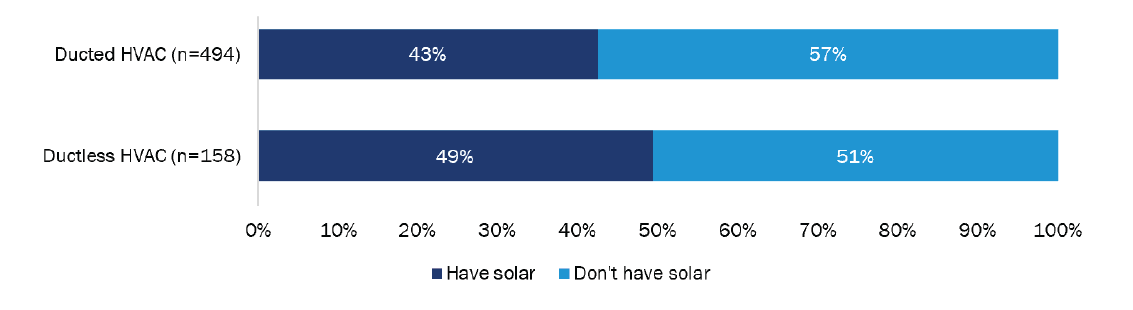
Nearly half of HVAC customers, whether they purchased a ducted (210 of 494; 49%) or ductless (78 of 158; 43%) system, had a solar PV system that generates electricity for their home (Figure 18).
Figure 18. Proportion of HVAC Customers with Solar (n=652)
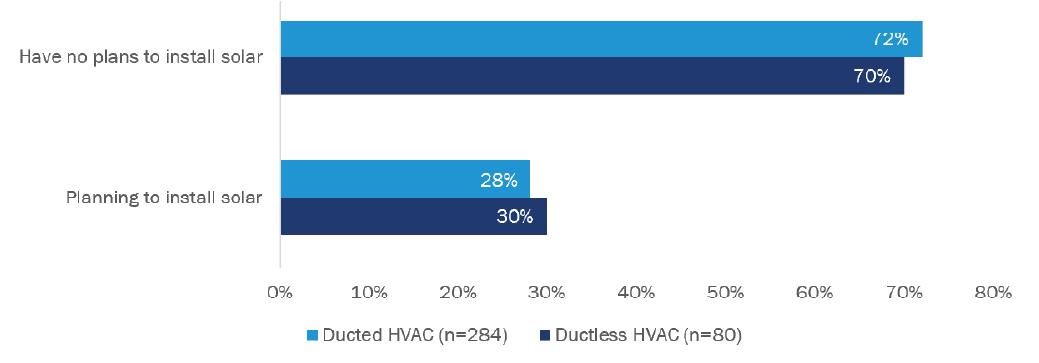
Of TECH HVAC customers without solar, nearly a third of both ducted (80 of 284; 28%) and ductless (24 of 80; 30%) customers reportedly plan to install solar in the near future (Figure 19).
Figure 19. Solar Plans Among Customers Who Don’t Have Solar (n=364)
2.3.2 Description of Equipment
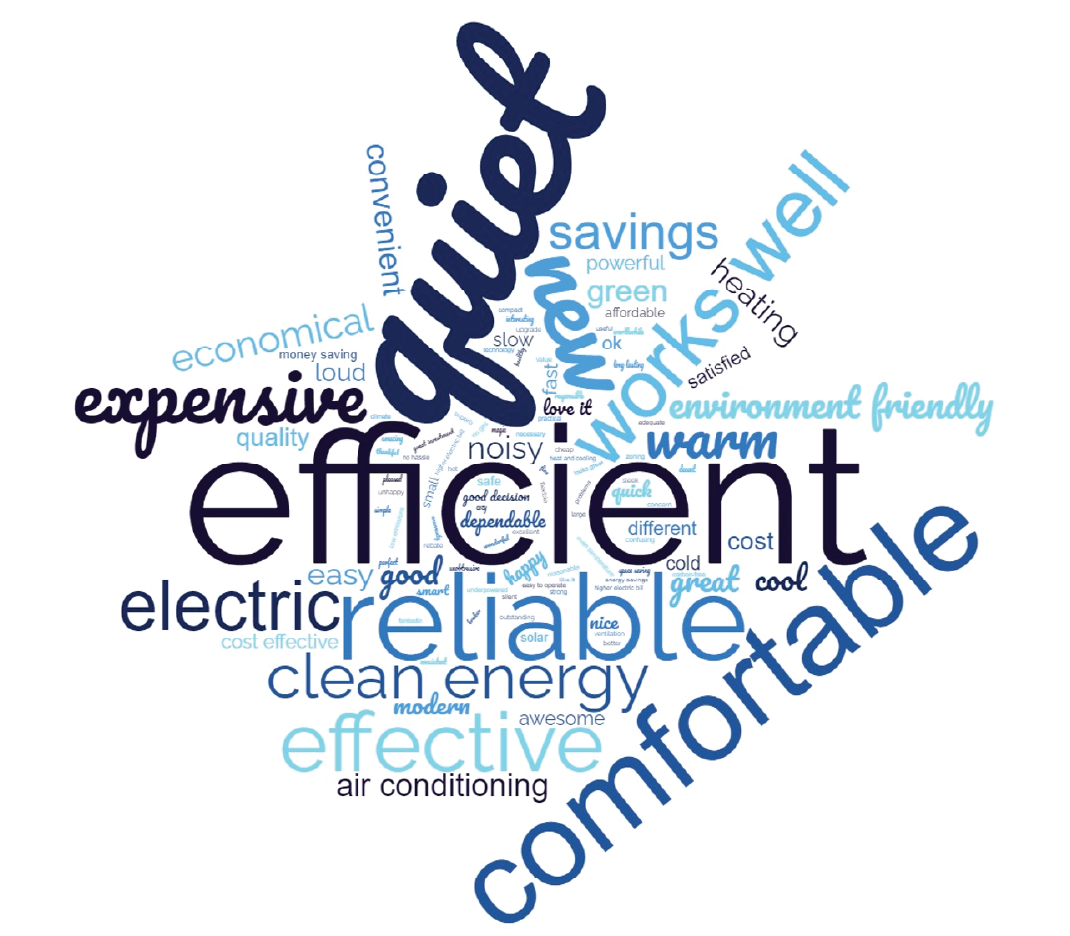
As done for HPWHs, we asked TECH customers who had a HVAC heat pump installed in their home to list the first three words that came to mind when thinking about their new equipment. Positive features customers called out about their new HVAC heat pump included that it was efficient, quiet, and reliable. In contrast, negative aspects included that the equipment was expensive, noisy, and slow.
Figure 20. Customers’ Top Three Words to Describe HVAC Heat Pump Equipment (n=652)
2.3.3 Equipment Use in Home
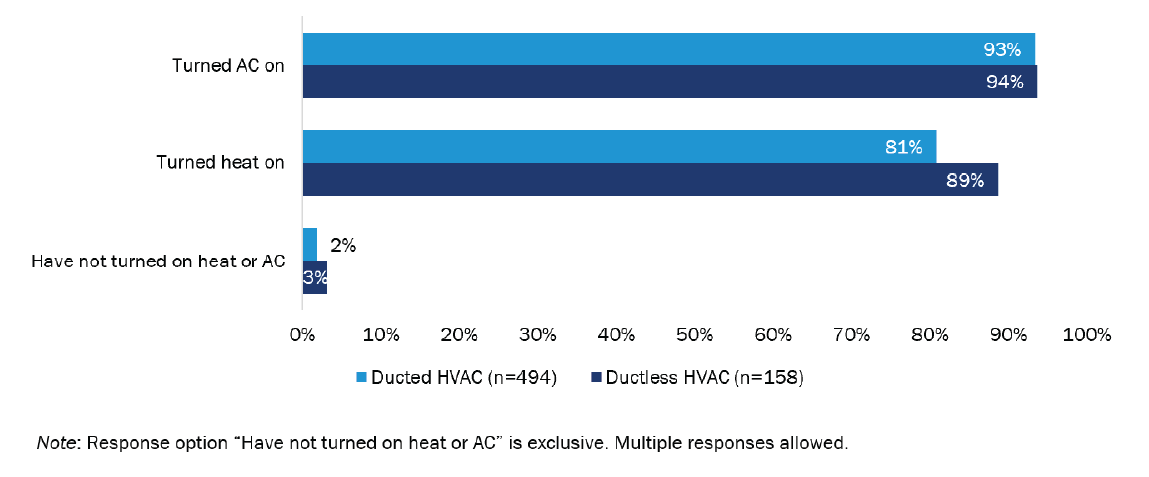
Nearly all respondents had used their new heat pump system to heat or cool their home (Figure 21). In fact, most customers, regardless of whether they purchased ducted (375 of 494; 76%) or ductless (135 of 158; 85%) heat pumps, used it to both heat and cool their home. More respondents had experience using the heat pump to cool their homes than to heat their homes. Although, two percent of HVAC customers overall (14 of 652) had not yet used their heat pump; by equipment type this accounted for two percent of ducted systems (9 of 494) and three percent of ductless (5 of 158). Of the 14 customers who had not yet used their heat pump, eight reportedly have another system that provides heat in their home and seven used another cooling source.
Figure 21. Actions Taken by Customer Since Installing HVAC Heat Pump
Motivations for Installing and Spaces Served (Ductless Systems Only)
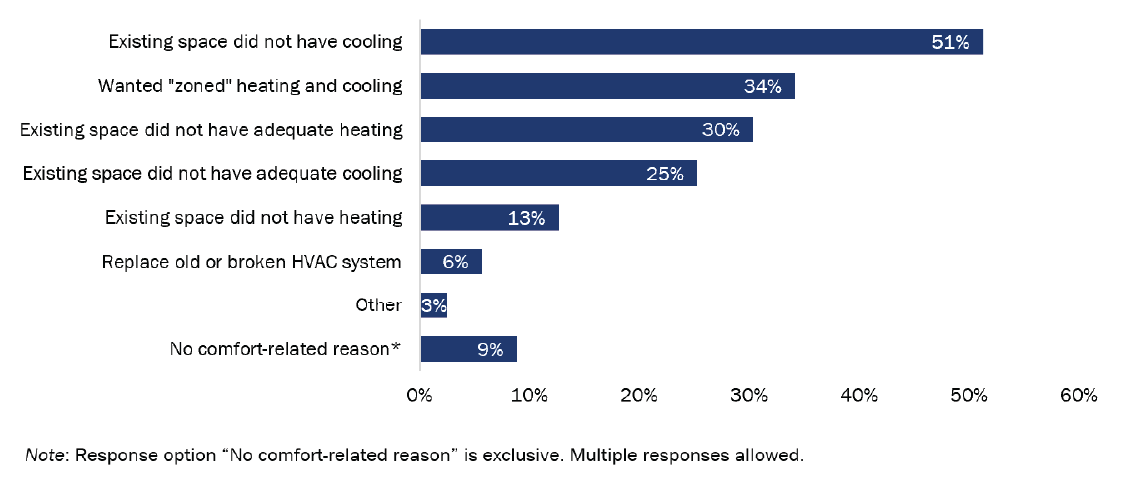
To qualify for TECH incentives, the HVAC heat pump must replace the home’s existing (non-heat pump) heating source; customers do not need to have an existing air conditioning unit. We asked respondents who installed a ductless HVAC heat pump what comfort-related reasons motivated them to choose a ductless system (Figure 22). The most common reason (81 of 158; 51%) was to add cooling to a space that did not previously have cooling, although a third (54 of 158; 34%) of respondents chose the system due to the unique “zoned” temperature control capabilities. One respondent who installed a ducted system explained they would have purchased a ductless system instead if their contractor had presented them with the various benefits different heat pump systems provide:
“Would have installed zoned system IF the firm had brought the benefits to my attention in our 2-story house.” ~ Ducted heat pump customer
This example demonstrates how lack customer education may prevent the customer from purchasing the most appropriate system for their home.
Figure 22. Comfort-Related Reasons That Motivated Customers to Select Ductless Heat Pump (n=158)
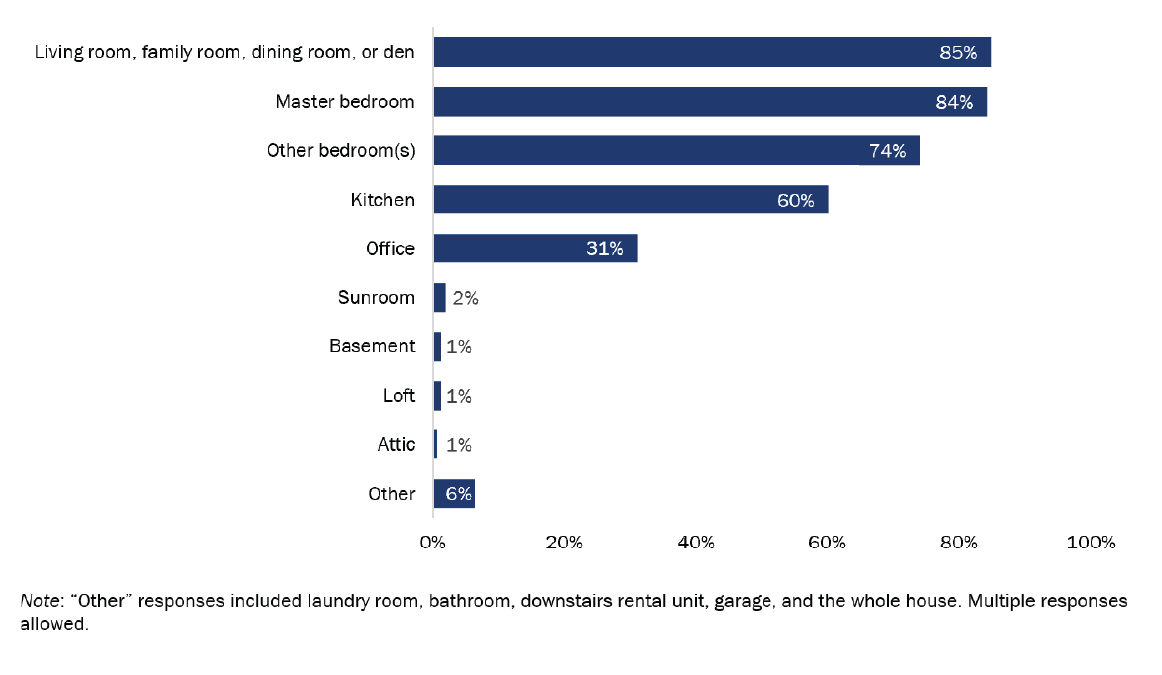
When asked about the spaces in their home their ductless HVAC heat pump served, respondents most commonly reported larger living areas, such as the living room, family room, dining room, or den and bedrooms (Figure 23).
Figure 23. Spaces Ductless Heat Pump Serves in Home (n=158)
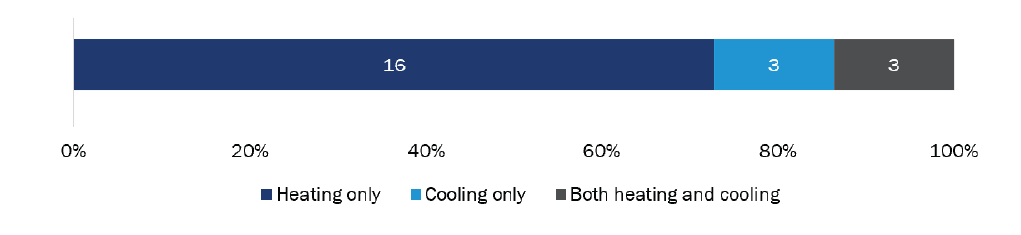
Most TECH customers (136 of 158; 86%) reported the ductless heat pump system was the only space-conditioning equipment for the spaces it served. Those with another system serving the same space(s) as the ductless heat pump most commonly used their alternate system for heating (Figure 24).
Table 3. Survey Respondents by Sector (Multiple Responses Allowed; n=229)
COOLING
Key Finding
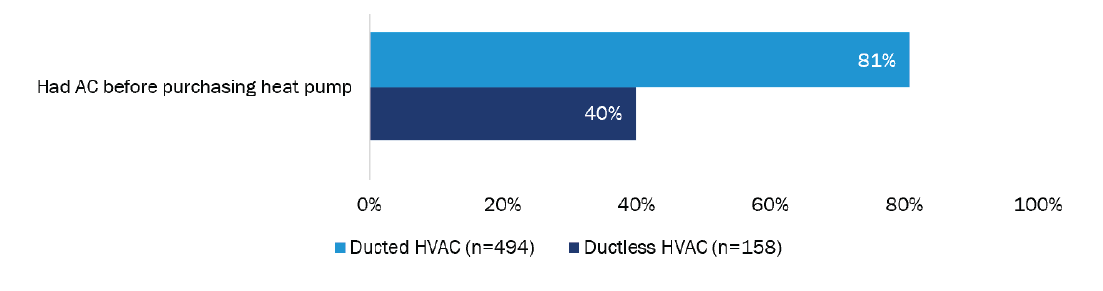
Ductless heat pump customers were unlikely to have AC before, while ducted HVAC customers were likely to have had AC before.
Ducted heat pumps can often use the home’s existing ductwork, if it is in good condition, while ductless heat pumps are a good option for those with limited or poor ductwork. TECH customers who purchased a ducted HVAC heat pump (399 of 494; 81%) were twice as likely as those who purchased a ductless system to have had air conditioning previously (Figure 25). This finding is not surprising, because customers who previously had air conditioning would likely have had ductwork in good condition, while those without air conditioning may have had limited ductwork.
Figure 25. Customers Who Had AC Before Installing HVAC Heat Pump
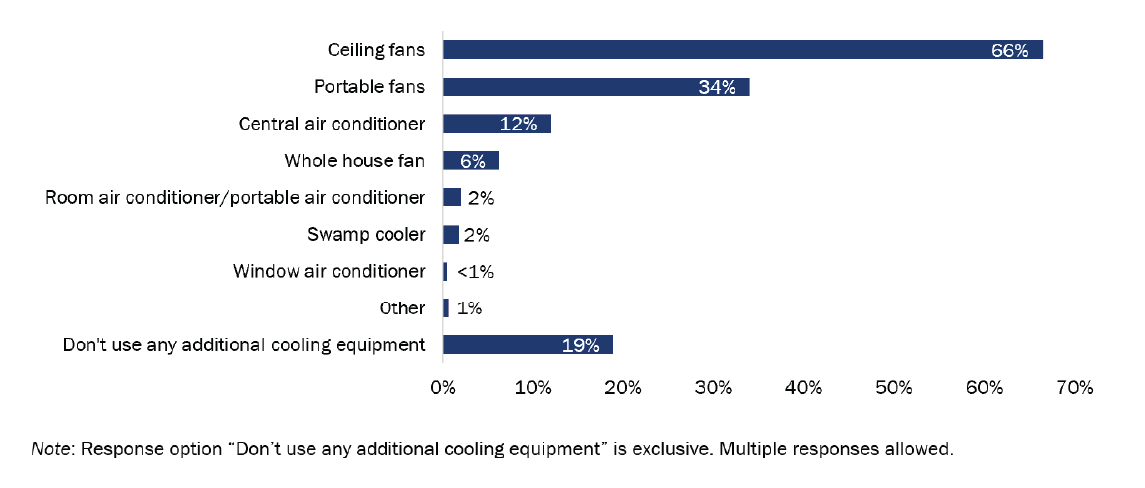
Newly installed HVAC heat pumps served as the primary air conditioner in nearly all customers’ homes, for both ducted (475 of 494; 96%) and ductless systems (150 of 158; 95%). Nevertheless, most respondents with a ducted HVAC system (401 of 494; 81%) reported using at least one other type of cooling equipment regularly in their home, commonly ceiling fans and portable fans (Figure 26). Despite using other equipment, nearly all these respondents (383 of 401; 95%) considered their heat pump to be their primary source of cooling.
Figure 26. Other Cooling Equipment Regularly Used in Home, Ducted HVAC (n=494)
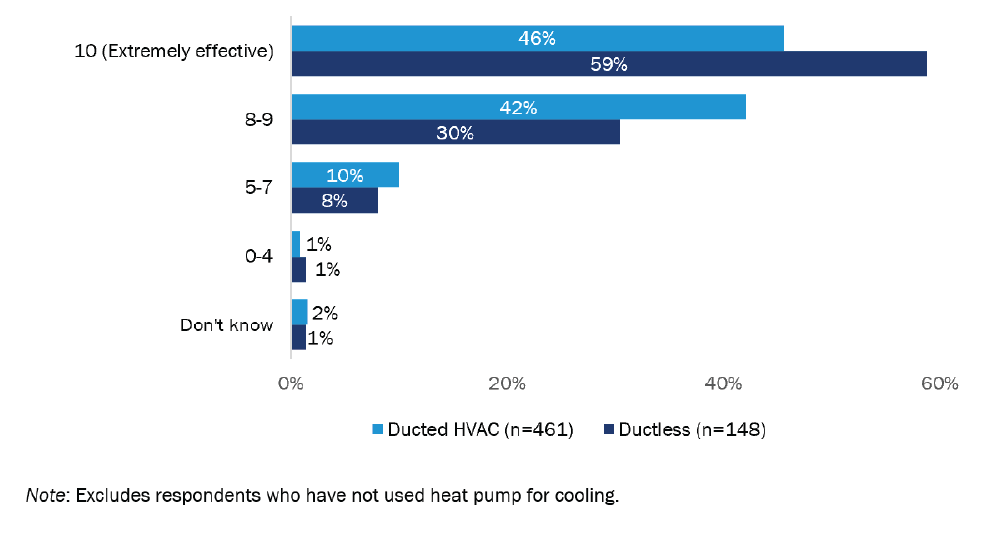
Both ducted and ductless HVAC heat pumps have been effective when cooling customers’ homes (Figure 27). We asked customers who had used their HVAC heat pump for cooling to rate the cooling effectiveness of their heat pump using a scale from zero (not at all effective) to 10 (extremely effective). Customers indicated their system had been highly effective, with more than four-fifths of customers providing a rating of eight or higher for ducted (404 of 461; 88%) and ductless systems (132 of 148; 89%). Customers with ductless systems were more likely to say their heat pump was extremely effective than those with ducted systems. One possible explanation is that ductless systems efficiently cool specific areas of a home, whereas those who rely on whole-home cooling may experience uneven cooling in certain spaces that may not meet their desired comfort levels.
Figure 27. Customer Rating for HVAC Heat Pump Cooling Effectiveness
Heating
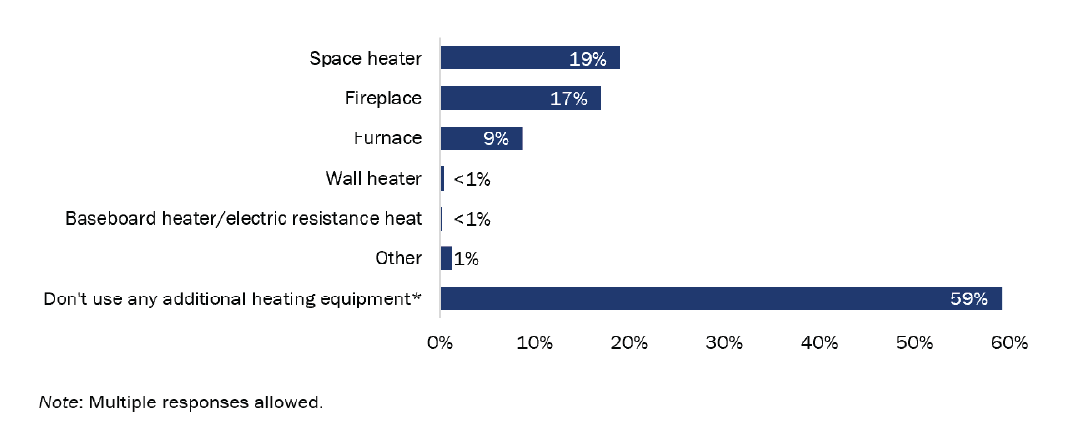
More than half of customers who installed a ducted HVAC system (292 of 494; 59%) reported relying solely on their heat pump for heating (Figure 28). Those who regularly use other equipment for heating most commonly use space heater(s), a fireplace, or a furnace as supplemental sources.
Figure 28. Other Heating Equipment Regularly Used in Home, Ducted HVAC (n=494)
Key Finding
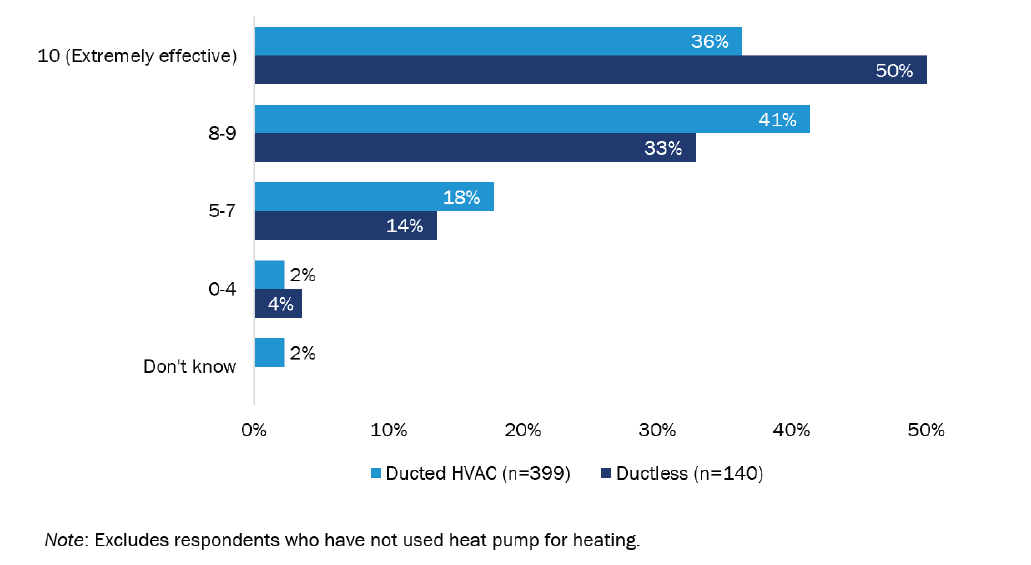
Ductless heat pump customers were more likely than ducted heat pump customers to rate the equipment as “extremely effective” for both heating and cooling.
Similar to cooling, both ducted and ductless HVAC heat pumps have been effective when heating customers’ homes (Figure 29). We asked customers who had used their HVAC heat pump for heating to rate the heating effectiveness of their heat pump using a scale from zero (not at all effective) to 10 (extremely effective). Over three-quarters of customers provided a rating of eight or higher for ducted (310 of 399; 78%) and ductless systems (116 of 140; 83%); again, with a greater proportion of customers rating the ductless system as “extremely effective.” Customers who gave lower ratings explained that it takes longer for the heat pump to heat the house than their old system.
Figure 29.Customer Rating for HVAC Heat Pump Heating Effectiveness
Thermostat
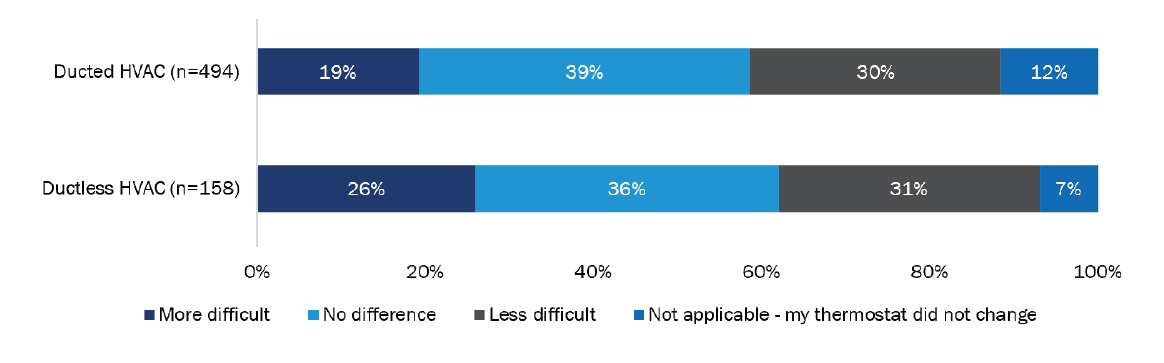
It is likely that when purchasing an HVAC heat pump, customers will also need to update their thermostat. Overall, 90% of customers who purchased an HVAC heat pump received a new thermostat to control their equipment. Most TECH customers have found their new thermostat to be similar or easier to operate than their old thermostat (Figure 30). More than one-quarter of customers with ductless HVAC heat pumps reported difficulty with their new thermostat. Ductless systems often use a remote control to adjust the temperature settings, which can be a big departure from a wall-mounted thermostat.
Figure 30. Level of Difficulty Operating New Thermostat Compared to Old System
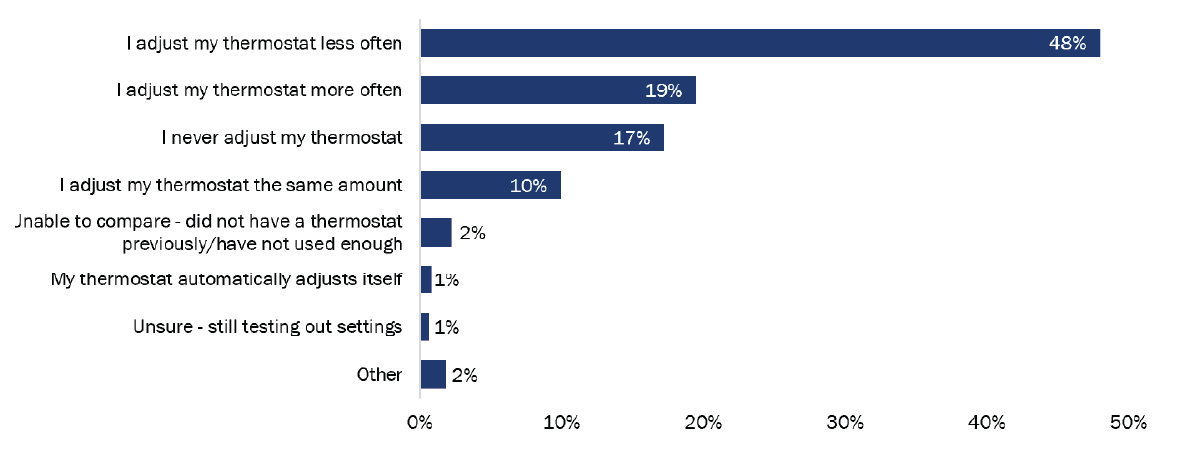
Most customers (286 of 494; 58%) adjust their new thermostat less often or about the same amount since getting their ducted heat pump (Figure 31). Nearly half (237 of 494; 48%) of customers reported adjusting their new thermostat less often, while approximately one-fifth (96 of 494; 19%) now adjust their thermostat more often. The fact that half of customers are adjusting their thermostat less often aligns with the recommended operation for heat pumps, because heat pumps operate most efficiently when holding a steady temperature. Adjusting the temperature for short periods of time, like while asleep or away, will use more energy than leaving it on because it has to work harder to come back to the desired temperature.
Figure 31. How Often Customers Adjust Their Thermostat Compared to Old System, Ducted HVAC (n=494)
2.3.4 Issues with Equipment
Most customers had not experienced any issues with the HVAC heat pump since it was installed (Figure 32). For those who experienced an issue, a contractor addressed the issue for a majority of those with a ducted (81 of 115; 70%) and ductless (29 of 36; 81%) system. Issues with the HVAC equipment were severe enough to require replacing the entire unit for 14 people (2%).
Figure 32.Work Required on HVAC Equipment
Respondents who reported needing to repair, replace, or troubleshoot an issue with their equipment were asked to describe the issue they experienced. Respondents answered in an open-ended format, and we coded their responses into the categories displayed in Table 10.
Table 10. HVAC Heat Pump Equipment Issues (n=151)
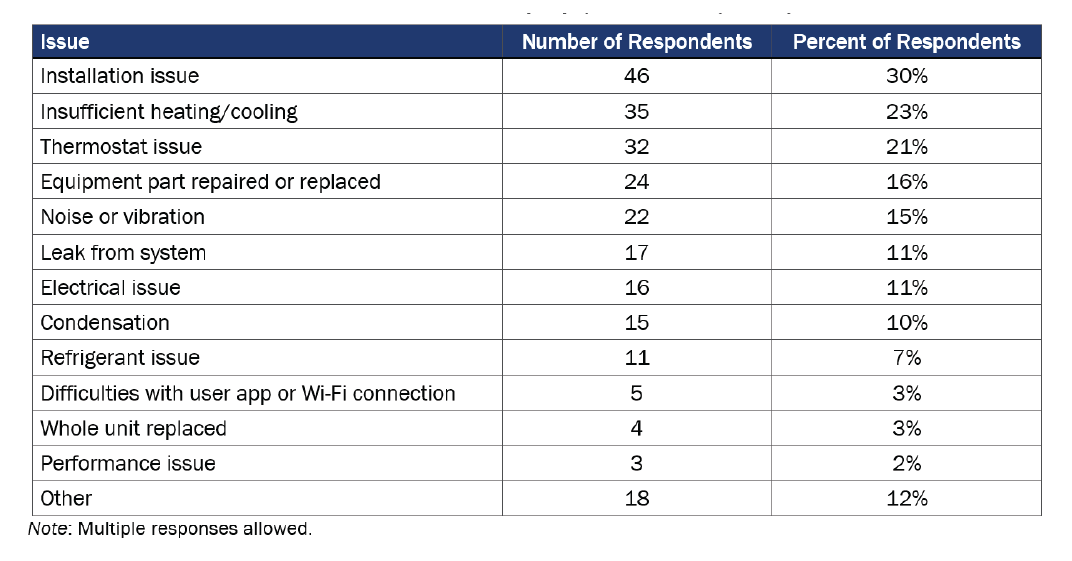
We elaborate on each issue reported by respondents below.
-
- Installation issue (46 of 151): Heat pumps are advanced systems that are new to many contractors, leaving potential for errors to occur during installation. As a result, some customers needed follow-up visits from contractors to resolve issues that, with proper knowledge and expertise, likely would not have occurred otherwise. Some examples included incorrect wiring, improper plastic fittings, not flushing drainpipe to avoid clogging, incorrect setting of air handler, and errors with ductwork.
- Insufficient heating/cooling (35 of 151): The new HVAC heat pump is not heating and/or cooling the customers’ homes sufficiently to reach the temperature setpoint. In some cases, the respondent believed the inability to heat or cool their home may be due to improper sizing of equipment for the space it serves.
- Thermostat issue (32 of 151): These customers reported issues with the overall temperature control system, such as temperatures in their home ranging up to seven degrees from the set temperature or temperatures not following the set schedule they had programmed. In some cases, respondents said their issue required replacement of the thermostat initially installed.
- Equipment part repaired or replaced (24 of 151): In order to resolve an equipment issue, these customers had a follow-up visit from a contractor where a specific part of the equipment was repaired or replaced. A few examples of these parts included an air scrubber bulb, motor and fan sensor, unit transformer, a wall unit (ductless specific), air filter, and the compressor. This excludes full unit replacements.
- Noise or vibration (22 of 151): These customers reported noisy or vibrating equipment. Issues were most typically identified as noise produced by the compressor, along with others that simply referred to a squeak, buzz, or hum when equipment was operating.
- Leak from system (17 of 151): These responses refer to liquid leaking from equipment, sometimes related to leaking “coolant” and excessive condensate causing a leak in the area where the equipment was located.
- Electrical issue (16 of 151): These responses reported issues with the electrical setup of the equipment, such as improper wiring, a faulty unit transformer, or electrical surges when running the heat pump. One respondent shared that due to an electrical issue resulting from improper installation of the unit, they were unable to heat or cool their home for an extended period of time. This response is an example of an issue that was coded under multiple categories (i.e., electrical issue, installation issue, and insufficient heating/cooling):
“Installer damaged the entry to our attic during install. Also, one of the electric connectors was not bolted down so it was knocked out and we did not have HVAC for two weeks due to scheduling issues.” ~ Ducted heat pump customer
-
- Condensation (15 of 151): These were issues related to the condensate and how it leaked out onto the floor around the heat pump, occasionally causing damage to the area where the equipment is located. Customer responses that identified condensate leaking from the equipment were also coded under “Leak from system” category.
- Refrigerant issue (11 of 151): These customers reported a refrigerant or coolant leak, shortage of freon in system, or issue preventing refrigerant fluid from reaching wall units of ductless system.
- Difficulties with user app or Wi-Fi connection (5 of 151): Across various manufacturers, respondents have had difficulty connecting their equipment to Wi-Fi and controlling their heat pump using the corresponding online app.
- Whole unit replaced (4 of 151): These responses include cases where a full unit replacement was necessary to fix the issue(s).
- Performance issue (3 of 151): These were cases where no other obvious issues existed, but the system still failed to operate as expected, such as heat coming on very slowly, system frequently blowing cool air when in heat mode, and heat turning on through both units while only one is set to heat and the other is set to a low temperature (ductless system).
- Other (18 of 151): These responses included uneven air flow from vents, unspecified adjustments or repairs on equipment, gaps in air sealing around ceiling cassettes, fine dust discovered in grills behind filters causing odd smells, unreplaceable fan filter, damaged fan motor, and white residue coming out of registers. One customer also mentioned their home lacks adequate insulation, causing their system to run longer, more often, and be less energy efficient.
As noted above, in many instances responses were coded in multiple categories due to customers describing a number of different issues they experienced with their equipment. One primary example of this was a respondent who listed five separate issues they experienced only months after they had their unit installed:
“Fan malfunction, pipe with refrigerant too cold /frosty, sensor malfunction, pump water overflowed several times, and motor and fan sensor replaced all within four months from installation.” ~ Ducted heat pump customer
In other cases, respondents experienced persisting issues that contractors have attempted to fix using numerous approaches, making the root cause of the issue unclear. One respondent explained they were on their fourth attempt to resolve an issue that prevented their heat pump from heating and cooling their home:
“During the summer months, the system failed to cool our home. They said they found a possible leaky refrigerant connection and repaired it. The issue returned, then they attempted a new circuit board for the outside unit. The issue returned, then they replaced the living room air handler. The issue returned, except failed to heat our home during winter, now they are looking for another leak. At this time the system is not working and will not heat our home.” ~ Ductless heat pump customer
As was done for HPWHs, we asked respondents who installed an HVAC heat pump if they had experienced a few specific issues that have been typical complaints about the equipment (Figure 33). More than half of respondents had not experienced any of these common issues, with fewer problems reported for ductless (55 of 158; 35%) than ducted (232 of 494; 47%) systems. Issues reported were similar across both system types; the most common issue for both being insufficient heating or cooling in certain spaces in the home.
Figure 33. HVAC Heat Pump Equipment Issues
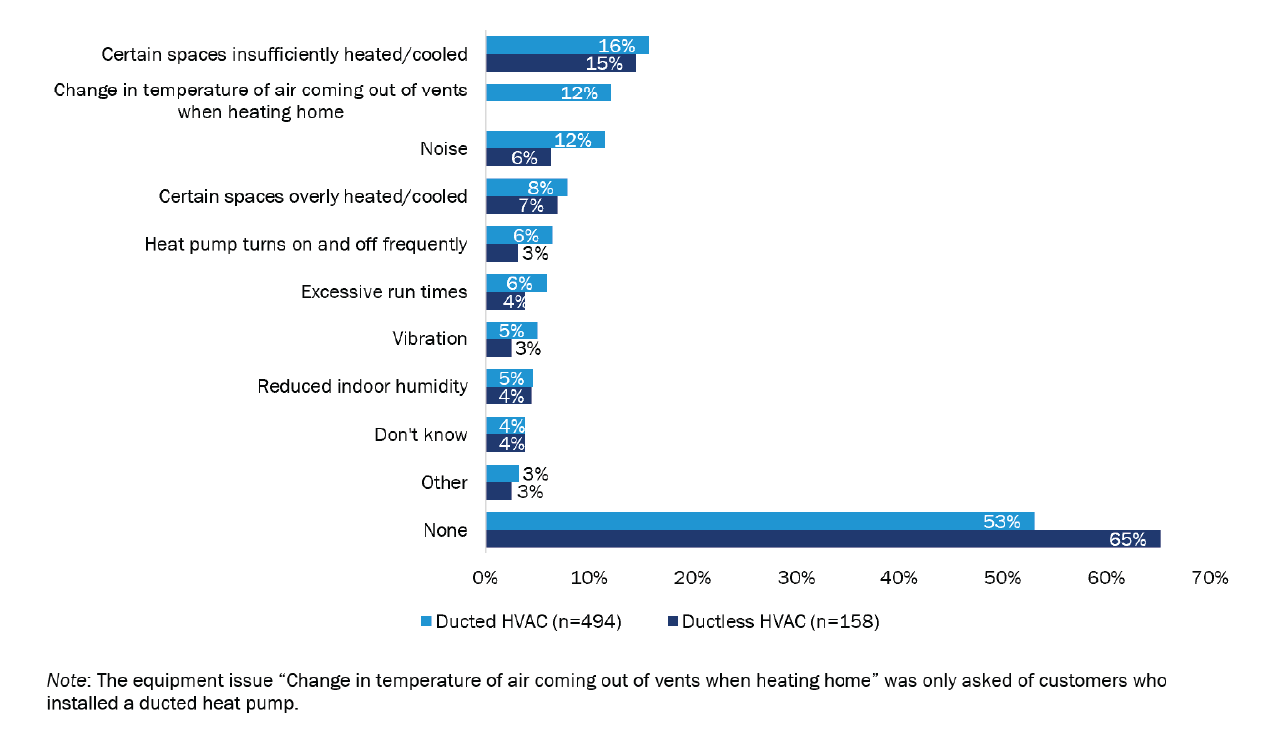
We asked customers who had experienced one or more of these issues a follow-up question to gauge how bothersome they found each to be in their home. Customers who had a ducted system installed in their home were also asked whether the change in air temperature that comes out of the vents when heating was an issue for them. Notably, nearly two-thirds (37 of 60; 62%) of those who reported experiencing this found it to be at least slightly bothersome. We highlight this issue as it tends to be common among households that replace a furnace with a heat pump for heating purposes, as well as a typical complaint heard by contractors that may discourage them from recommending the equipment. As one respondent wrote in the survey:
The air coming from the heat pump is not as cold or as hot as the prior system with a gas furnace and an AC compressor. Therefore, it takes longer to heat and cool the house.
The perception of warmth and coolness varies from person to person. Yet, as our survey findings show, most people who notice the vented air is not as hot as their prior system are unhappy about it. As such, contractors should be sure to mention this fact to the customer when discussing equipment options, so the customer is not unpleasantly surprised when it happens.
Otherwise, most respondents’ equipment issues were noticeable but not bothersome (Figure 34). Overall, respondents were most bothered by excessive run times, and insufficient or overly heated/cooled spaces in their home. For ducted HVAC systems specifically, noise and vibration were also among issues most bothersome to respondents.
Figure 34. Extent HVAC Heat Pump Issues Bother Customer
Few customers had taken steps to address their heat pump’s issues (Figure 35). In cases where the customer contacted a contractor about the problem, there was nearly double the rate of success resolving issues with ductless systems (7 of 15; 46%) than with ducted (12 of 49; 24%).
Figure 35. Steps Taken to Address HVAC Heat Pump Issues
2.3.5 Energy Costs
Whether respondents’ energy bills went up or down was very similar between those with ducted and ductless systems (Figure 36). About one-quarter said their monthly bills remained the same, while two-fifths (268 of 652; 41%) said they had decreased. Over half (154 of 268; 57%) of customers whose monthly energy bills went down had a solar PV system that generated electricity for their home. Respondents were instructed to consider both gas and electric utility bills combined, if applicable.
Figure 36. Perceived Change in Monthly Energy Bills by HVAC Type
The change in monthly energy bills is more apparent when looking at whether the TECH customer had air conditioning before they purchased their HVAC heat pump (Figure 37). Nearly half of those with air conditioning before reported a decrease in their bills, while fewer than one-third without air conditioning prior experienced a decrease. One-fifth of customers without air conditioning before (40 of 190; 21%) reported higher monthly energy bills since having their HVAC heat pump installed.
Figure 37. Perceived Change in Monthly Energy Bills by Whether Customer Had AC Before
A sizeable percentage of TECH customers reported they were unsure how their bills have changed. Of the 198 people who were not sure whether their bills were higher or lower, nearly half (48%) had solar PV. One customer wrote in the survey explaining why it is hard to know the impact on the monthly bills:
I got the heat pump around the same time I got my solar panels. It is very difficult to understand how much money I am saving for either the solar panels or the heat pump because of the new payment schedule related to my solar. I get charged a huge amount of money once a year making it difficult to compare.
As we did with HPWH customers, we asked HVAC heat pump respondents who experienced higher or lower total energy bills about changes in their home that may have contributed to the difference in their bills other than their new heat pump. More than half (191 of 354; 54%) reported a change other than their new HVAC heat pump. Involuntary changes in electric and gas rates were among the most common reported, along with insulation added to walls, attic, or floor (Figure 38). Those who added insulation to their homes were highly likely to report a decrease in monthly energy bills, suggesting that upgrade is complementary to heat pumps and would be a good “upgrade package” for homeowners.
Figure 38. Additional Changes That Might Impact Energy Bills by Energy Bill Impact, HVAC Customers (n=191)
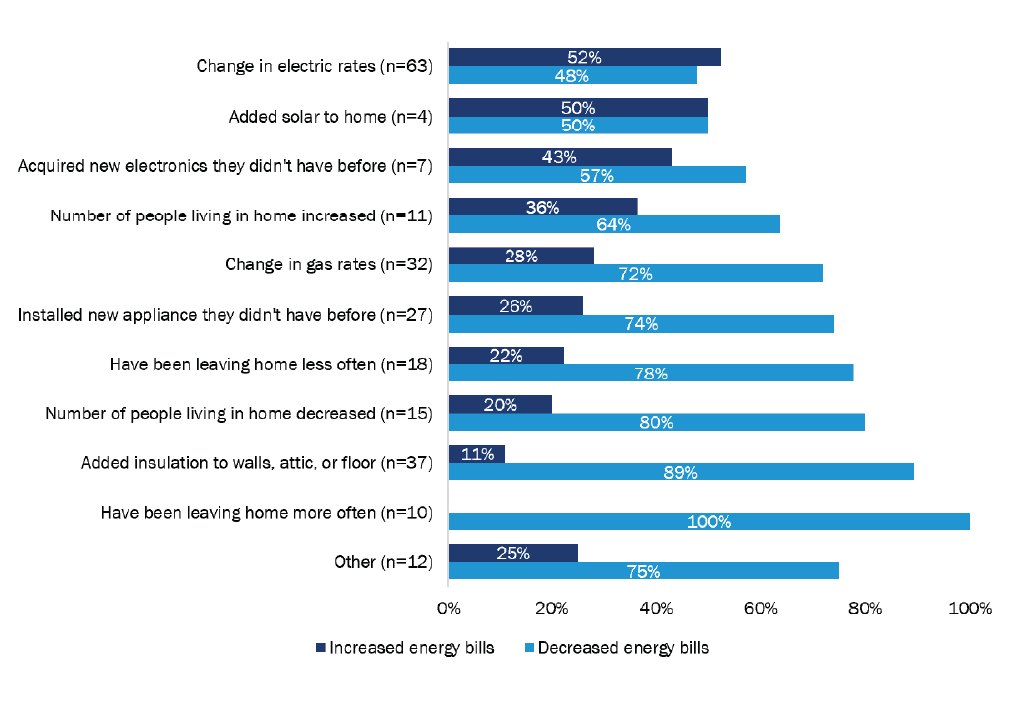
We followed up with respondents who reported a rate change to understand if the adjustment was voluntary, such as switching to a different rate plan, or if the change was an involuntary increase in fuel cost. Among those who reported a change in their electric rate, nearly all (58 of 63; 92%) said this was due to their utility involuntarily raising their price of electricity. Additionally, 94% of those who reported a change in their gas rate (30 of 32) said it was a result of their utility increasing the price.
2.3.6 Satisfaction
Overall, customers were satisfied with their HVAC heat pump, although those with a ductless system expressed slightly higher satisfaction than those with a ducted system (Figure 39).
Figure 39. Customer Satisfaction with HVAC Heat Pump
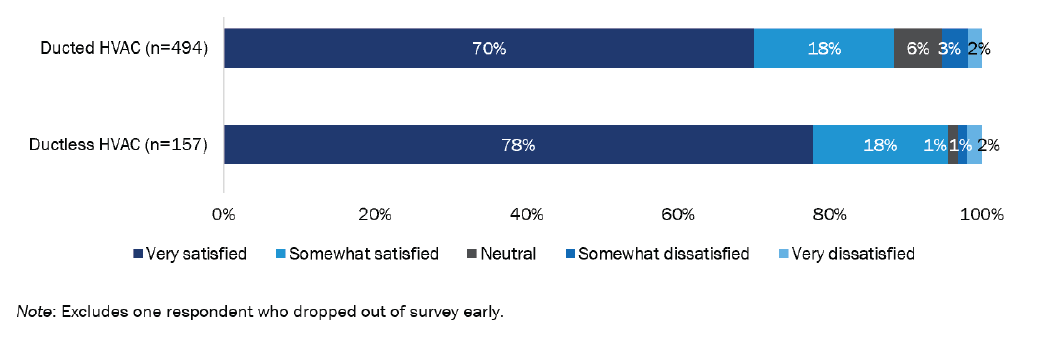
Respondents who expressed dissatisfaction with their ducted system (26 of 494; 5%) shared the reason(s) for their low rating (Table 11). Surveyed TECH customers were most commonly dissatisfied with their ducted heat pump due to noise produced by the system and insufficient heating and/or cooling. For ductless systems, respondent dissatisfaction was the result of insufficient heating/cooling (four respondents), as well as difficulty with and high cost of operating the equipment (one respondent).
Table 11. Customer Reasons for Dissatisfaction with Ducted HVAC Heat Pump (n=26)
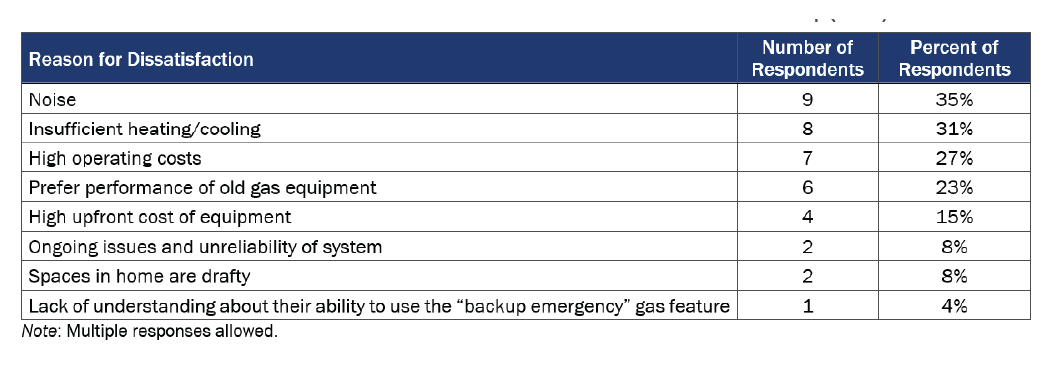
In general, most TECH customers saw value in their HVAC heat pump investment (Figure 40). Although, customers more commonly rated the investment as “good” rather than “great.”
Figure 40. Customer Perceived Value in HVAC Heat Pump Investment
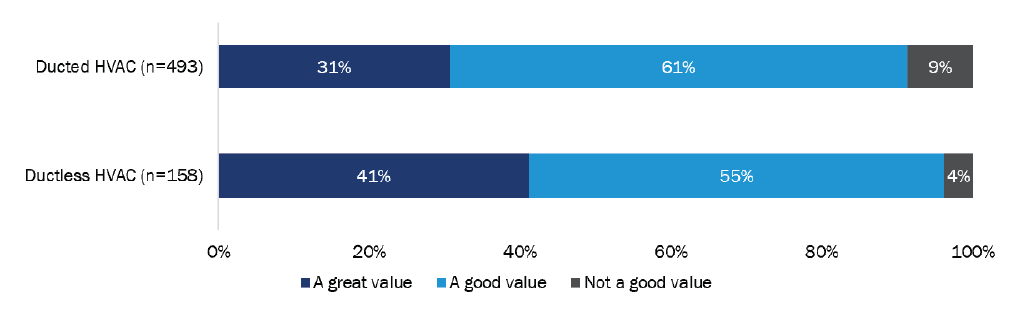
Customers who rated their HVAC heat pump as “not a good value” most often cited high operating costs and high upfront costs (Table 12).
Table 12. Customer Reasons Why HVAC Heat Pump Investment Was Not a Good Value (n=49)
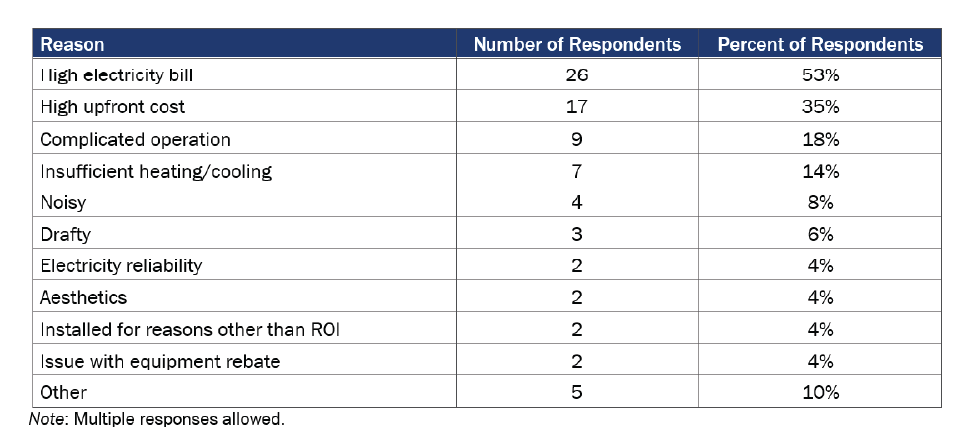
We elaborate on each reason shared by respondents below.
-
- High electricity bill (26 of 49): Since heat pumps run on electricity and provide both heating and cooling, many customers who transitioned from a gas-powered heater, or did not previously have air conditioning, saw an increase in their electric bill. This large appliance now running on electricity for both heating and cooling, paired with rising electric rates in California, has resulted in high electric costs for many customers, some mentioning a longer wait to realize a ROI. Additionally, as with the high upfront cost, respondents did not feel the various benefits of the equipment outweighed the high cost to operate.
- High upfront cost (17 of 49): The initial cost of the heat pump equipment and installation is generally higher than other HVAC equipment options. For many, the performance of the equipment, including its all-electric feature reducing GHG emissions, did not outweigh the burden of the higher upfront cost.
- Complicated operation (9 of 49): Due to the high cost of the equipment, customers had specific expectations for their HVAC heat pump. For some, the performance had fallen short of these expectations or the operation of the equipment had been more complicated than anticipated.
- Insufficient heating/cooling (7 of 49): The new HVAC heat pump was unable to sufficiently heat and/or cool certain spaces in the home, or in some cases the whole home, to the set temperature.
- Noisy (4 of 49): A few customers expressed frustration with the level of noise produced by their HVAC heat pump, one specifying it was much louder than they expected considering the cost of the equipment.
- Drafty (3 of 49): Since having the equipment installed, three customers noticed unfavorable drafts in their home produced by the HVAC heat pump.
- Electricity reliability (2 of 49): Two respondents shared concerns about electricity reliability in California, particularly in the summer. They noted that electricity supply can sometimes be curtailed to prevent wildfires.
- Aesthetics (2 of 49): A couple customers disliked the look of the equipment, one specifying distaste for the intake vent cover.
- Installed for reasons other than ROI (2 of 49): A couple respondents who rated the equipment as not a good value elaborated that although they do not feel the investment is of good monetary value, they had motivations other than ROI for selecting the equipment. These included environmental impacts and to utilize energy generated by their solar panels.
- Issue with equipment rebate (2 of 49): Through the TECH Initiative, customers were offered a rebate to offset a portion of the upfront equipment cost, helping to alleviate the cost difference between cheaper heating/cooling equipment options. Some customers have still not received this rebate and thus have paid significantly more money for the equipment than they agreed to pay.
- Other (5 of 49): These responses included continuous issues with equipment causing inability to heat the home, dislike of performance in comparison to gas equipment, technology was considered too new and glitchy, reliability issues (system consistently shuts down), and they did not use the system enough to make up for cost.
Customers were likely to recommend an HVAC heat pump to others. In fact, half (323 of 637; 51%) indicated they were extremely likely to recommend it. Respondents rated how likely they were to recommend an HVAC heat pump to their family and friends using a 0 to 10 scale (zero was “not at all likely” and 10 was “extremely likely”). The average rating score across respondents with a ducted system was an 8, respondents with a ductless system was a 9. For both ducted (112 of 222; 50%) and ductless (57 of 101; 56%) systems, more than half of those who were extremely likely to recommend the equipment also indicated they had solar installed in their home.
Table 13 is organized into three columns based on likelihood to recommend; it also includes reasons customers provided in open-ended responses to explain why they gave the rating they did. The reasons in bolded font correlate with higher likelihood to recommend an HVAC heat pump, while the reasons in normal font are why customers would be unlikely to recommend the equipment. For example, most customers who said the equipment was cost-effective and quiet were likely to recommend it, while those who said it had a high upfront cost and was noisy were unlikely to recommend it.
Table 13. Rating for Likelihood to Recommend HVAC Heat Pump by Reason(s) for Rating (n=637)
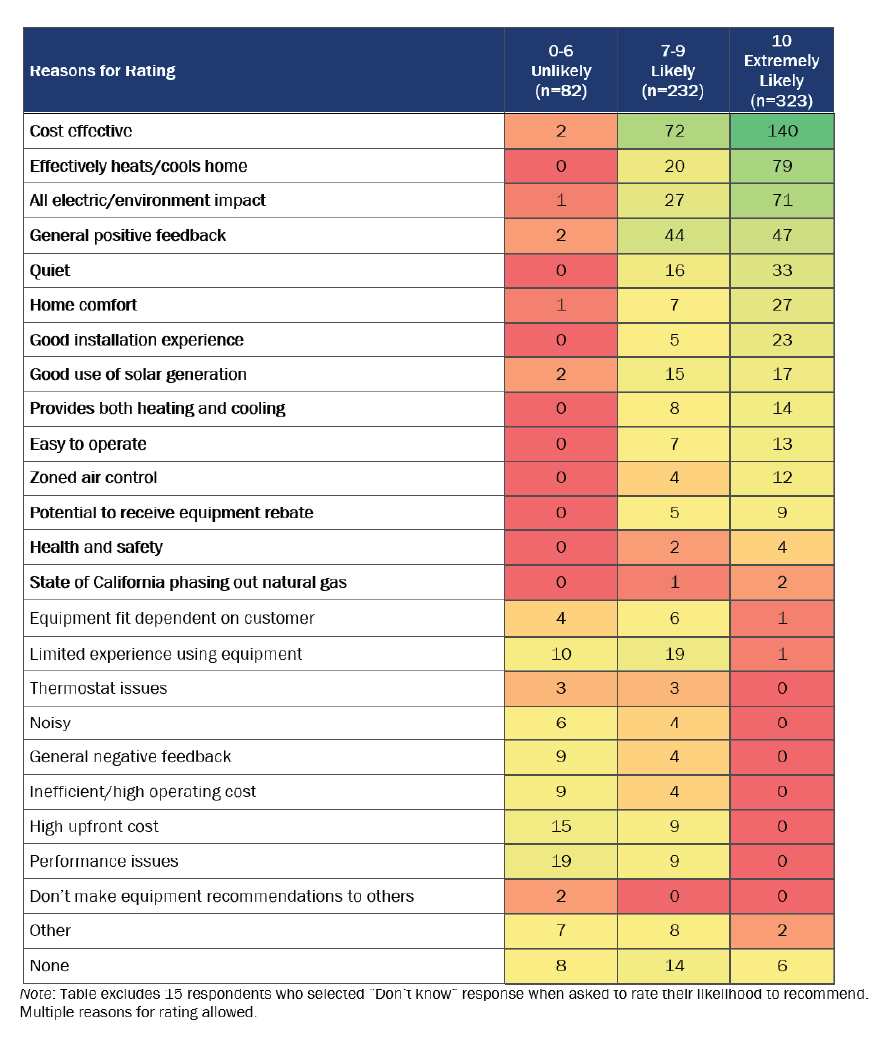
We elaborate on each reason provided by respondents below.
- Cost effective: Nearly all customers who mentioned this topic were at least likely to recommend an HVAC heat pump. Responses discussed how heat pumps use less energy, cost less to operate, or provide good value, even when considering the higher upfront cost compared to other HVAC equipment options. This category also includes responses that noted the efficiency of the equipment.
- Effectively heats/cools home: These 99 respondents had experienced their heat pump effectively heating and/or cooling their home as intended, causing them all to be highly or extremely likely to recommend an HVAC heat pump to others,
- All electric/environment impact: All but one of the customers who shared they want to encourage others to install electric appliances to mitigate climate change by reducing carbon footprints were highly or extremely likely to recommend an HVAC heat pump.
- General positive feedback: These respondents shared nonspecific positive feedback indicating satisfaction with their heat pump. All but two of these respondents were highly or extremely likely to recommend the equipment to others.
- Quiet: These 49 customers were at least highly likely to recommend a HVAC heat pump due to their satisfaction with the low to unnoticeable noise produced by equipment when operating. There were 10 heat pump brands represented among these customers, and one-quarter had a Mitsubishi (12 of 49; 24%). The Trane and Daikin brands closely followed with nine customers each saying their equipment was quiet.
- Home comfort: In most cases, this referred to improvements in home comfort due to more consistent temperature control throughout the home and cleaner air (as a result of transitioning from gas to electricity). Only one respondent included in this category was unlikely to recommend a HVAC heat pump, and mentioned a weird smell produced by the equipment as a negative impact on their home’s comfort.
- Good installation experience: These 28 customers found the equipment installation to be easy and seamless, making them at least highly likely to recommend it to others. Their experience with the contractor who installed the equipment was positive; they reported the contractor provided satisfactory service.
- Good use of solar generation: Most of these respondents were highly or extremely likely to recommend a heat pump to others because, as a major electric-powered appliance, heat pumps present a great opportunity for those with solar PV systems to use their sustainably generated energy and reduce their energy bills and reliance on utility providers.
- Provides both heating and cooling: These 22 respondents were all highly or extremely likely to recommend due to the convenience of both home heating and cooling being produced by a single unit rather than two separate systems. Respondents emphasized how this is an advantageous feature in situations when a whole-house unit needs replaced.
- Easy to operate: These 20 respondents were likely to recommend an HVAC heat pump as they found it easy to operate and a simple, straightforward system.
- Zoned air control: For ductless systems specifically, the ability to control heating/cooling in the home by specific “zones” or areas is convenient, economical, and efficient, making these 16 customers likely to recommend the equipment.
- Potential to receive equipment incentive: These 14 respondents were highly or extremely likely to recommend the equipment to others due to incentives available for the equipment to significantly offset the high upfront cost.
- Health and safety: Compared to a gas-powered system that emits carbon and poses potential for combustion, these six customers recognized heat pumps as a safer option for homes and thus were highly or extremely likely to recommend the equipment.
- State of California phasing out natural gas: Due to the State of California’s plan to phase out natural gas use in homes, a few respondents mentioned they would be likely to recommend the equipment since switching to a heat pump may be advantageous for others to proactively align with these future requirements.
- Equipment fit dependent on customer: These respondents varied in terms of likelihood to recommend a heat pump to others, acknowledging that heat pumps may not be appropriate for all people and their home needs. Respondents shared criteria they thought impacted home fit, such as income level/affordability, space in home and location options in home to install heat pump, climate zone, and size and layout of home.
- Limited experience using equipment: Due to limited experience with the equipment, some respondents felt uncomfortable or unfit to recommend a HVAC heat pump to others. Many respondents who mentioned having limited experience with the equipment have so far had a positive experience; however and were therefore still highly likely to recommend it.
- Thermostat issues: The six customers in this group had a poor experience using the thermostat, including general difficulty operating the equipment and setting the temperature, as well as needing to constantly adjust for heating/cooling. Despite this, half of these respondents were still highly likely to recommend a HVAC heat pump to others.
- Noisy: These respondents found the excessive noise or vibrations produced by their equipment to be disruptive in their home, making most of them unlikely to recommend a heat pump to others.
- General negative feedback: These respondents shared vague, negative feedback indicating dissatisfaction with their heat pump, most of whom were unlikely to recommend the equipment.
- Inefficient/high operating cost: These respondents were unlikely to recommend a heat pump after they observed the equipment to be inefficient or failed to see a decrease in their energy bills as expected. In some cases, respondents reported an increase in their overall energy bills.
- High upfront cost: Respondents found the higher initial cost of a heat pump in comparison to other HVAC equipment options unattractive. Although this factor made most (15 of 24) of these respondents unlikely to recommend the equipment, a few acknowledged this higher cost but said they would still recommend it. Therefore, for some, the performance or benefits a heat pump provides outweigh the initial cost burden.
- Performance issues: It seems that poor performance was the number one reason customers were unlikely to recommend an HVAC heat pump. For these 28 customers, their system had failed to operate as designed, or as expected, and had not sufficiently heated or cooled the home. In some cases, respondents said their system’s performance was inconsistent, such that either the system operated correctly a portion of the time (both ducted and ductless systems), or it operated better or worse depending on the space in the home (specific to ductless systems). Despite this being the primary reason many were unlikely to recommend the equipment, a few who expressed some form of dissatisfaction with their system’s performance were still likely to recommend it. This suggests these issues may have been resolved or other benefits of the equipment, such as reducing GHG emissions or it being safer than a gas appliance, outweigh the issues they experienced.
- Don’t make equipment recommendations to others: Some respondents said they are unlikely to recommend the equipment simply because they don’t generally make recommendations to others.
- Other: These responses include difficulty in becoming accustomed to heat pumps, the belief that heat pump technology has room for improvement, concern about durability compared to a furnace, and the equipment’s minimal maintenance needs.
- None: These customers did not provide a strong reason for their rating, and reported answers such as “just a feeling,” “nothing in particular,” or “no reason.”
2.4 Customer Suggestions for Improvement
At the end of the survey, we provided the TECH customers an opportunity to share any final comments. More than a third of those who offered comments (97 of 253; 38%) provided positive feedback, mentioning how happy they were with their system.
A minority of comments, from 24 respondents, offered recommendations they thought should help improve heat pump adoption and ease the customer experience when using their new heat pump equipment. These customer suggestions included,
-
- educate customers more about heat pump technology to provide clearer expectations about pros and cons of equipment, including maintenance needs;
- provide online user manuals to operate equipment;
- offer more models with smart home or advanced scheduling features;
- direct rebates to customers and contractors separately to ensure they are relayed to the customer; and
- package equipment rebates to maximize potential savings for customers.
3. Conclusions and Recommendations
Overall, we found customers were largely satisfied with their heat pump equipment. We offer the following conclusions and recommendations.
Conclusion: The factors causing the greatest dissatisfaction with the HPWH purchase included the high upfront cost and a high electricity bill. Customers who paid a premium for the equipment may seek to recoup some of that investment via an expectation of reduced monthly energy bills, and if those financial savings are not realized, that can lead to dissatisfaction with the equipment. At the same time, many of those who were “extremely likely” to recommend a HPWH found it to be cost-effective. Notably, most surveyed HPWH customers whose monthly energy bills went down had solar PV, suggesting that those without solar PV may be paying more to heat their water than before due to the relatively lower cost of natural gas.
Recommendation: We suggest TECH contractors inform customers who purchase a HPWH about Time-of-Us rates if they are not already on those rate plans because they afford additional baseline allocations for heat pump customers. The CPUC and TECH implementers may also want to consider exploring ways to encourage customers to install solar PV at the same time they are purchasing a HPWH. The PV and HPWH are complementary and, together, can result in higher customer satisfaction with HPWHs and lower utility bills. Pairing incentives for HPWHs with solar PV or developing synergies between HPWH contractors and solar contractors may be fruitful for expanding home electrification.
Conclusion: Though representing a minority of cases, the most common HPWH issues surveyed TECH customers reported derived from something that occurred during installation. Noise and vibration issues were common, but surveyed customers also reported plumbing issues, leaks from pipes, and condensate issues. Noise from the HPWH was noticed by one-third of customers (100 of 300), and it bothered most of them (73 of 100). Vibration issues were only noted by 12 customers but were more bothersome to them. Even so, of the 61 surveyed customers bothered by HPWH issues, most (47) had not taken any steps to address the issue. For 11 customers, the contractor came back to the home and installed a foam kit, vibration isolation kit, or a replacement fan to address the issue.
Recommendation: The TECH Initiative should ensure the organizations they partner with to provide HPWH training include instruction on how to avoid noise and vibration issues as well as leaks. The training should focus on installation practices that reduce noise and vibration issues such as not installing the HPWH near a bedroom wall or installing a vibration isolation kit.
Conclusion: Some surveyed customers reported difficulty controlling their HPWH via the user app or its Wi-Fi connection. These customers were frustrated that they could not access the functionality to adjust the water temperature, generate the intended reports, or consistently use the app.
Recommendation: The TECH Initiative should take advantage of the relationships made with HPWH manufacturers to provide feedback on the usability of the user app and smart equipment features. We recommend the TECH Initiative staff request manufacturers provide online user manuals in different languages about how to best control the equipment and effectively use the equipment’s app.
Conclusion: Ductless heat pumps were rated as more effective and having fewer problems than ducted equipment, and ductless customers were more satisfied. Surveyed ductless heat pump customers were more likely than ducted heat pump customers to rate the equipment as “highly effective” for both heating (50% vs. 36%) and cooling (59% vs. 46%). Fewer equipment issues were reported by customers with ductless systems than ducted (35% vs. 47%). And, more ductless customers were “very satisfied” with their heat pump than ducted (78% vs. 70%).
Conclusion: Whether a surveyed customer had air conditioning before their heat pump was a stronger predictor of lower energy bills than whether they bought a ducted or ductless system. Nearly half (46%) of those with air conditioning before reported a decrease in their bills, while fewer than one-third (29%) without air conditioning prior experienced a decrease. Surveyed HVAC heat pump customers were more likely to rate their equipment as a “good value” rather than a “great value.” Reasons why the remaining customers said their heat pump investment was “not a good value,” included high electricity bills and the high upfront cost.
Conclusion: HVAC heat pump performance is different enough from furnaces that customers should be advised about what to expect in terms of run times and the air temperature coming out of the vents. Surveyed HVAC customers noticed that the air coming out of the vents was not as hot as it had been with a furnace and that their heat pumps ran longer to heat up the home. About two-thirds of customers who noticed the change in air temperature from the vents were bothered by it (37 of 60). Heat pumps heat the air to about 95°, which is about 30°lower than furnace air.[9]
Recommendation: Contractors should educate their customers about these differences during the sales process. Setting the customers’ expectations in advance should reduce the number of callbacks and hopefully lead to a more satisfied customer.
Conclusion: A sizeable minority of surveyed HVAC heat pump customers needed the TECH contractor to come back and troubleshoot an issue. About one-quarter of surveyed customers experienced an issue with their HVAC heat pumps for which they needed to contact a contractor. In the majority of those cases, the contractor addressed the issue with troubleshooting. The three most common issues were an error during installation (such as incorrect wiring, incorrect setting of air handler, and errors with ductwork), insufficient heating or cooling, and thermostat issues.
[9] Bailes, Allison A. 2022. A House Needs to Breathe… Or Does It? Bright Communications: Hellerton, PA.
Appendix: Survey Instrument
Please click on the icon below to view the TECH Customer Six-Month Post-Install Survey instrument.

TECH Six Month Post-Install Survey