
TECH CLEAN CALIFORNIA WIKI
TECH Initiative Baseline Market Assessment
October 3, 2022
1. Executive Summary
The State of California is encouraging installations of low-emission space- and water-heating equipment in order to reduce greenhouse gas (GHG) emissions and meet its climate goals. The Technology and Equipment for Clean Heating (TECH) Initiative incentivizes the installation of air-source heat pumps (ASHPs) for space-conditioning and heat pump water heaters (HPWH) for water-heating in existing residences. TECH does this through a combination of market incentives, supply chain engagement, workforce development, consumer education, regional pilots, and Quick Start Grants. The initiative’s overall goal is full-scale market transformation of the heat pump market in California to ensure a thriving market for clean heating technologies in the next 10 years.
Opinion Dynamics is the embedded evaluator for TECH, measuring its impacts in the market. This report characterizes the baseline conditions in the space- and water-heating markets for heat pumps in 2021, before the TECH Initiative incentives launched. To characterize the markets, we investigated the installed base of heat pumps; awareness and preferences of property owners who purchase heat pumps; contractor readiness to install heat pumps; trends in shipments of the equipment; incentive and financing offerings to help consumers pay for heat pumps; and the cost of installations. This was done through a combination of primary and secondary data.
We found that the HVAC heat pump market is more developed than the HPWH market. Below we share key findings from the study.
Heat pumps represent a small portion of the installed base of HVAC and water-heating equipment. California is largely using natural gas-powered space-heating equipment or inefficient electric heating equipment. On the water-heating side, gas storage and gas tankless systems are common. About 4% of space-heating equipment in 2021 were ASHPs, while HPWH comprised about 2% of water heaters in multifamily homes and 0.4% of water heaters in single-family homes in California.
Homeowner awareness of heat pumps is moderate, but their understanding of them is low. Half of homeowners had heard of HVAC heat pumps and only half of those were either very or somewhat familiar with them, compared to 83% reporting the same for traditional central air conditioners. Fewer than one-third of homeowners (31%) had heard of a HPWH and fewer than one-third of ductless heat pump owners were very familiar with them. These data demonstrate a growing awareness of heat pumps among property owners but also a lack of familiarity in heat pump features and function.
Homeowners perceive ASHPs as expensive to install, service, and repair, and question whether they’re reliable and a good value. Reliability, performance, and cost were extremely important factors for homeowners when replacing their heating and/or cooling equipment. At the same time, more than half of surveyed homeowners were unsure if heat pumps are reliable and offer a better value than other electric heating and cooling options. Twice as many homeowners agreed heat pumps are expensive to install, service, and repair than disagreed.
Concern about increased utility costs is the biggest barrier to purchasing a heat pump among homeowners who were aware of them. For HPWHs, 55% of surveyed homeowners were concerned about rising utility bills; and 50% had this concern if they were to purchase an HVAC heat pump.
Heat pump jobs comprise a minority of surveyed contractors’ work. The majority of surveyed contractors’ firms sold fewer than two ASHPs per month last year. Across the whole sample, they averaged about five ASHP installs per month, which was skewed by one high-performing firm, that reportedly installed 1,000 HVAC heat pumps in 2021. For water heating, surveyed contractors’ companies installed fewer than one HPWH per month in 2021. Over one-third of surveyed contractors’ companies did not sell a single HPWH last year. About half of the remaining companies sold fewer than 10 HPWHs in 2021.
A majority of contractors (69%) were extremely confident in their ability to install ASHPs despite a smaller number (54%) being extremely confident in their ability to size the equipment. Contractors were least confident in their ability to service and maintain ASHPs with some reporting they were “not at all confident” with those specific tasks. Water heating contractors were also generally confident in their ability to work on HPWHs, though only half were extremely confident installing them. They were least confident in their ability to maintain and service HPWHs.
With few industry standards available for heat pump water heater system sizing, contractor training about sizing is warranted to provide guidance on how to balance maximizing energy efficiency and greenhouse gas reductions with oversizing HPWHs to maximize grid benefits.
A minority of the ASHPs are installed with time-of-use controls. Half of the surveyed contractors who sell ASHPs did not include time-of-use controls on the heat pumps, and the remainder did it infrequently. The potential for ASHPs to be responsive to grid conditions can be improved as more contractors become familiar with time-of-use controls and how to implement them on HVAC heat pumps.
ASHPs are more expensive to install than gas-fired furnaces, while the total cost to install a HPWH was similar, though slightly higher, than a natural gas tankless water heater. The average cost to install an ASHP was estimated at roughly double the average cost of installing a natural gas furnace, though labor costs vary by region. The factors that influence HPWH installation costs included location (both of the unit within the house and of the home in California), contractor experience, and customer budgets. There may be some “risk pricing” in these estimates, whereby contractors inflate their prices to cover unforeseen risks. As the TECH Initiative is implemented and more contractors gain experience with heat pumps, these costs will likely decline.
Availability of incentives for heat pumps in 2021 were concentrated in the Bay Area and Northern California. According to data from Energy Solutions, the TECH implementer, Northern California cities outside of the Bay Area included Redding, Shasta Lake, Roseville, Sacramento, and Modesto. About half of contractors knew of heat pump incentives and most of those promoted the incentives to their customers. A majority of homeowners who had heard of HVAC heat pumps were unaware of the incentives for them.
Half of surveyed contractors offer financing to their customers for heat pump retrofits and about 20% of their heat pump customers used financing. Half of surveyed homeowners were unaware of financing available to help them pay for HVAC or water-heating equipment.
Together, these findings demonstrate the heat pump market is primed to grow. Awareness of heat pumps is expanding among homeowners, yet they lack a deep understanding of the benefits heat pumps can offer. Homeowners are concerned about rising electric bills and are skeptical of heat pumps’ value. Marketing to consumers can increase their awareness of heat pump benefits and of heat pump incentives and financing, helping them reduce their upfront payments.
Contractor training will be important to ensure installers are confident working on heat pumps; training should target sizing, servicing, and maintaining heat pumps. The fact that a minority of contractors’ work is heat pumps and a minority of them are installed with time-of-use controls shows substantial potential in heat pumps’ ability to be a grid resource. The TECH Initiative’s main activities and intervention strategies are well positioned to target these market areas.
2. Introduction
TECH is a $120 million initiative designed to help advance the state’s mission to achieve carbon neutrality by 2045 by driving the market adoption of low-emissions space and water-heating technologies for existing single-family and multifamily residential homes. The initiative was created as part of California Senate Bill 1477 and is funded by revenues collected through California’s Cap-and-Trade program. Through a combination of market incentives, supply chain engagement, workforce development, consumer education, regional pilots, and Quick Start Grants, the initiative installs low-emissions space and water-heating technologies across California homes. Additionally, TECH will collect and publish energy and GHG impacts and market data to inform California’s long-term decarbonization plan.
The initiative’s overall goal is full-scale market transformation of the heat pump market in California to ensure a thriving market for clean heating technologies in the next 10 years. To do so, the initiative is designed to be a centralized flagship program used to create best practices for statewide implementation for all existing and potential heat pump HVAC and HPWH programs. To achieve lasting scale, the initiative will pave a path for favorable decarbonization policy that makes heat pumps cost-competitive with incumbent technologies.
Opinion Dynamics is serving as the embedded evaluator for the TECH Initiative. One of our first evaluation activities was to work with the prime program implementer, Energy Solutions, to create a Program Theory Logic Model (PTLM) that explicates the TECH Initiative’s activities, outputs and intended market and program outcomes. We also developed key performance indicators (KPIs) that, when measured, can demonstrate whether the intended outcome was achieved. Examples of KPIs include measures of how contractors’ heat pump promotion strategies have changed, or measures of improvements in customer familiarity with heat pump benefits.
It is integral that we understand the natural market baseline when evaluating a market transformation initiative. This baseline is defined as the counterfactual, or what would have occurred in the market absent the initiative. It takes into account current practices, impending policy changes and known code updates to equipment standards or building energy codes. In these cases, evaluators develop a forecast based on reliable data sources with adjustments for market changes that influence the baseline. After the initiative has been implemented, we will be able to evaluate the difference between the market KPIs and the baseline to understand market changes the TECH Initiative influenced.
This report is a baseline assessment of the residential space- and water-heating retrofit market in California as it relates to heat pumps. It describes the market conditions in California before the TECH Initiative incentives began. The TECH Initiative officially launched December 7, 2021; and is a midstream pilot program intended to transform the California market, by incentivizing contractors to install ASHPs and HPWHs.
2.1 Study Objectives
Opinion Dynamics sought to characterize the residential retrofit, space- and water-heating market in California in 2021. We examined homeowner preferences and decision-making around equipment replacement, as well as their awareness of home upgrade financing and heat pump rebates. We also investigated the availability of a qualified workforce to sell and install heat pumps, including their experience and confidence with heat pumps, and their promotion of heat pump rebates and financing. Finally, we assessed the size of the heat pump market in California, looking into shipments and sales. At times, we compared findings between the single-family and multifamily markets, disadvantaged communities (DACs) and non-disadvantaged communities, as well as by climate zone.[1]
[1] The TECH Initiative defines multifamily buildings as those with five or more units.
2.2 Methods
Opinion Dynamics used a variety of data sources to complete this residential baseline assessment of HVAC and water-heating heat pumps in California. Secondary data sources informed market penetration and primary data sources collected insights of single-family property owners and licensed contractors.
2.2.1 Secondary Data
Data on shipments of HVAC heat pumps and their refrigerants came from the Heating, Air Conditioning Refrigeration Distributors International (HARDI) organization. We also used shipment data from the Air-conditioning, Heating & Refrigeration Institute (AHRI). The 2019 Residential Appliance Saturation Study (RASS) informed heat pump penetration statistics. The installation cost information comes from a Delphi Panel conducted by Opinion Dynamics in 2020.[2] The Delphi study collected primary data from individuals interfacing with the ASHP and HPWH markets. The core objective of the Delphi study was to develop cost baselines, which included: upfront incremental equipment costs, upfront incremental installation costs, including labor and infrastructure upgrades, upfront permitting costs and timelines, upfront incremental design costs, and annual incremental operation and maintenance costs. We also used data from the Contractors State Licensing Board (CSLB) to estimate the number of contractors licensed to work on heat pumps. Data on baseline heat pump incentive programs was provided by Energy Solutions. Finally, information from the use of financing for residential equipment upgrades comes from the California Alternative Energy and Advanced Transportation Financing Authority (CAEATFA).
[2] Opinion Dynamics. California Heat Pump Residential Market Characterization and Baseline Study. May 9, 2022. https://www.calmac.org/publications/OD-CPUC-Heat-Pump-Market-Study-Report-5-17-2022.pdf
2.2.2 Contractor and Installer Survey
Opinion Dynamics surveyed market actors to gather information about contractor familiarity with heat pump technologies and the share of HVAC and water-heating jobs and sales that are heat pumps. This survey was designed to fulfill multiple objectives:
- Assess contractor confidence in selling, installing, servicing, and/or maintaining HVAC heat pumps and HPWHs
- Assess share of HVAC and hot water work and sales that is heat pump-related
- Gather information about the number of workers trained to sell, size, install, service, and maintain heat pumps
- Gather information about the type of training contractors receive or prefer
- Collect information about percent of available positions selling, installing, maintaining, and/or servicing HVAC heat pumps and HPWHs
- Assess availability of heat pump financing offered through contactors
- Understand contractor promotion of heat pump systems and initiatives
Our sample frame was based on two groups: licensed contractors in California who either were or were not enrolled in the TECH Initiative. We included more contractors not enrolled in TECH because this is a baseline study intended to capture contractors’ awareness and experience with space- and water-heating heat pumps prior to appreciable intervention by the TECH Initiative. Of the 4,032 contractors we invited to complete the survey, 532 were enrolled in TECH.[3] We selected contractors who had one of the following licenses: C-20 HVAC Contractor, C-36 Plumbing Contractor, or B General Building Contractor. We prioritized the first two licenses, as those are the specialty licenses needed to install space- and water-heating heat pumps, though B General Building Contractors can also install them in some situations. Please note that many surveyed contractors held a combination of these licenses, and some held other related licenses such as C-10 Electrical Contractor and D-34 Prefabricated Equipment. A total of 972 contractors in our sample frame held more than one license. Please see Table 28 in Appendix B for a breakdown of the licenses held by those we invited to take the survey.
In April and May 2022, we contacted these market actors via email and mail-push-to-web when an email address was not available, contacting each up to two times. The response rate was 3.4%. We achieved a total of 139 survey completes with market actors who offer residential equipment or services for HVAC and/or water heating. (Table 1). Respondents received a $100 gift card as a token of appreciation for taking the time to participate in this research.
[3] Contractors enrolled in TECH have met the license and insurance requirements and taken the required onboarding trainings. They are then eligible to apply for TECH incentives. Of the TECH contractors invited to take the survey, 489 were HVAC contractors, 119 were water heating contractors, and 109 were general contractors.
Table 1. Surveys by Market Actor (n=139)
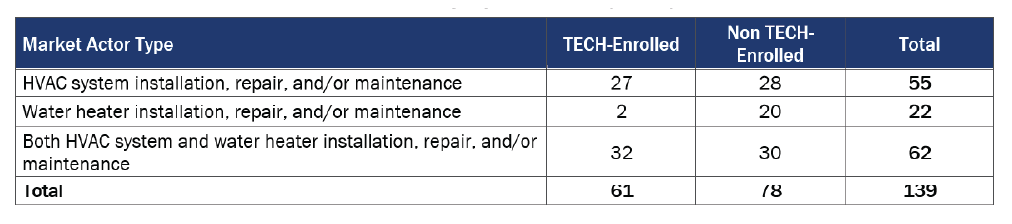
Nearly all respondents (136 of 139; 98%) provided retrofit services, with the remaining (3 of 139; 2%) respondents only working in new construction. Over half (85 of 139; 61%) indicated they work within both industries.
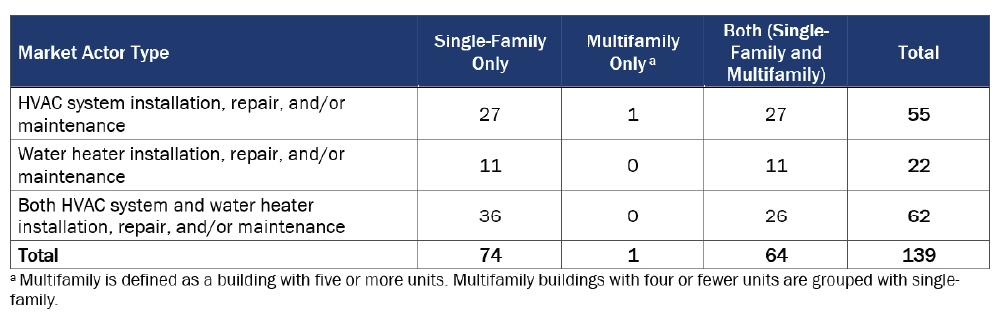
Almost all (138 of 139; 99%) served the single-family market and nearly half (65 of 139; 47%) served the multifamily market; thus, there was a strong overlap with (64 of 139; 46%) of respondents serving both single-family and multifamily markets (Table 2). When asked about their role within their company, respondents reported they were the owner (92 of 139; 66%), president or CEO (43 of 139; 31%), general manager (44 of 139; 32%), service manager (121 of 139; 15%), or sales manager (22 of 139; 16%), and the remaining eight (of 139; 6%) respondents reported they hold a different position at their company.
Table 2. Survey Respondents by Sector (Multiple Responses Allowed; n=139)
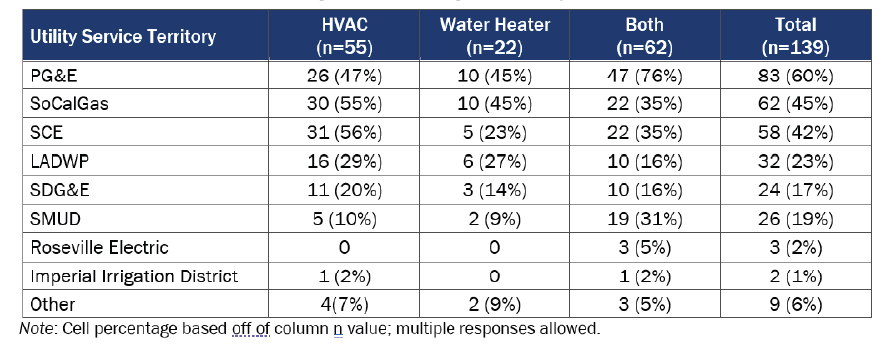
More than half of contractor respondents worked in PG&E’s service territory; this was the most common utility service territory reported among both HVAC and water heater market actors (Table 3). Just over one-third (53 of 139; 38%) of surveyed contractors work in two or more utility service territories in California.
Table 3. Utility Service Territory Where Respondents Work
Most surveyed contractors (118 of 139; 84%) worked in a single-location facility. Remaining respondents said the facility they work in is the headquarters of a company with multiple locations (14 of 139; 10%), a branch or franchise location of a company based in California (4 of 139; 3%), or something else (3 of 139; 2%).[4]
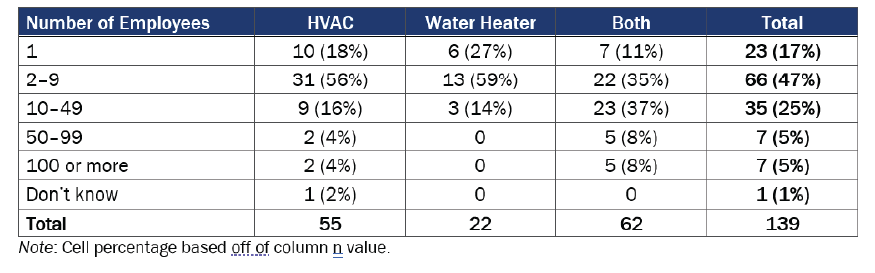
Half (50%) of respondents reported their company had fewer than five employees, and 17% (23 of 139) were sole proprietors (Table 4). One-third (46 of 139; 33%) said their company currently employs between two and four people. More than a third (49 of 139; 35%) of respondents worked for companies with ten or more employees, and five percent (7 of 139) noted their company had 100 or more employees.
[4] Other responses included a home office (one mention), a job site (one mention), and that they work from Home Depot, Costco, and Lowes stores all around the Southern California region. Two respondents said they don’t know what type of facility it is.
Table 4. Number of Employees by Market Actor (Part- and Full-Time; n=139)
A tiny portion of surveyed contractors reported their company’s employees are members of a union (4 of 139; 3%). These four respondents worked solely on HVAC systems. Among these four, two belonged to the Local 250 union, and two are associated with the Sheet Metal Workers Local 104 union. No respondents who work on water heaters reported employees at their company being members of a union.
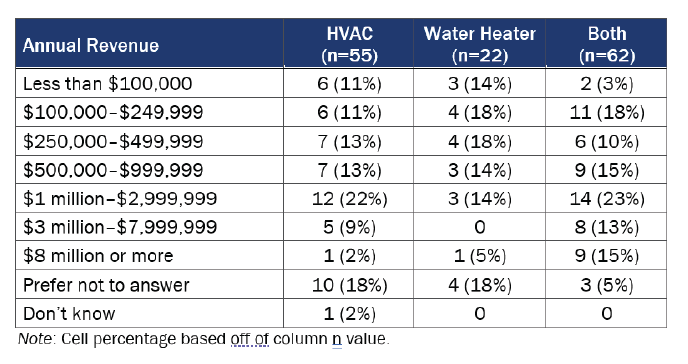
More than one-third (53 of 139; 38%) of respondents indicated their company’s annual revenue is one million dollars or more (Table 5). Only eleven (of 139; 8%) respondents reported an annual revenue of less than $100,000. Seventeen respondents (of 139; 12%) chose not to disclose this information, and one respondent said they did not know.
Table 5. Company Annual Revenue (n=139)
2.2.3 General Population Survey
Opinion Dynamics fielded a general population survey to single-family residents to assess awareness, familiarity, interest, and decision drivers around space conditioning and water heating in California. Specifically, the survey explored respondents’ perceptions and understanding of heat pump technologies and the benefits and barriers associated with them. The objectives of this survey follow:
- Explore respondent environmental belief systems and willingness to use electric appliances
- Gather information about homeowners’ heating, cooling, and water heating systems
- Explore customer decision drivers around space conditioning and water heating
- Gauge awareness and assess familiarity of HVAC heat pumps and HPWHs and the benefits and barriers to adoption
- Assess awareness of financing options and utility rebates for installing heat pump technology
They survey was fielded in March 2022. We achieved a total of 500 survey completes, representing a response rate of 25%. Half of respondents reported that they had a family size of two people or fewer, with only 10% of homeowners reporting that they had a family size of five or more. The average family size in DACs was slightly larger than in non-DACS, 2.7 and 2.5, respectively. PG&E and SCE provided electricity to two-thirds of respondents and PG&E and SoCalGas provided natural gas services to 80% of respondents. There was an even distribution across income categories, this was by design because the survey equally sampled DAC (n=250) and non-DAC (n=250) homeowners. The data was weighted based on US census data for gender, age, race, and education to ensure representation of the overall California population.
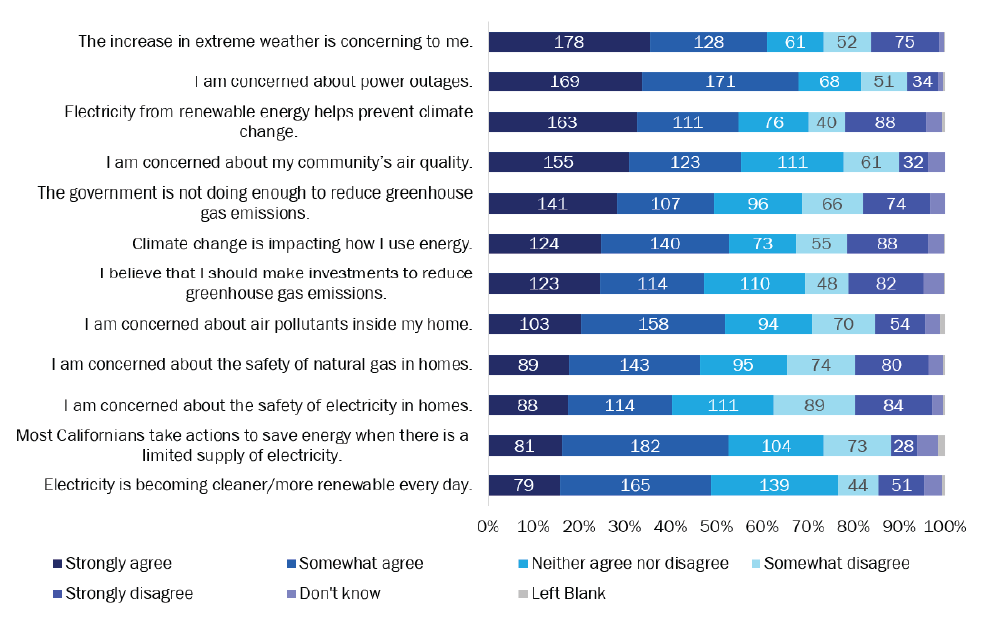
There was a subset of respondents (77 of 500; 15%) who appeared to be climate change skeptics. These respondents strongly disagreed that electricity from renewable energy helped to prevent climate change and strongly disagreed that climate change was impacting how they used energy. Figure 1 also shows that more than half of respondents were concerned about extreme weather, the highest level of agreement. Fewer than 20% of respondents strongly agreed that electricity was becoming cleaner and more renewable.
Figure 1. Environmental Belief Systems
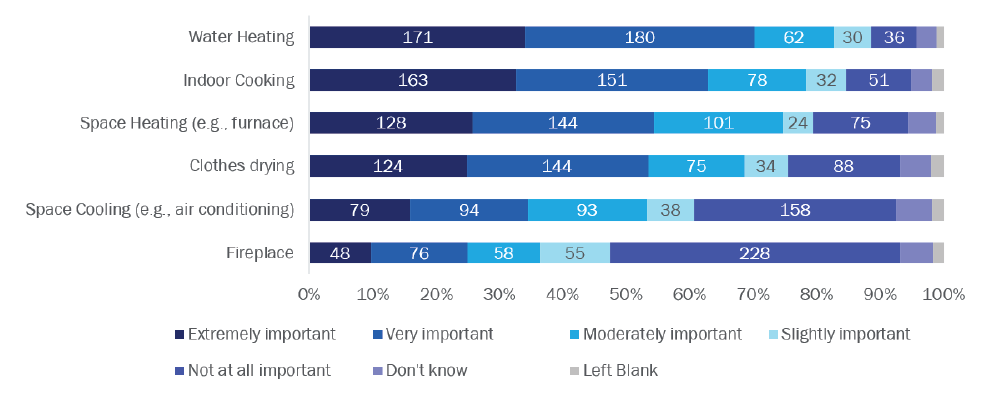
Homeowners were also asked about their willingness to use electric appliances in their home. Preferences for appliance fuel types were positively correlated, meaning that if a respondent had strong preferences for one natural gas appliance, they tended to prefer gas for other appliances as well. More respondents reported that it was extremely important to have natural gas appliances for water heating and indoor cooking, while fireplaces were less important (Figure 2). People concerned about the air pollutants inside their home tended to be more willing to use electric appliances.
Figure 2. Importance of Having an Appliance be Natural Gas (n=500)
3. Air-Source Heat Pump Market Detailed Findings
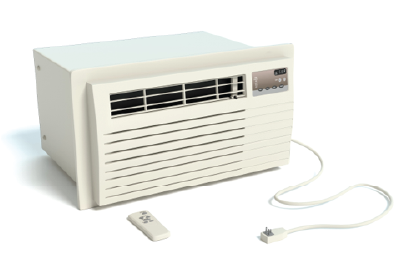
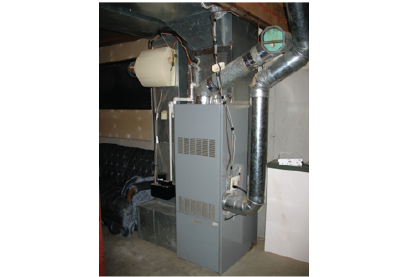
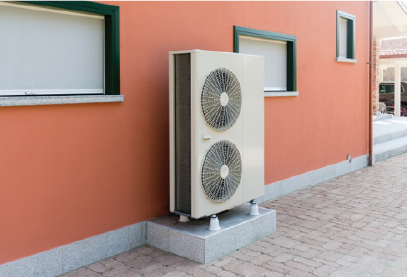
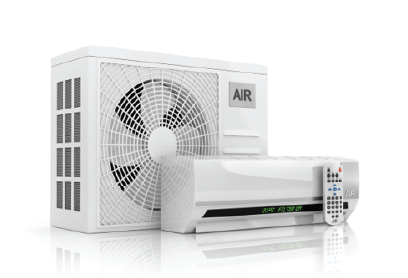
This chapter characterizes the market for ASHPs, drawing on the secondary data to describe shipments and the installed base, and the surveys with licensed contractors and homeowners to characterize awareness and preferences. ASHPs are one of many different HVAC devices available in the California market. Common residential devices and how they work are described in Figure 3.
Figure 3. Common Residential HVAC Units
Central Air Conditioner
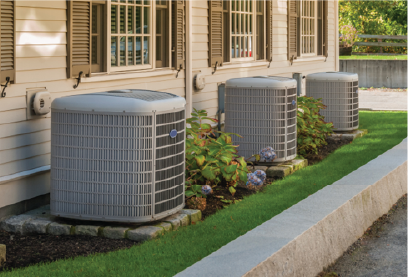
Central air conditioners circulate cool air using a blower through a system of supply and return ducts. Every air conditioner has three main parts: a condenser, an evaporator, and a compressor. With a typical “split system,” the condenser and the compressor are in an outdoor unit. The evaporator is mounted on or in the air-handling unit, which is often a forced-air furnace. With a “package system,” all of the components are combined in a single outdoor unit that may be located on the ground or on the roof. The most efficient air conditioners use 30% to 50% less energy to produce the same amount of cooling as air conditioners made in the mid-1970s.
Window Air Conditioner
A window air conditioner is the simplest type of AC unit. It is a single unit with all of the parts and components contained inside one box or casing. Window air conditioners are all rated with British thermal units (BTUs)—usually ranging between 5,000 and 12,000. BTUs are a measure of energy that essentially tells you how effectively a device can lower the temperature in a given space. This type of AC is usually mounted or installed in a window and plugs into a traditional electrical outlet.
Natural Gas Furnace
Natural gas furnaces are large heating appliances designed to distribute heat throughout a home through ducting. Natural gas furnaces generate heat by burning natural gas. Although older natural gas furnaces have efficiencies in the range of 56% to 70%, modern natural gas heating systems can achieve efficiencies as high as 98.5%, converting nearly all the fuel to useful heat for a home.
Air Source Heat Pump
Air source heat pumps (ASHPs) are an efficient electric heating and cooling option for homes. When properly installed, an ASHP can deliver 1.5 to 3 times more heat energy to a home than the electrical energy it consumes. This is possible because a heat pump moves heat rather than generates heat. An ASHP extracts heat from outdoor air, even in cold weather, and uses that to heat a home. In the summer, an ASHP works in reverse transferring the inside heat to the outdoor unit. ASHP systems have the capacity for single and multi-zoning.
Ductless Mini-Split Heat Pump
A ductless mini-split heat pump is a heating and cooling system that allows for the ability to control temperatures in individual rooms or a combination of rooms. Mini-split systems include a head unit, or multiple head units, that are mounted on an interior wall or ceiling, with an accompanying unit outside. Similar to an ASHP, a mini-split heat pump extracts heat from outdoor air, even in cold weather, and uses that to heat a home. In the summer, it works in reverse transferring the inside heat to the outdoor unit. Because they transfer rather than generate heat (or cold), mini-splits use up to 60% less energy.
3.1 Market Overview
According to HARDI, there were 167,649 air source heat pumps shipped to California in 2021. This is a slight increase from the 165,588 shipped in 2020; however, it is still lower than the sales observed in 2015 (172,899). ASHPs are tracked as cooling equipment given the specification alignment. Figure 4 shows the changes in ASHP shipments by month, since 2019 through the end of 2021. It only includes fossil fuel furnaces since distributor sales of electric furnaces are often sold just as the electric insert. In 2019, furnaces were much more popular than ASHPs, but that trend changed. In 2020 and 2021, shipments of ASHPs slightly outnumbered those for furnaces.
Figure 4. Monthly HVAC Sales in California 2019–2021
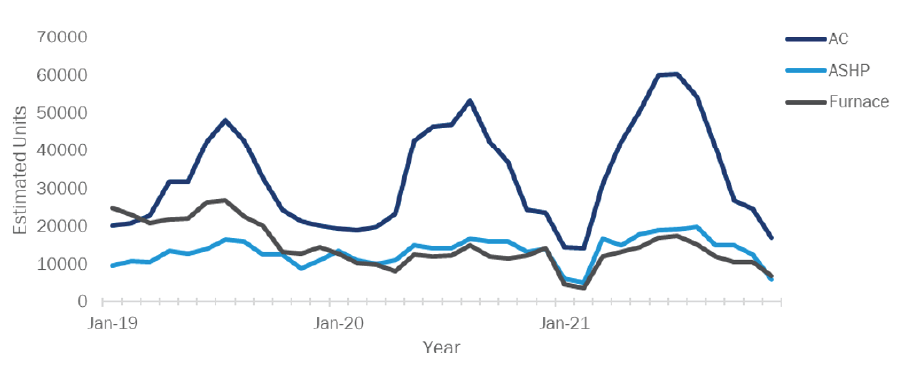
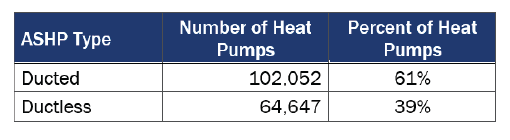
Table 6 shows that more ducted ASHPs were sold in California than ductless ASHPs in 2021.
Table 6. ASHP Types Sold in California in 2021
Almost 100% of the ASHPs sold in California in 2021 used refrigerant 410A, and only a few used refrigerant R-22. The Decision that authorized the TECH Initiative deemed a refrigerant global warming potential (GWP) threshold criterion of 750 GWP to begin January 1, 2023. Manufacturers indicated they will not be ready to meet this standard by the beginning of 2023.
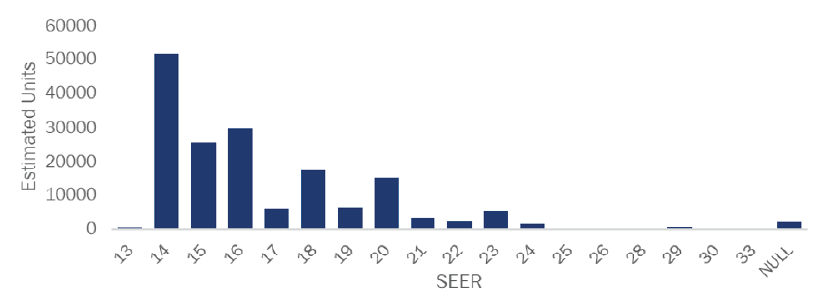
The Seasonal Energy Efficiency Rating (SEER) is used to rate the energy efficiency of ASHPs in cooling mode. Although the most common ASHPs shipped to California in 2021 were 14 SEER, over half (53%) had a SEER of 16 or higher. Figure 5 shows the breakdown of SEER ratings of the ASHPs sold in California in 2021.
Figure 5. Distribution of ASHP SEER Levels in 2021
3.2 Customer Awareness of Air Source Heat Pumps
The evaluation team gauged homeowner awareness of air source heat pumps, their benefits, and barriers.
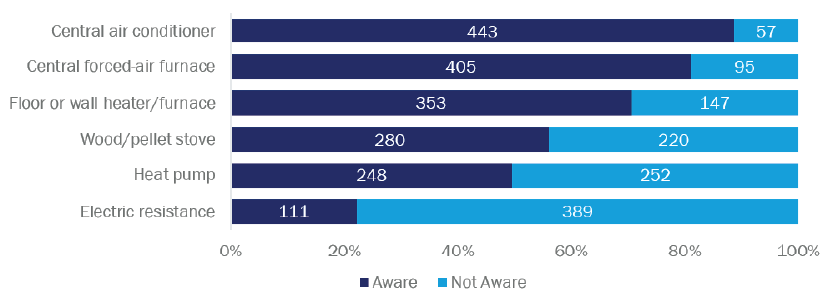
Almost 90% of respondents were aware of central air conditioners and just over 80% had heard of central forced-air furnaces (Figure 6. Note: multiple responses allowed). Half of respondents were aware of HVAC heat pumps while far fewer had heard of electric resistance heating.
Figure 6. Awareness of Different Heating and Cooling Systems (n=500)
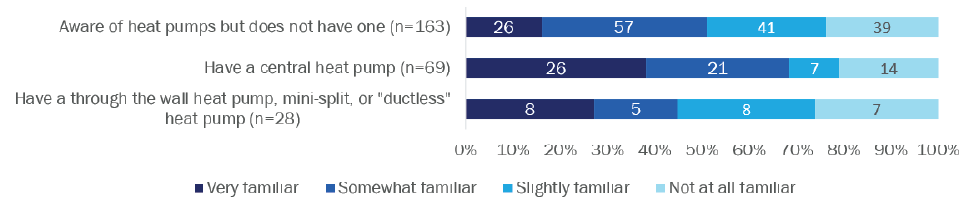
Of the 163 homeowners who knew of heat pumps but did not own one, half were very (16%) or somewhat (35%) familiar while the other half were slightly (25%) or not at all (24%) familiar (Figure 7). Compared to central air conditioners, which 83% of respondents were very or somewhat familiar and only 6% were not at all familiar. Even among respondents who had a central heat pump in their home, fewer than half (40%) felt they were very familiar with them; this figure dropped below 30% for ductless heat pump owners.
Figure 7. Familiarity with Heat Pumps
Twenty-seven percent of respondents who were aware of heat pumps first heard about them through word of mouth; other popular sources of information included social media (12%) and news articles (10%).
Homeowner respondents did not know a lot about the benefits and drawbacks of HVAC heat pumps. When the evaluation team asked respondents to identify heat pump benefits in an open-ended, unaided question, 54% said they did not know enough to even make a guess. Otherwise, 13% believed they were more efficient and saved energy, while another 6% did not believe they were beneficial. Below are some illustrative quotes from respondents, representing those three groups:
- More efficient. “Heat pumps are more efficient than some other forms of heating and are reversible to also provide cooling. There are different types of heat pumps that work in different environments.”
- Don’t know. “I don’t know enough to make a statement.”
- Not beneficial. “None, I’ve heard heat pumps are energy wasters.”
An additional 6% noted they were all-electric and could reduce GHG emissions, while 4% noted that they provide both heating and cooling. Another 3% mentioned that they could provide improved indoor comfort.
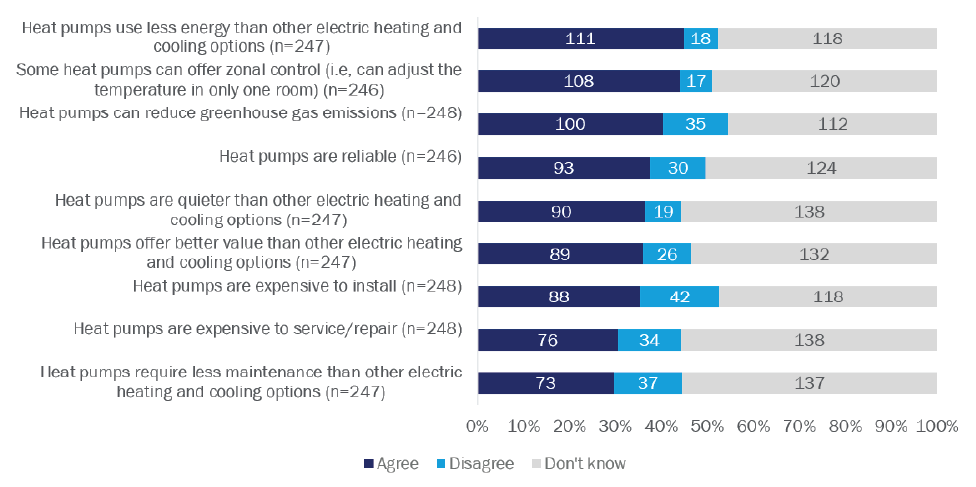
We then asked them to agree or disagree with statements about HVAC heat pumps, with the option of answering “don’t know.” Figure 8 shows that for each statement, between 45% and 55% of respondents reported that they did not know. The high rate of “don’t know” tells us that they did not feel comfortable taking a side or even guessing an answer. Only respondents who said they were aware of heat pumps were asked these questions, demonstrating that even though people were aware of them, they did not understand the benefits and drawbacks of these systems.
The statement that had the largest number of respondents agreeing with it, was that HVAC heat pumps use less energy than other heating and cooling options with only 7% disagreeing. There were conflicting responses for whether a heat pump was expensive to install, although, twice as many people agreed (35%) than disagreed (17%) that heat pumps are expensive to install. We see the same pattern for the statement expensive to service/repair. A lot more, though, agreed that they offer a better value than other equipment options (36% agreed versus 10% disagreed).
Figure 8. Benefits and Drawbacks to Heat Pumps
3.3 Current HVAC Systems
RASS data indicate that in 2019, California had a total of 12.2 million installed space heating units, and 19% of them are electric (2,318,000). Of those electric units, 25% are central ASHPs and mini-splits. Therefore, in 2019, California had 597,500 space-heating heat pumps, or 4% of the installed base.[5] RASS data indicate ASHP penetration is higher among multifamily buildings than among single-family homes.
According to the findings from our survey of single-family homeowners, the predominant equipment in use was natural gas central forced air furnaces for heating and central air conditioning for cooling. Most of the equipment was between 4 and 30 years old with minimal difference between DACs and non-DACs.
[5] This estimate comes from Opinion Dynamics’ California Heat Pump Residential Market Characterization and Baseline Study, which used unweighted 2019 RASS data. (May 9, 2022). https://www.calmac.org/publications/OD-CPUC-Heat-Pump-Market-Study-Report-5-17-2022.pdf
3.3.1 Heating
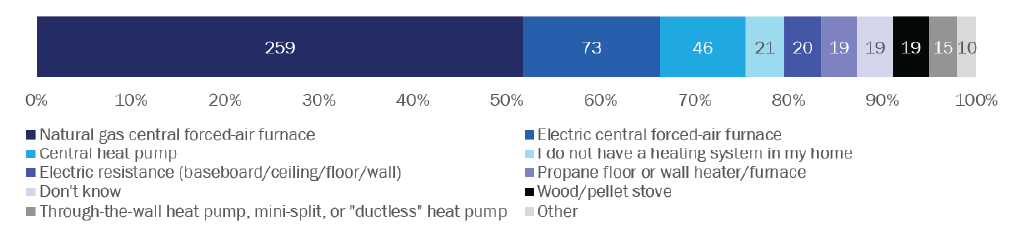
Over half (52%) of the surveyed homeowners had a natural gas central forced-air furnace as the main heating system in their home (Figure 9). The next most common heating systems were electric forced-air furnaces (15%) and central heat pumps (9%). Fifteen percent of respondents used another heating source, such as electric resistance, propane floor furnace, ductless heat pumps, wood/pellet stove or other. Other heating sources included radiant floor heating, portable heaters, or fireplaces.
Figure 9. Primary Heating Systems (n=500)
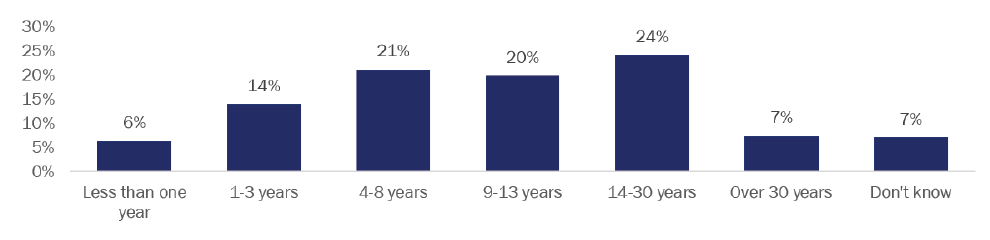
Not all surveyed homeowners knew what heating system they had in their home. We only asked respondents how old their system was if they were aware of their heating system type. Of the 460 respondents, one-third (31%) reported that their system was 14 years or older. Nearly half of systems (41%) were eight years or younger with 6% under one year old. Figure 10 shows the system age distribution in more detail. The average heating system age in DACs was 12 years old, which was slightly lower than non-DACs that had an average system age of 14 years.[6]
[6] Calculated using midpoint of range.
Figure 10. Age of the Primary Heating System (n=460)
3.3.2 Cooling
The most common air conditioning/cooling system was central air conditioning (57%), followed by no air conditioning (18%). Those who had no air conditioning were most commonly found in PG&E and SDG&E territories. The least common systems were central evaporative coolers and mini split ductless heat pumps, both at 4%. Only 1% of respondents reported that they had a different cooling system; this consisted mainly of portable AC units.
Figure 11. Primary Cooling Systems (n=500)

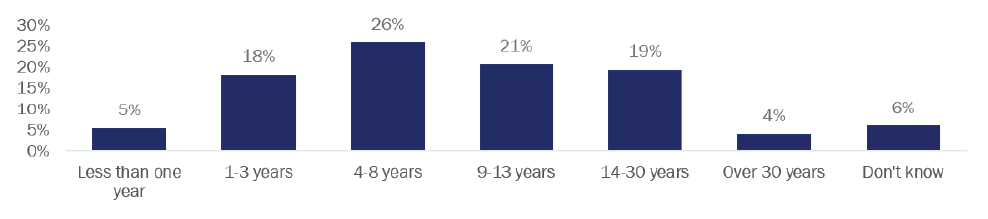
Most of the cooling equipment was reported to be between 1 and 13 years old with 26% between 4 and 8 years old, shown in Figure 12. Only 4% of equipment was over 30 years old and 5% was under a year old. When segmented into DACs and non-DACs we see very similar distribution with a slightly older average cooling system age in non-DACs (11 years) compared to DACs (10 years).
Figure 12. Age of Primary Cooling System (n=403)
3.4 Customer HVAC Decision Drivers
Opinion Dynamics sought to understand homeowners’ decision drivers when purchasing heating/cooling systems. This includes understanding the reasons for installing new equipment, identifying the attributes of the equipment that are important and, recognizing what is influential in the decision-making process.
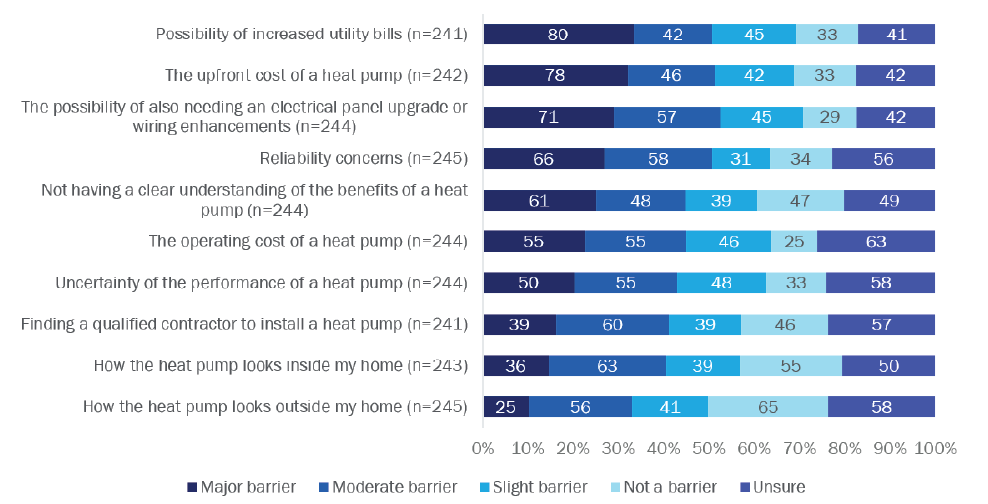
Among those aware of HVAC heat pumps, the biggest barrier to purchasing one is the possibility of increased utility bills (Figure 13). Homeowners also identified the upfront cost, and the possibility of needing to upgrade an electrical panel as major barriers. The appearance of the heat pump, especially outside the home, was not a major barrier. Again, we see a high incidence of uncertainty, between 17% and 26% per statement.
Figure 13. Barriers to Purchasing HVAC Heat Pumps
There was an even split between respondents who reported never replacing or installing a new space heating or heating system (47%) and those that reported they had (49%). Figure 14 shows that over two-thirds of respondents who installed new heating or cooling equipment did so because the equipment failed completely (37%), or it did not function well (31%). Recommendations from contractors, the availability of discounts, the return on investment, and the desire to be more sustainable were the main reason for 10% of respondents.
Figure 14. Main Reason for Installing New Heating/Cooling Equipment (n=232)

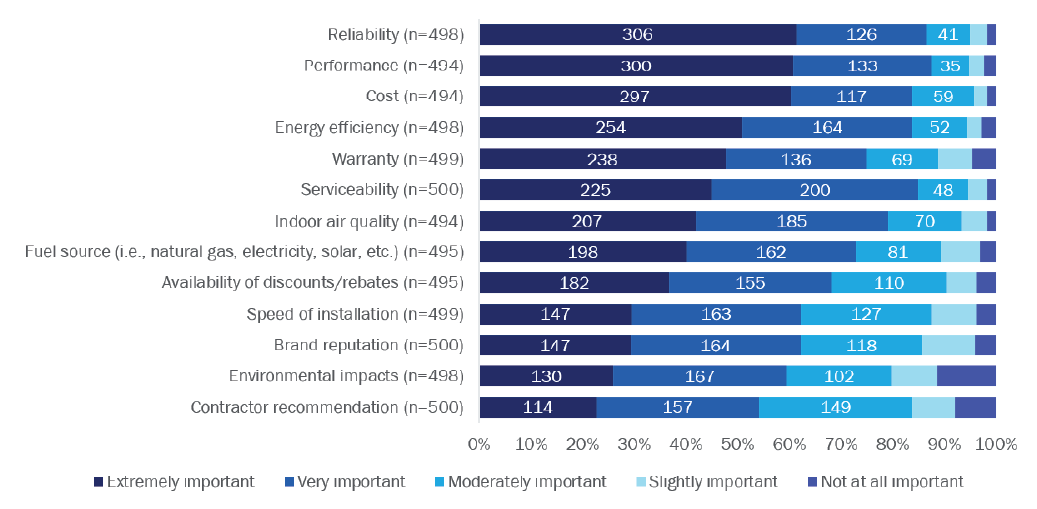
California homeowners most often identified reliability, performance, and cost as extremely important factors when replacing their heating and/or cooling equipment. Environmental impact, contractor recommendation and warranty had the highest number of not at all important ratings, as shown in Figure 15. The evaluation team assessed the importance of these factors by community type and found a few notable differences between DACs and non-DACs. A slightly higher percentage of respondents from DACs reported that cost was an extremely important factor when compared to non-DACs; however, when combined with those that reported it as a very important factor, the two groups were very similar. We also found that residents in DACs were more likely to view the availability of discounts and rebates, the fuel source, and the speed of installation as moderately to extremely important than residents in non-DACs.
Figure 15. Importance of Factors When Replacing Heating and Cooling Equipment
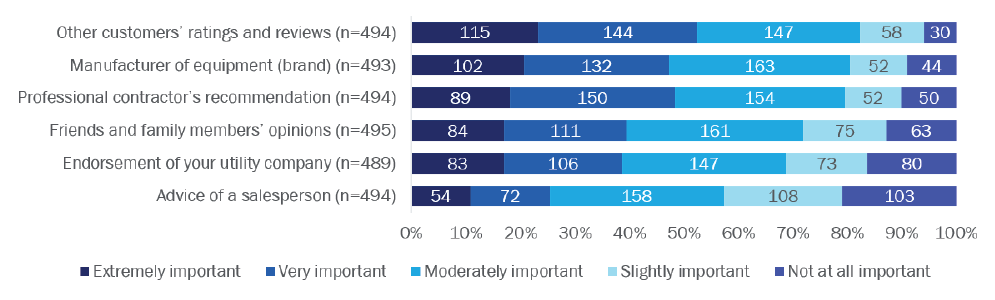
The evaluation team also asked homeowners about influential sources of information when purchasing new HVAC equipment. Homeowners reported that the advice of a salesperson was the least influential factor, while other customer’s ratings and reviews, the brand, and a professional contractor’s recommendation were more important in their decision-making. The top three findings were consistent during the process of purchasing a primary heating system (Figure 16) and a primary cooling system (Figure 17). The largest difference between DACs and non-DACs was the influence of a utility company endorsement, a higher percentage of respondents from DACs reported that it was extremely or very important in influencing their decision than respondents from non-DACs, for both primary heating (47% vs. 28%) and cooling (43% vs. 30%) systems.
Figure 16. Influential Sources When Considering a New Primary Heating System
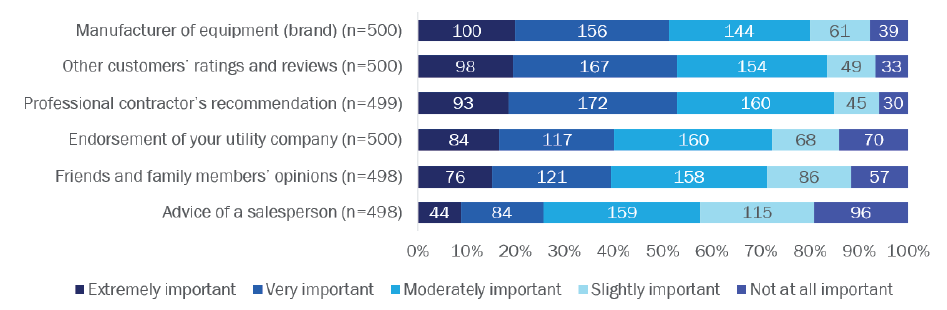
Figure 17. Influential Sources When Considering a New Primary Cooling System
3.5 Air Source Heat Pump Costs
Opinion Dynamics conducted a Delphi study in 2020 to gather information about ASHP costs. A Delphi study is a systematic, multi-round, interactive research methodology administered to a group of experts to elicit the best thinking of the group about a complex issue. Opinion Dynamics asked 15 contractors to produce hypothetical quotes for installing a natural gas furnace and an ASHP in the same home scenario. The scenario is a pre-1978, one-story, single-family home of 1,400 square feet with an existing natural gas furnace and no air conditioning.
Equipment Removal
The average cost to remove the existing equipment from this home in order to install an ASHP, considering both labor and material costs, was $724 (Table 7). Costs ranged from $600 to $2,300. This was marginally higher than the cost to remove equipment to install a new natural gas furnace installation, which averaged $555. Most Delphi participants felt that the average ASHP cost was in line with their estimates (6 of 15; 40%) or slightly lower than what they were expecting (6 of 15; 40%). One participant increased their cost after seeing the average and range of costs in Round 2.
Table 7. Equipment Removal Costs

Equipment removal costs tend to be lower if the removal process is easy: simply replacing the fan coil and not replacing or upgrading any ducts. Equipment removal costs can also lower if the home is in a location with lower labor costs. Removal can be more expensive if unforeseen issues arise during the process or if the internal configuration of the home or equipment location is odd, which is especially prevalent in old Victorian homes in San Francisco. Additional labor is often spent on disassembling the existing equipment, removing lines, cutting wires, and flushing coolant. Two participants noted that at times asbestos is detected in the existing ducts or pipes during disassembly, requiring an asbestos abatement company to come in and remove the asbestos. This increases the cost significantly.
Equipment Unit Cost
Delphi participants reported a wide range of unit equipment costs for ASHPs; costs ranged from $1,114 to $7,428, with an average cost of $3,387 (Table 8). Many participants were not surprised by the variability, as several factors determine the unit cost of a heat pump. This cost element saw the largest difference between a natural gas furnace and heat pump, where the average natural gas furnace cost was nearly $2,000 less expensive than the heat pump.
Table 8. Equipment Unit Costs

Participants reported the following prominent determinants of equipment cost variance:
- Type of heat pump. Six Delphi participants noted that heat pump costs vary because there are multiple types of heat pumps in the market with varying sizes, capacities, and motors.
- Heat pump brand. Delphi participants explained that equipment costs vary because some brands are more expensive than others. Big name brands such as Carrier may be more costly than off-brand heat pumps due to varying degrees of quality.
- Equipment markup. Participants represented a variety of contractor companies from different regions of California. It is natural for companies to mark up the cost of the equipment differently as they have varying business practices. Higher equipment costs align with more overhead coverage and a higher profit margin.
- Heat pump efficiency. ASHPs that have higher SEER ratings are often more expensive than models with lower SEER ratings. Four participants noted this as a reason for cost variability.
- Supplier relations. Two participants reported that having a good relationship with suppliers or distributors is financially beneficial. Contractors can purchase a large volume of heat pump units at a lower cost if they maintain a good relationship with suppliers and/or distributors.
A large component of the equipment costs of installing an ASHP is the air handler. An air handler unit consists of an evaporator coil, a blower motor, and typically an electric heat strip. The air handler is designed to efficiently circulate conditioned air through the duct work. Air handler upgrade costs ranged from $500 to $4,000, with the average being $1,826. Air handler upgrades can be more expensive if the location of the air handler is far from the main service panel in the home, which can require the costly installation of lengthy and complex electrical conduits, as reported by six participants. At times, upgrading the air handler component of the system can require additional equipment replacements, such as heat strips, the fan coil, refrigerant lines, or the condensate drain. This increases the air handler labor and material costs significantly, according to five participants. Furthermore, similar to the variance of the heat pump unit costs, air handler costs vary due to different brands, quality, and type. For example, an air handler with a variable speed motor will be more expensive than one with a single speed motor.
Installation Labor and Materials
Delphi participants reported a wide range of labor costs for the ASHP installation, with $570 as the minimum and $13,000 as the maximum (Table 9). The average cost to install an ASHP was $2,888, roughly double the average cost of installing a natural gas furnace.
Table 9. Installation Labor and Material Costs

Most participants (11 of 15; 73%) reported labor costs are dependent upon the geographical location of the installation. Some regions, such as some parts of the Bay Area, are more expensive than other areas, such as other communities that are more economically distressed. Contractor companies that service affluent areas charge more for labor to cover high overhead and rent. Another reason for installation labor cost variability is the structure and age of the home. Older homes with odd internal configurations will likely need more ductwork and electrical modifications than newer, production homes. Thus, more time and labor are needed to complete the install.
Ducting Modifications
Participants reported a wide range of costs related to ducting modifications for both the natural gas furnace and the heat pump installation. The average ducting modification cost for a heat pump installation was $2,277 (Table 10), only marginally higher than the furnace average. One participant modified their original cost from Round 1 to be 10%–15% higher in Round 2, after explaining their Round 1 cost was not representative of the industry average due to conducting work in lower income areas.
Table 10. Ducting Modification Costs

The extent of ducting modifications needed depends on the existing condition and presence of ducts throughout a home. In some cases, a ducted heat pump system may be able to utilize the existing ductwork to circulate conditioned air in the home, therefore modifications and costs would be minimal. Some contractors assumed this was the case for the scenario, where only the duct plenums needed to be adapted to the new system.
There are many scenarios where ducts or the entire duct system need replacement, which align with the higher reported costs for this cost element. As described by Delphi participants, ductwork can be a time-consuming and tedious process. Factors that determine the need for ducting modifications or entire duct system replacement include existing ducts that are old, poorly designed ductwork, ducts that contain asbestos, small ducts that will not support high refrigeration from a heat pump, or inaccessible ducts.
Natural Gas, Electric, and Ventilation Modifications
Participants reported an average cost of $1,982 to cover the natural gas, electric, and ventilation modifications of the ASHP installation (Table 11). This cost was not drastically different than the modification costs for the furnace installation, which averaged $1,844. Two participants altered their original costs in Round 2. One participant increased their cost by $1,000, explaining there was a likelihood that the home in the scenario had electrical wiring not sufficient for the heat pump, thus would require wire upgrades. Another participant also reported increasing their cost after seeing the group average.
Table 11. Natural Gas, Electric, and Ventilation Modification Costs

Participants who reported costs on the higher end assumed the main service panel would need to be upgraded to a 200-amp panel in this scenario. This alone typically costs between $1,900 and $4,000. Participants who reported on the lower end assumed no panel upgrades were needed; merely labor to disconnect the gas line. Most participants reported that the majority of the modifications needed during a heat pump installation relate to the electrical upgrades, which would be likely for this scenario as there was no existing 200-amp service panel. Other reasons for higher costs include the “difficulty factor” of the installation, meaning the modifications can be tricky due to the structure and age of the home.
Total Costs
The average total costs between the natural gas furnace and ASHP were significantly different. The heat pump total cost average was roughly $4,500 higher than the furnace, which averaged around $7,000 (Table 12). After seeing the group averages in Round 2, two participants increased their ASHP total costs, and one participant increased their total estimate for the furnace installation.
Table 12. Total Installation Costs

Participants explained that in their experience, heat pumps have always been significantly more expensive to purchase and install than a furnace. A couple of participants noted that a more measurable situation would be to compare the heat pump installation with a coupled furnace and air conditioner installation. Delphi participants explained the core reasons for the cost differences between these systems:
Converting a natural gas HVAC system to accommodate a heat pump system is inherently more complex and time-consuming than replacing the system with a furnace. This is due to the potential significant changes to the ductwork and electrical system. Entire duct system replacement and upgrading the main service panel are line items that can be cost-prohibitive for the customer.
Current average equipment prices between a furnace and a heat pump are not comparable, as the heat pump equipment consists of more components, such as the air handler upgrade. According to Delphi participants, heat pump units typically cost $1,000 to $2,000 more than furnaces on average.
3.6 Labor Market
The CSLB, under the Department of Consumer Affairs, protects California consumers by licensing and regulating the state’s construction industry. The CSLB was established in 1929 and today licenses about 290,000 contractors in 44 different licensing classifications. All businesses or individuals who construct or alter any building, highway, road, parking facility railroad, excavation, or other structure in California must be licensed by the CSLB if the total cost (labor and materials) of one or more contracts on the project is $500 or more. Licenses are issued to individuals, partnerships, corporations, joint ventures, and limited liability companies (LLCs). Each license requires a “qualifying individual” who must undergo a background check and meet experience and exam requirements. In addition, the licensee must submit documentation to prove they meet insurance and bond requirements. CSLB licenses are separated into three classifications: Class A (General Engineering Contractor), Class B (General Building Contractor), and Class C (Specialty Contractor). Within the Class C license classification, there are 42 Class C licenses for work that requires specialized skills. Installing ASHPs requires specific knowledge and licenses. See Appendix B for a description of licenses. This section presents findings about the workforce who installs HVAC heat pumps.
3.6.1 Availability of Qualified Trade Allies
According to the US Energy and Employment Report 2021, approximately 85% of California energy-related employers who hired new employees for energy efficiency reported difficulty hiring.[7] Their top three reported reasons were lack of experience, training, or technical skills; competition/small applicant pool; and difficulty finding industry-specific knowledge, skills, and interest.
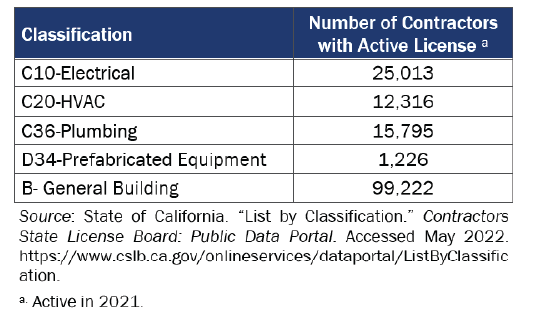
The licenses potentially needed for the replacement of gas appliances with electric appliances include a B-General Building Contractor license, a C-20 HVAC license, a C-36 Plumbing license, a D-34 Prefabricated Equipment license, and a C-10 Electrical License.
There were 138,980 contractors with at least one of the licenses in Table 13 in California in 2021. Please note that some contractors hold more than one license and are represented multiple times in the table. Contractors with Class B licenses outnumber the other licenses. Climate zone 9 near Los Angles had the most contractors licensed with one of the licenses in Table 13 at 22,877 contractors, followed by climate zone 12 in the Central Valley which had 17,602 licensed contractors. Climate zone 1 had the fewest (1,195). The number of licensed contractors by climate zone can be found in Appendix B.
[7] United States Department of Energy. “Energy Employment by State: 2021.” United States Energy & Employment Report. (Publication: DOE/SP-003). https://www.energy.gov/us-energy-employment-jobs-report-useer.
Table 13. Count of Licensed Contractors in California in 2021
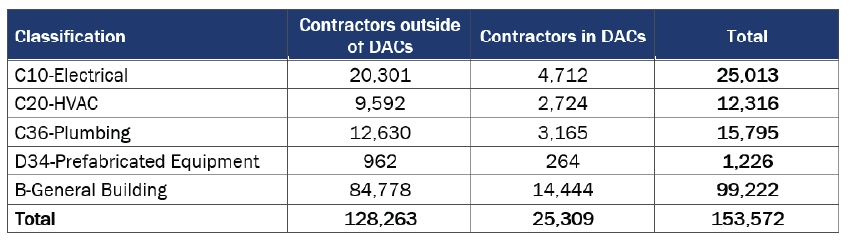
Licensed contractors with a business address outside of DACs outnumbered those contractors with a business address inside of DACs (Table 14). The definition of a DAC is a census tract in the 25% of census tracts most burdened by pollution per the CalEnviroScreen 4.0 scoring tool. Again, please note that contractors with more than one license type are represented more than once.
Table 14. Count of Licensed Contractors by DAC Classification
3.6.2 HVAC Workers’ Experience with Heat Pumps
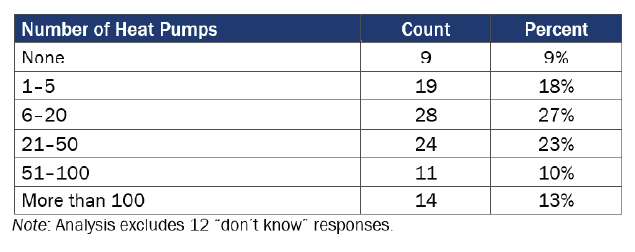
The majority (56 of 105; 54%) of surveyed contractors’ firms sold fewer than 20 heat pumps in the past year, and nine of those (105; 9%) sold none (Table 15). Less than a quarter (25 of 105; 23%) sold more than 50 heat pump HVAC units over the past year, the highest number of units sold was 1,000 (one mention). Overall, respondents’ firms, on average, sold 65 HVAC heat pumps in the past year.
Table 15. Number of HVAC Heat Pumps Sold by Firms in Past Year (n=105)
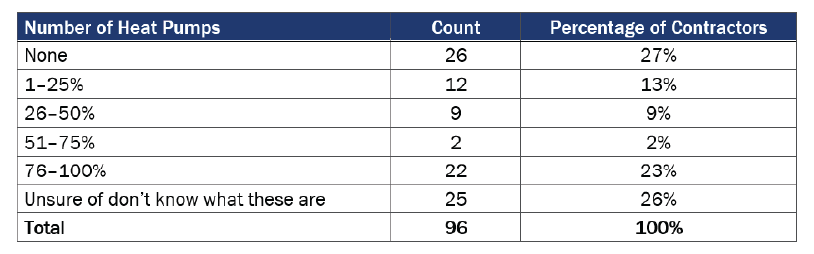
Half of the surveyed contractors (51 of 96; 53%) did not install ASHPs with time-of-use controls, did not know what they were, or were unsure about the controls (Table 16). Excluding “unsure” responses, on average, 40% (28 of 71) of heat pumps sold by contractors’ firms over the past year included time-of-use controls. More than half (38 of 71; 53%) reported a quarter or fewer of the heat pumps sold by their firm included time-of-use controls. Of those who knew about time-of-use controls, more than one-third (26 of 71; 37%) never included time-of-use controls with their HVAC heat pump installations.
Table 16. Number of Heat Pumps Sold in Past Year with Time-of-Use Controls (n=96)
Heat pump jobs represented about one-third of residential HVAC jobs completed by respondents’ companies in the past year. On average, respondents reported 36% of jobs completed by their company in the last year involved heat pumps (n=112).[8] Respondents whose company completed a heat pump job in the past year reported the average length of time needed to complete an HVAC heat pump installation was two days. Although the majority of responses ranged from one to five days to complete an installation, one respondent reported the average length of time their firm needed to complete an HVAC heat pump installation was 18 days.
Surveyed contractors had more experience with heat pump installations for single-family and smaller, in-unit multifamily properties than with centralized heat pump systems for larger multifamily properties. Among the 48 respondents who reported 50% or more of their company’s business is based on installation jobs, nearly all (47 of 48; 98%) said their company has experience installing HVAC heat pumps for single-family residential, low-rise multifamily, and in-unit multifamily properties. Contrastingly, fewer than half (20 of 48; 42%) of respondents reported their company is experienced with HVAC heat pump installations in large, centralized systems like those existing in high-rise multifamily buildings. Approximately 70% of technicians working at companies with more than one employee had experience installing or working on any type of HVAC heat pump in the past year (n=97).[9]
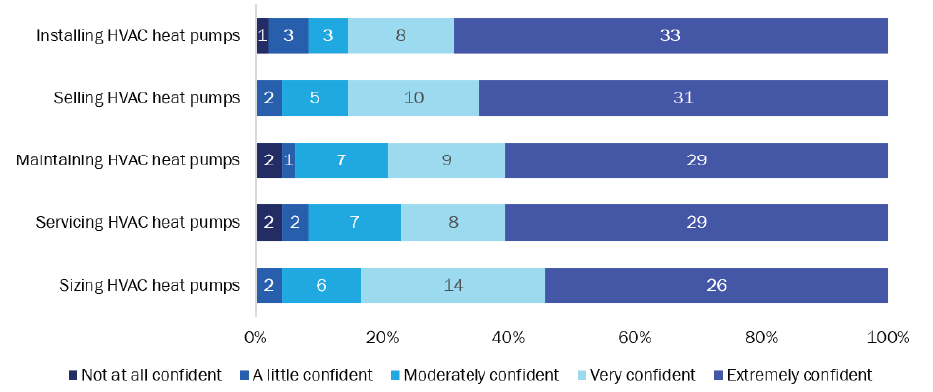
Most surveyed contractors were extremely confident in their ability to install heat pumps. Among the 48 respondents who reported 50% or more of their company’s business is based on installation jobs, over two-thirds (33 of 48; 69%) were extremely confident in their ability to install heat pumps despite a smaller number (54%) being extremely confident in their ability to size the equipment (Figure 18). Contractors were least confident in their ability to service and maintain heat pumps because the most contractors reported they were “not at all confident” performing those tasks (two each).
Approximately half of surveyed contractors were extremely confident in their ability to size HVAC heat pumps. Among the 48 respondents from companies with 50% or more of their business is based on installation jobs, 54% indicated they were extremely confident in their ability to size space conditioning heat pump equipment (Figure 18). While this is promising, historical research indicates that many contractors size HVAC equipment based on rules-of-thumb. Cooling system size in tons would be based on the square feet of conditioned floor area e.g., one ton of air conditioning capacity for every 500 square feet of conditioned floor area, so a 4 ton unit would be needed for a 2,000 sq ft home. Unfortunately, this approach can lead to oversizing and inefficient, short-cycling of the cooling system. The best approach is to perform a load calculation to size the HVAC equipment. The industry standard is to use the ANSI/ACCA Manual J Residential Load Calculation. The second step is using ANSI/ACCA Residential Equipment Selection Manual S to select the equipment to deliver necessary heating and cooling. Past California evaluation studies have found that many HVAC installations are incorrectly sized and that contractors are typically not using Manual J or Manual S when designing systems. HVAC heat pumps require additional considerations when designing a system. For example, the system size can be based on either the heating load or the cooling load, whichever is considered the larger of the two, which varies by region and climate zone. Another unique design consideration is the selection and type of back-up heating system. Considerations include the coldest temperatures expected for the location, and the heat pump performance at those lower temperatures. The back-up system design would include either selecting the number of electric resistance strips to use in the unit or using a gas furnace back-up heating system for resiliency or to eliminate the need for a very large electric resistance heater. With the history of improperly sizing HVAC cooling equipment, and the more numerous design considerations versus conventional AC-only or gas heating systems, additional research into HVAC HP sizing practices and contractor training to address any discovered issues is warranted.
[8] Five “don’t know” responses excluded from average.
[9] Three “don’t know” responses excluded from average.
Figure 18. Confidence in Ability to Install, Sell, Size, Service, and Maintain HVAC Heat Pumps (n=48)
Heat pump experience is attractive when hiring installers and technicians. The number of installers and/or technicians hired by respondents’ companies in a typical year ranged from zero to 45, resulting in an average of four hires per year (n=102).[10] When hiring new technicians and installers, more than half of respondents (68 of 117; 58%) reported heat pump experience to be very attractive (Table 17).
[10] Fifteen “don’t know” responses excluded from average.
Table 17. Attractiveness of Heat Pump Experience When Hiring (n=117)

3.6.3 Training on HVAC Heat Pumps
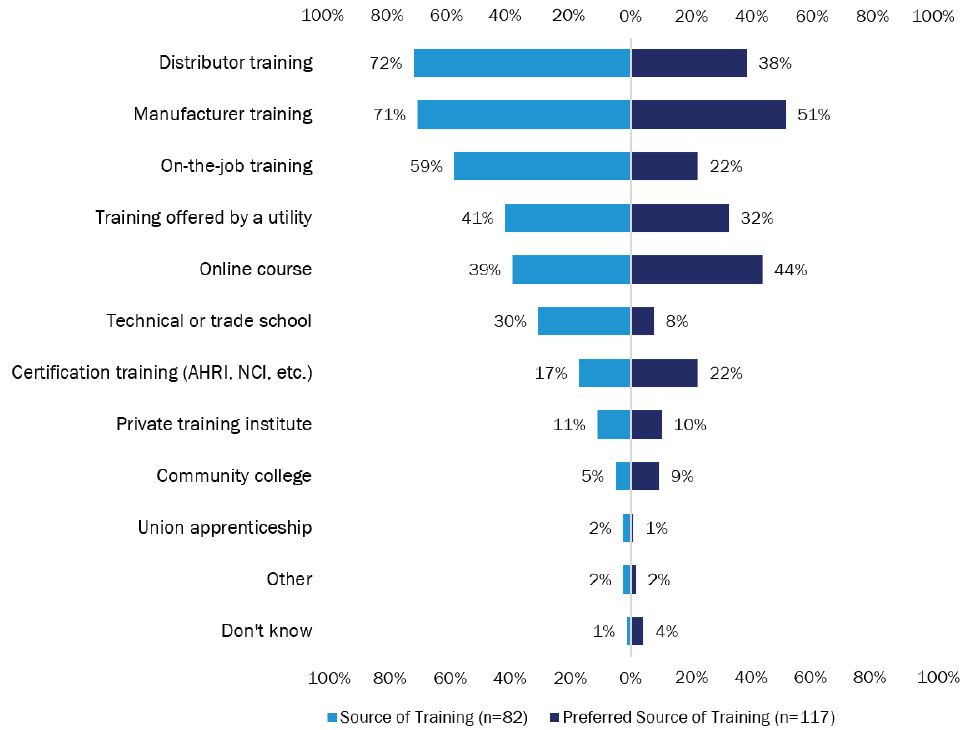
Surveyed contractors were most likely to receive heat pump training through a distributor and/or manufacturer. A majority of contractors (82 of 117; 70%) received heat pump training, while nearly one-third (35 of 117; 30%) had not. Among the 82 contractors who had been trained, most (73 of 82; 89%) received it through a distributor or manufacturer (Figure 19). The majority (67 of 82; 82%) of contractors who have received heat pump training reported receiving the training through more than one source.
Just over half of respondents (51%) preferred to receive heat pump training through a manufacturer (Figure 19). About 59% (48 of 82) had received heat pump training on the job, though this was not a commonly preferred source of training. Other preferred sources of heat pump training included through an online course (51 of 117; 44%) or a distributor (45 of 117; 38%). Two respondents reported other options for receiving training, including in-house (one mention) and through a subcontractor (one mention).
Table 17. Attractiveness of Heat Pump Experience When Hiring (n=117)
Note: Respondents were allowed to select up to three preferred training options.
4. Heat Pump Water Heater Market Detailed Findings
This chapter characterizes the market for HPWHs, including discussion of the installed base, installation costs, homeowner awareness and preferences, as well as contractor experience and confidence.
4.1 Market Overview Findings
AHRI reports roughly 5 million residential gas storage water heaters and 4.8 million residential electric storage water heaters were shipped in the United States in 2021. Residential gas storage water heater shipments grew 8.3% and residential electric storage gas water heaters grew 4.9% between 2020 and 2021.[11] Unfortunately, AHRI does not make California-specific data available and Opinion Dynamics has not found a reliable source for California-specific HPWH shipment data. Three companies manufacture 90% to 95% of all residential water heaters in the United States: AO Smith®, Rheem®, and Bradford White®.[12] Other smaller manufactures include Nyle Systems, Stiebel Eltron®, General Electric®, and Midea.[13] ENERGY STAR® reports that 8% of water heaters are replaced each year.[14]
[11] Air-Conditioning, Heating & Refrigeration Institute. “AHRI Releases December 2021 U.S. Heating and Cooling Equipment Shipment Data.” February 22, 2022. https://www.ahrinet.org/Portals/Reports/December2021StatisticalRelease_1.pdf.
[12] All product or company names that may be mentioned in this publication are tradenames, trademarks, or registered trademarks of their respective owners.
[13] Butzbaugh, Joshua B., Linda J. Sandahl, and Michael C. Baechler. 2018. “US HPWH Market Transformation: Where We’ve Been and Where to Go Next.” United States. https://doi.org/10.2760/113534.
[14] US Department of Energy. New Technologies New Savings: ENERGY STAR® Water Heater Market Profile and Program Design Guide. September 2009.
4.2 Current Water Heating Systems
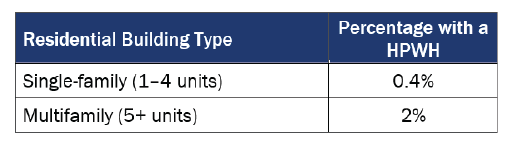
HPWHs represent a tiny portion of existing water heaters in California and are more common in multifamily buildings than single-family buildings, according to the 2019 RASS survey (Table 18). The single-family category includes townhomes of four or fewer units and manufactured homes.
Table 18. HPWH Penetration in California
Among the surveyed California homeowners in this study, we found that gas conventional storage tank water heaters were the most common (59%), followed by electric conventional storage tank water heaters (13%). About 4% of respondents had electric heat pump water heaters. Figure 20 presents the detailed breakdown of respondents’ systems.
Figure 20. Water Heating Systems (n=500)

We discovered that over half (57%) of water heaters were under 8 years old and that only 17% were above 14 years old, with 3% above 30 years old, shown in Figure 21. As with the space heating and cooling systems data, these survey data came from respondents who knew what water heating system they had in their home. The evaluation team found minimal difference in average system age between DACs (8 years) and non-DACs (9 years).
Figure 21. Age of Water Heating System (n=475)

4.3 Customer Awareness
Homeowner respondents were asked which water heating systems they had heard of before taking the survey. We see a slightly lower level of awareness for HPWHs than for ASHPs, with just over 30% of respondents reporting awareness of HPWHs (Figure 22). Of the 159 respondents who were aware of HPWHs, half were very or somewhat familiar while the other half were slightly or not at all familiar. For comparison, of the 449 respondents who were aware of gas conventional storage water heaters, 78% of them were very or somewhat familiar with the equipment. Like HVAC heat pumps, a quarter of respondents who were familiar with HPWHs had heard about them through word of mouth. Social media (18%) and advertisements (16%) were also popular sources of information on heat pump water heaters.
Figure 22. Awareness of Different Water Heating Systems (n=500)
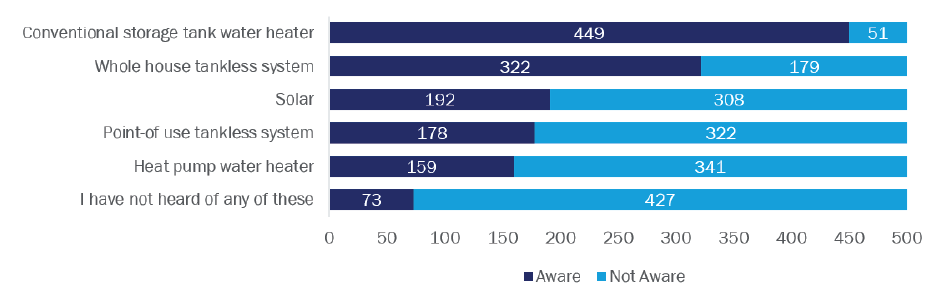
Note: Multiple responses allowed
Homeowner respondents did not know a lot about the benefits and drawbacks of HPWHs. When the evaluation team asked respondents to identify heat pump benefits in an open-ended, unaided question, the large majority (83%) reported that they did not know what benefits they offered, 6% believed they were more efficient than alternative water heaters, and 5% thought they had good performance.
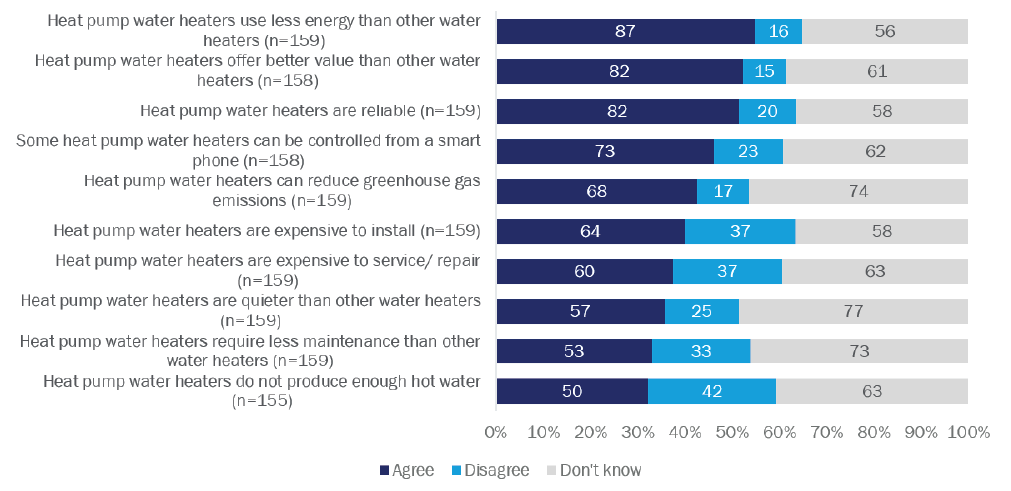
We then asked the homeowners to agree or disagree with specific statements while offering a “don’t know” option. Again, we saw a high incidence of “don’t know” responses; between 35% and 50% of respondents for each question, as shown in Figure 23. The largest number of respondents agreed that HPWHs use less energy than other water heaters with only 10% disagreeing. There were conflicting responses for whether a HPWH was expensive to install and whether it was expensive to service, with approximately 40% of respondents agreeing that they were expensive and 20% disagreeing. One-third of respondents said that HPWHs do not produce enough water.
Figure 23. Benefits and Drawbacks to Heat Pump Water Heaters
4.4 Customer Water Heating Decision Drivers
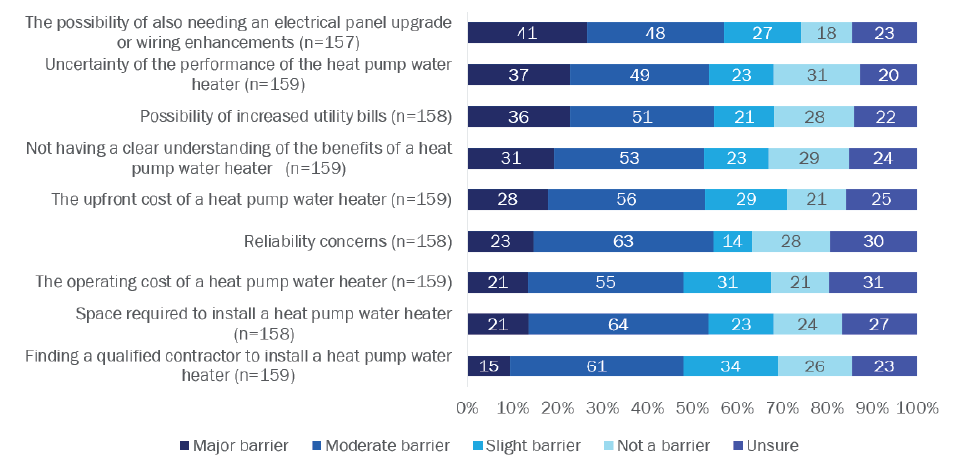
The evaluation team also asked the homeowners aware of HPWHs to rank the severity of barriers they anticipated facing when purchasing one. As Figure 24 shows, the largest portion of respondents (26%) identified the possibility of needing an electrical panel upgrade as a major barrier, another 30% rated it as a moderate barrier. Consistent with the barriers to heat pump HVAC, about 50% of respondents reported that the possibility of increased utility bills was a major or moderate barrier. Very few respondents (10%) believed that finding a qualified contractor would be a major barrier to installing a heat pump water heater.
Figure 24. Barriers to Purchasing Heat Pump Water Heaters
Respondents identified performance, reliability, and warranty as extremely important factors and contractor recommendation as less important when replacing a water heating system, shown in Figure 25. Performance and reliability were similarly important to respondents when replacing an HVAC system and contractor recommendation similarly appeared to be less important, but warranties were rated more important in the water heating context than in the HVAC context. Typically, HPWHs come with a ten-year warranty, longer than that of most tankless or other tanked equipment. In general, respondents from DACs were more likely than respondents outside of DACs to rate the following factors as extremely important: indoor air quality, availability of discounts and rebates, performance, and cost.
Figure 25. Importance of Factors When Replacing Water Heating Equipment
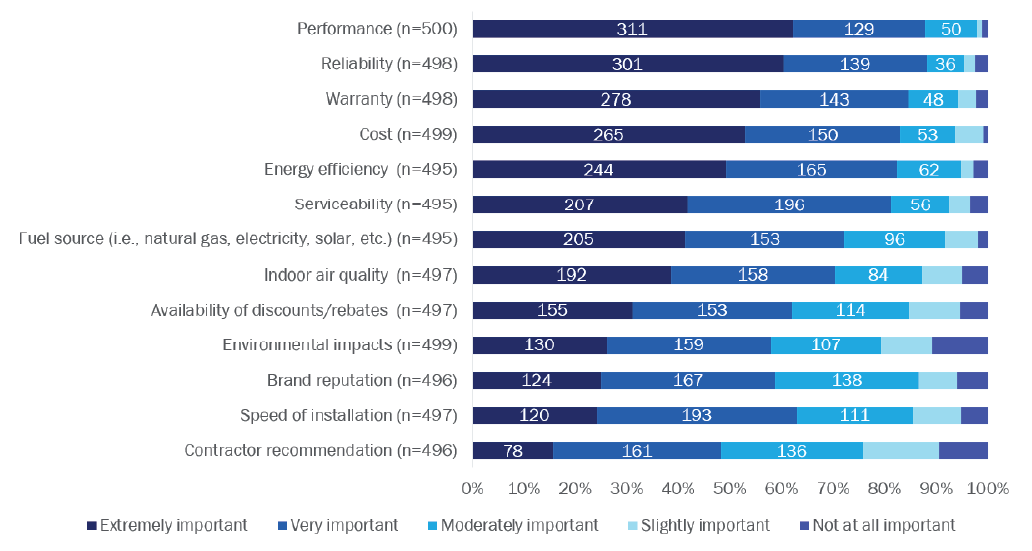
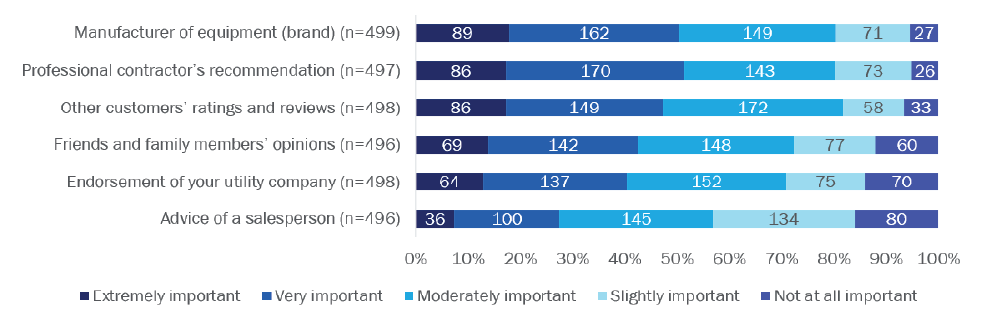
Figure 26 shows the influence of different sources respondents rated when considering new water heater equipment. They reported that brand and professional contractor recommendations are more influential than advice of a salesperson or the endorsement of a utility company.
Figure 26. Influential Sources When Considering New Water Heater Equipment
4.5 Heat Pump Water Heater Costs
The information about HPWH installation costs comes from a Delphi study conducted by Opinion Dynamics in 2020. The evaluation team asked nine contractors to produce hypothetical quotes for installing a tankless natural gas water heater and a HPWH in the same home scenario. The scenario is a pre-1978, single-family home with two residents and the existing equipment was a natural gas tanked storage water heater in a garage.
Equipment Removal
Delphi participants reported an average cost of $247 to cover the materials and labor associated with removal of any existing equipment before installing an HPWH (Table 19). While the range of costs seems large, spanning from $0 to $563, only one participant (1 of 7; 14%) quoted $0 explaining that they include the cost of removal in their estimate for installation labor while the rest of the participants quoted costs much closer to the average cost. The participant said the same for their tankless water heater quote as well. The difference between average cost of equipment removal for a tankless water heater versus an HPWH was very small with tankless water heaters installations having a slightly higher average equipment removal cost of $304.
Table 19. Equipment Removal Costs

Over half of the participants (5 of 9; 56%) reported the average equipment removal cost for an HPWH installation to be accurate and in line with what they quoted. One participant felt that the average cost was higher than expected; they explained that they utilize a fixed rate for equipment removal that stays constant for all jobs or home specifications. Conversely, the other contractors cited the variability of each job as a reason for costs to be higher, emphasizing the influence of the geographical location of the home and condition of existing equipment in removal cost.
Equipment Unit Cost
The average unit cost for an HPWH unit and a tankless water heater were very similar: $1,575 and $1,484, respectively (Table 20). Similarly, the two units had a comparable range and median value showing the similarity in upfront unit cost between the two types of units.
Table 20. Equipment Unit Costs

Participants provided a large range of HPWH unit costs, varying from $700 to $3,250. Potential reasons for the range in HPWH unit costs include:
- Type of HPWH. There are many different HPWH models, sizes, and brands available that vary in price due to perceived quality associated with brand name models compared to off-brand models.
- Contractor experience. Contractors’ varying levels of experience with HPWH installations caused variation in the mark up on equipment prices to cover any overhead associated with installation. Also, contractors with more HPWH projects can buy units in bulk driving down unit cost.
- Location of installation. The location of the HPWH installation can greatly affect the cost of installation in terms of labor and materials costs.
Installation Materials and Labor
Delphi participants reported an average cost of materials and labor associated with installation of an HPWH of $805 with quotes ranging from $300 to $1,850 (Table 21). The range of HPWH installation costs is reflective of tankless water heater installation costs as well.
Table 21. Installation Materials and Labor Costs

Most of the participants (6 of 7; 86%) attributed the wide range in materials and labor costs for installation to innate differences between contractors. Cost-shifting differences include contractor experience level, the amount of contractor competition in a given location, and HPWH brands available. The more contractors with HPWH installation experience in a given area leads to competition driving prices down, but as experience levels increase so does quality of work and cost of installations. Participants emphasized the competitive landscape of the HPWH market as driving a lot of cost variation across the industry.
Electric Supply and Space Ventilation Materials and Labor
For the HPWH installation quote, the costs of materials and labor for electric supply and space ventilation were split into two separate line items, while the tankless water heater quote combined natural gas, electric, and ventilation modifications into one line item. For the sake of comparison, all are shown in Table 22 below. The combined minimum, maximum, median, and average costs of HPWH electric supply and space ventilation are very similar to the respective quotes for a tankless water heater.
Table 22. Electric Supply and Space Ventilation Materials and Labor Costs
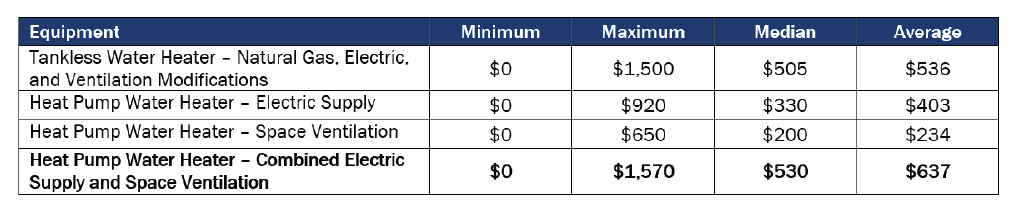
While the average cost of combined electric supply and space ventilation for an HPWH ($637) is only marginally higher than the average cost for a tankless water heater ($536), participants reported a wide range of costs for both water heater units. Participants explained that the predominate reason for the variation in electric supply costs was whether or not an electrician needed to be hired. A little over half (4 of 7; 57%) of the participants reported being licensed electricians themselves and thus not needing to outsource any electrical work reducing costs, while the rest (3 of 7; 43%) would have to involve an electrician to complete any electrical upgrades. One of the two participants to quote $0 for this line item reported they would increase their original quote from $0 to $330 to budget for electrical upgrades they did not consider previously.
Participants reported location of the water heater and the time involved in installation as the main reasons of cost variation in space ventilation costs. Two participants reported that they would alter their space ventilation quotes after reviewing the average of all participants. One increased their cost by $200 to a total of $400 and the other increased their original cost of $95 to $550 to account for both materials and labor.
Plumbing Modifications
The average cost of plumbing modifications for a HPWH reported was $403, which is more expensive than the $289 average costs for plumbing modifications for a tankless water heater (Table 23). While the range of plumbing modification costs for an HPWH were similar compared to the tankless water heater range reported, participants reported a median HPWH cost almost double that of the tankless water heater quote ($502 and $275, respectively).
Table 23. Plumbing Modification Costs

Similar to many of the other costs, several participants (5 of 7; 71%) reported that location, both of the unit within the home as well as geographically in the state, was a predominate reason for the wide variation in reported costs.
Total Costs
The range and average of total costs between the HPWH and the tankless water heater were similar. Participants reported an average total cost for a HPWH as $3,908 with a range from $1,400 to $5,825 (Table 24). The average total cost for a tankless water heater was $3,471 with a range from $1,665 to $5,850.
Table 24. Total Costs

In general, almost all participants (6 of 7; 86%) agreed with the lack of difference between the total cost of a HPWH and a tankless water heater given the home specification provided. When asked about the reason for the range in total costs, participants noted factors like location (both of the unit within the house and of the home generally), contractor experience, and customer budgets as potential cost shifters. Many of the participants also reported the extent of electrical upgrades needed as a potential cause for the large amounts of variation between installations.
4.6 Labor Market
The workforce is a critical component in the HPWH market. Contractors must be licensed to install the equipment and feel confident offering their customers heat pumps as an option. This section presents findings about the workforce who installs HPWH.
4.6.1 Availability of Qualified Trade Allies
While it was clear that contractors with the C-20 HVAC license could work on HVAC heat pumps, it was less clear if a contractor with a C-36 Plumbing license could work on the electric HPWH. We reached out to the CSLB for clarification on which licenses are needed to install a HPWH. They reported to us that the most appropriate CSLB licenses for stand-alone installation of HWPH are C-20 HVAC or C-36 Plumbing. If electrical upgrades are required as part of the HPWH installation, C-20 HVAC and C-36 Plumbing contractors can self-perform, or subcontract out, any electrical work required to accommodate the HPWH, including installing a dedicated circuit for the water heater. If an upgrade is required to the electrical service panel; however, then a C-10 Electrical license is most appropriate for that part of the project. General B Building Contractors are allowed to perform a HPWH installation only when the installation is part of a larger project involving two unrelated trades.
There were 15,795 contractors in California with a C36-Plumbing license in 2021, per the CSLB; 3,165 of those were in DACs. There were 12,316 C20-HVAC contractors in California in 2021 and 2,724 of those were in DACs. Manufacturers and distributors have anecdotally estimated that at least half of residential water heaters are installed by handymen as opposed to licensed contractors.
4.6.2 Worker Experience with HPWH
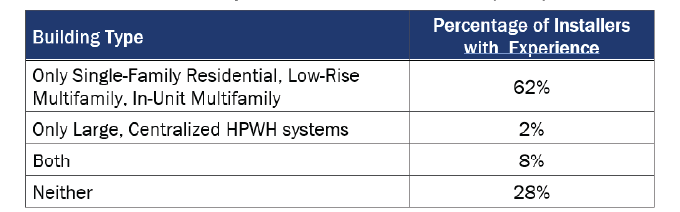
Surveyed contractors who worked with HPWHs had more experience with single-family or in-unit multifamily HPWHs compared to large, centralized HPWH installations (among those for whom at least 50% of their business came from installation jobs; Table 25). Over a quarter (14 of 50; 28%) of surveyed respondents whose firms sell water heating equipment and who attributed at least half of their business comes from installation jobs reported having no HPWH experience.
Table 25. Experience in HPWH Installations (n=50)
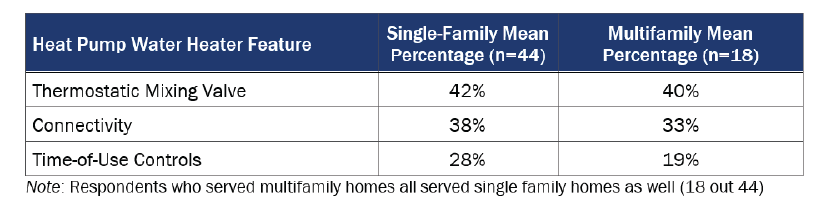
Contractors who sold at least one HPWH in the past year were most likely to have installed HPWHs that included a thermostatic mixing valve and least likely to have sold HPWHs with time-of-use controls (Table 26). About one-third of HPWHs were installed with connectivity such as Wi-Fi or Bluetooth®. Contractors installed these items slightly less frequently in multifamily homes than in single-family homes.
Table 26. Heat Pump Water Heater Features Sold by Building Type
HPWH sales varied greatly by company. Over one-third (30 of 84; 36%) of surveyed contractors’ companies did not sell a single HPWH last year. About half of the remaining companies (28 of 54; 52%) sold fewer than 10 HPWHs, while 5% of companies (4 of 84) sold between 100 and 150 HPWH last year. We had one outlier in our dataset: one company reportedly sold 300 HPWH last year, but this was a large company with more than 100 employees. Of those who sold at least 1 HPWH, the median number sold was 9 and the mean was 16.7 HPWHs.
In the last the year, HPWHs made up 16% of all the surveyed respondents’ companies’ water heating installations. One-third (27 of 84; 32%) did not install any HPWHs in the last year and an additional 8% (7 of 84) could not remember how many they installed. For companies that did install at least one HPWH, their projects tended to have relatively short turnarounds. Respondents estimated that they took an average of 1.4 days to complete and most (35 of 50; 70%) reported that their HPWH installs take only 1 day.
Companies with more than one employee (n=71) said a minority of their technicians worked on HPWH installations or services. Two-thirds (46 of 71; 65%) of companies either did not give an estimate or had fewer than half of their technicians work with HPWHs, including a quarter (18 of 71; 25%) who reported none of their technicians did so. The mean percentage of technicians who worked with HPWHs for a given company was 35% and the median percent was 20%.
Despite HPWHs making up a minority of most contractors’ installations, of companies where at least 50% of their business came from installation jobs (n=50), respondents were generally confident in their ability to work on HPWHs. Between 74% to 90% of respondents reported at least moderate levels of confidence for each of five tasks asked about (Figure 27). However, they were most confident in their ability to install the heat pump water heaters and least confident in their ability to service them.
Almost half of all respondents (46%) where at least 50% of their business came from installation jobs were extremely confident in sizing heat pump water heater systems (Figure 27). System sizing is important, as the price of HPWHs increase significantly as size increases, which is unlike other standard water heaters. However, past research has indicated that contractors often oversize heat pump water heaters to enable homeowners to participate in demand response programs, to account for slower recovery rate compared to gas-fired heaters, and to mitigate the risk of running out of hot water during power outages in areas with frequent power issues.[15]
[15] Opinion Dynamics. “California Heat Pump Residential Market Characterization and Baseline Study” May 17, 2022. https://www.calmac.org/publications/OD-CPUC-Heat-Pump-Market-Study-Report-5-17-2022.pdf
Figure 27. Contractor Confidence Related to HPWH (n=50)
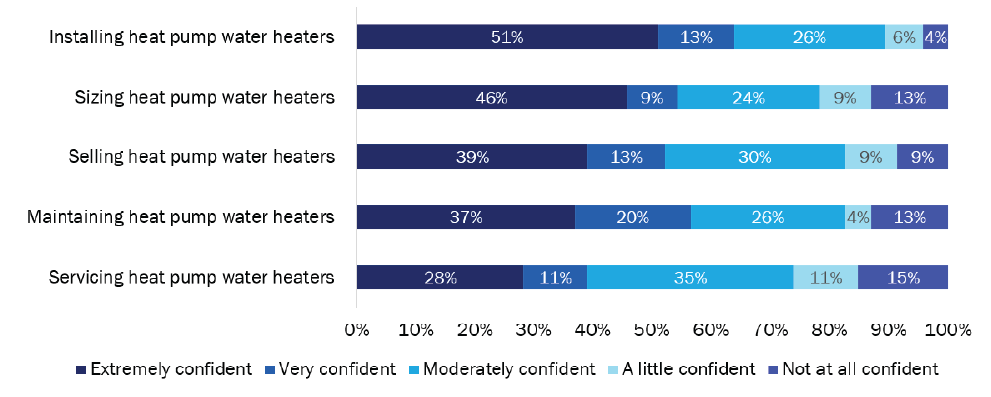
Note: Three or four respondents for each task reported that it was “not applicable” to their jobs and are excluded from the percentages.
4.6.3 Training on HPWH
Just over half (44 of 84; 52%) of surveyed water heating contractors had received training on how to sell, size, service, or maintain HPWHs for residential properties (Figure 28).
Figure 28. Contractor Training (n=84)
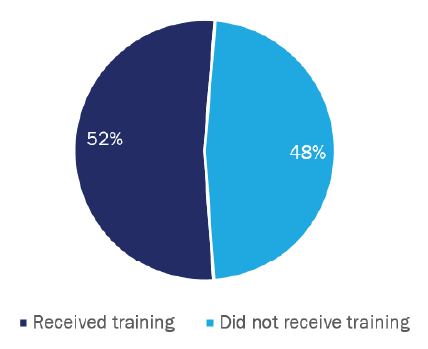
Of those who received HPWH training, they were most likely to have received training from distributors (37%), manufacturers (30%), and on the job (29%) (Figure 29). Respondents’ preferred sources of training were similar, though more than half preferred to get training from a manufacturer and nearly half desired online training. Another discrepancy between actual and preferred sources of training was found with certification training. About one-fifth (16 of 84; 19%) reported wanting to get certification training, but only one-tenth (4 of 44; 10%) received that type of training.
Figure 29. Source of Training
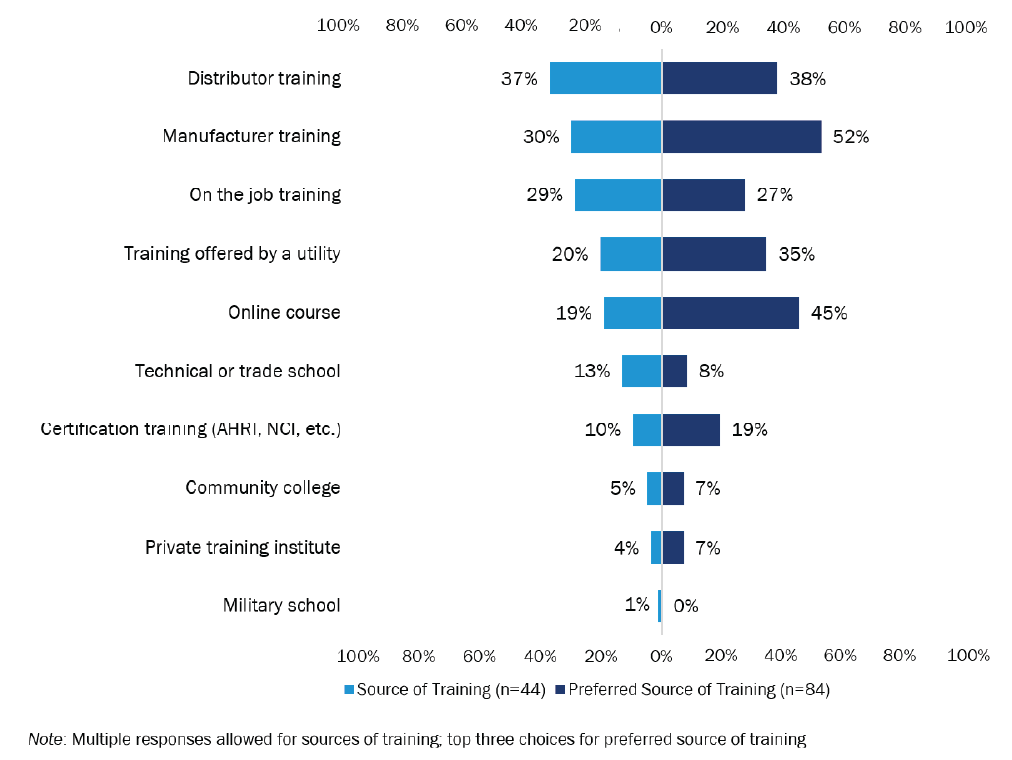
5. Heat Pump Financing Availability and Awareness
Rebates and financing enable customers to offset the upfront cost of heat pumps. Customers eligible for these financial offerings may be more likely to install heat pumps. In this chapter, we review the baseline incentive offerings in California for heat pumps, customer awareness of financing and rebates, as well as contractor awareness and promotion of financing and rebates.
5.1 Retrofit Incentive Programs
As of November 2021, there were seven programs in California offering HVAC heat pump incentives. These programs covered 16 cities or utilities, nine of which were associated with BayREN in the Bay Area. Incentive amounts ranged from $350 to $4,000; the most common amount offered was $500. We did not find any income-qualified incentives for HVAC heat pumps. BayREN, SMUD, and PG&E offered enhanced incentives for HVAC heat pump projects that included duct sealing, insulation, duct replacement, and downsizing; these incentives ranged from $300 to $800. The minimum efficiency required by the programs was often SEER 16, though SEER 15 heat pumps were incented in four cities.
Eighteen programs offered incentives for HPWHs to 19 cities in California in November 2021. More than half of these (11 of 19) were available in the Bay Area and associated with BayREN. Incentive amounts ranged from $450 to $3,000; the most common rebate amount was $1,000. There were also four programs offering HPWH incentives to income-qualified customers. These incentives ranged from $2,000 to $3,500. If a customer switched from gas to electric, the incentive was higher, on average, than for a customer who was already using an electric fuel source (Table 27). The required minimum Uniform Energy Factor (UEF) of incented HPWHs ranged from 2.0 to 3.2.
More incentive offerings were available for consumers switching from gas to electric water heating than were available for consumers who already had an electric water heater. The incentive amounts were also higher for those going from gas to electric; the maximum was $3,500 compared to a maximum of $2,500 for those with existing electric water heating.
Table 27. Baseline HPWH Incentive Ranges by Fuel Type (n=18)

Nearly all surveyed contractors who were aware of heat pump rebates promoted them to their customers. Of contractors whose firm sold at least one HVAC heat pump or HPWH in the last year, nearly three-fourths (75 of 104; 72%) were aware of rebates and/or incentives in California for heat pumps. Almost all of those contractors (66 of 75; 88%) promoted these discount offerings to their customers (Figure 30). About one-tenth (9 of 75; 12%) of contractors’ firms who sell HVAC equipment reported they aware of the incentives but do not promote them.
Figure 30. Do Your Promote Heat Pump Rebates or Incentives to Your Customers? (n=75)
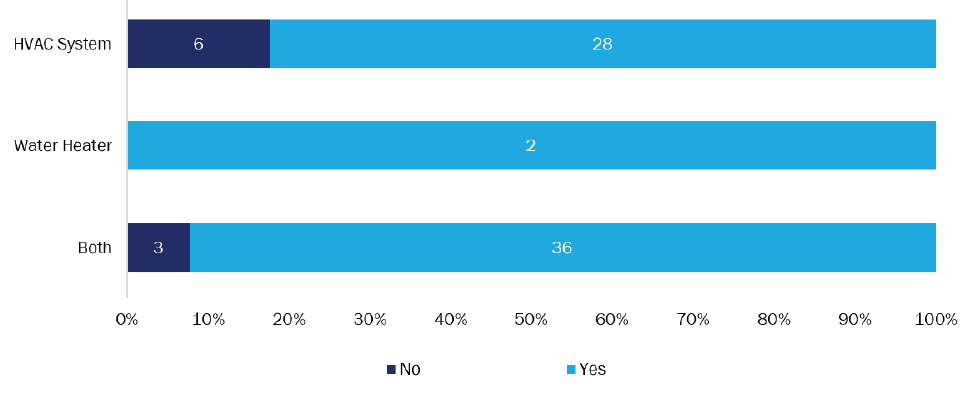
Nearly all surveyed contractors who were aware of heat pump rebates promoted them to their customers. Of contractors whose firm sold at least one HVAC heat pump or HPWH in the last year, nearly three-fourths (75 of 104; 72%) were aware of rebates and/or incentives in California for heat pumps. Almost all of those contractors (66 of 75; 88%) promoted these discount offerings to their customers (Figure 30). About one-tenth (9 of 75; 12%) of contractors’ firms who sell HVAC equipment reported they aware of the incentives but do not promote them.
Figure 31. Information Sources for Air Source Heat Pump Utility Rebates (n=98)
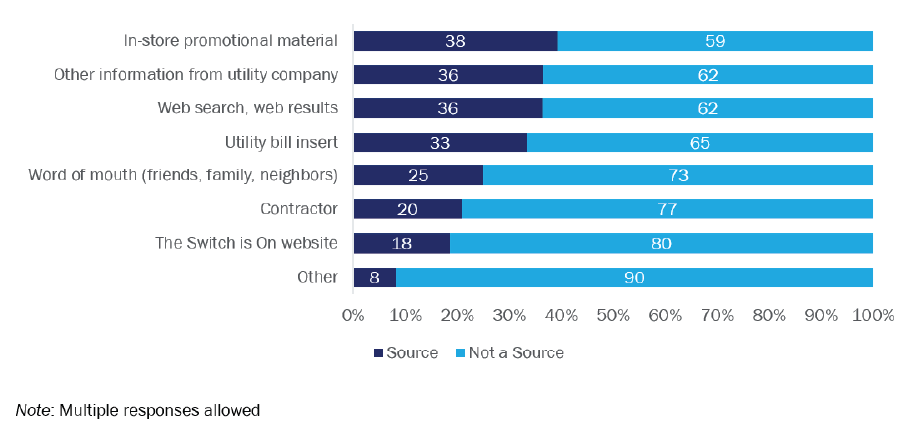
Less than half of surveyed homeowners aware of HPWHs were aware of financial incentives for installing them (99 of 248; 40%).[16] This breakdown differed slightly by community type, with 55% of DAC respondents aware of the incentives and 47% of non-DAC respondents. Figure 32 shows that respondents who were aware of the incentives for HPWH often heard about them through a contractor or a website; 29% reported that the Switch is On website was an informational source. The Switch is On website, which promoted heat pump incentives to Californians, launched December 8, 2021 and our survey was conducted in early March of 2022.
[16] Forty percent of the 248 respondents who were aware of HPWH were aware of the financial incentives. There were no differences between DACs and non-DACs.
Figure 32. Information Sources for Heat Pump Water Heaters Utility Rebates (n=84)
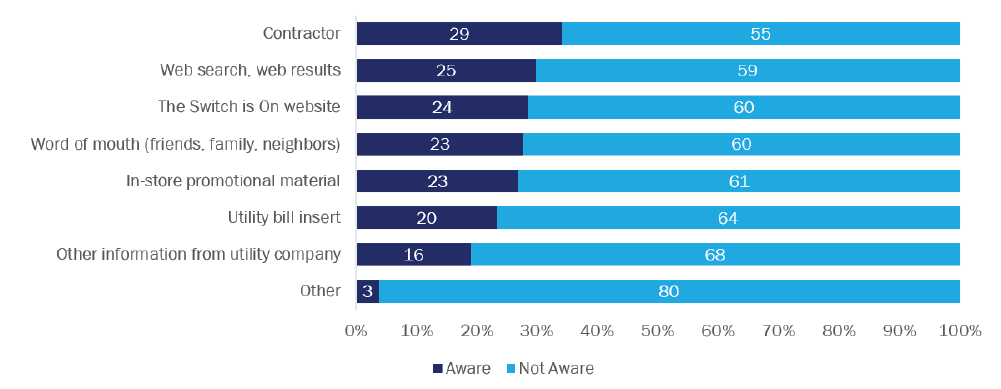
The evaluation team also asked homeowners about two California initiatives: The Switch is On and the TECH Clean California Initiative. Most respondents (375 of 500; 75%) had not heard of either initiative, 12% of respondents (60 of 500) had heard of The Switch is On, and 16% (80 of 500) had heard of the TECH Clean California Initiative. There were no notable differences in awareness between DACs and non-DACs.
5.2 Retrofit Financing
CAEATFA offers financing for Californians installing energy-efficient equipment. They did not begin tracking financing for heat pump equipment as a separate category until 2021. In 2021, heat pump projects comprised 13% of all space- and water-heating equipment projects they financed. Specifically, they financed 56 space-heating heat pump projects, 7 of which were in DACs, and 6 HPWH projects, 1 of which was in a DAC. Table 28 includes all space- and water-heating projects financed by CAEATFA in 2021. Please note that CAEAFTA reports on the number of projects that include particular measures, as opposed to the number of units installed; thus, a single project may contain multiple units of the same measure.[17]
[17] CAEATFA, Email to Opinion Dynamics, March 4, 2022.
Table 28. Space Heating and Water Heating Projects Financed by CAEATFA in 2021
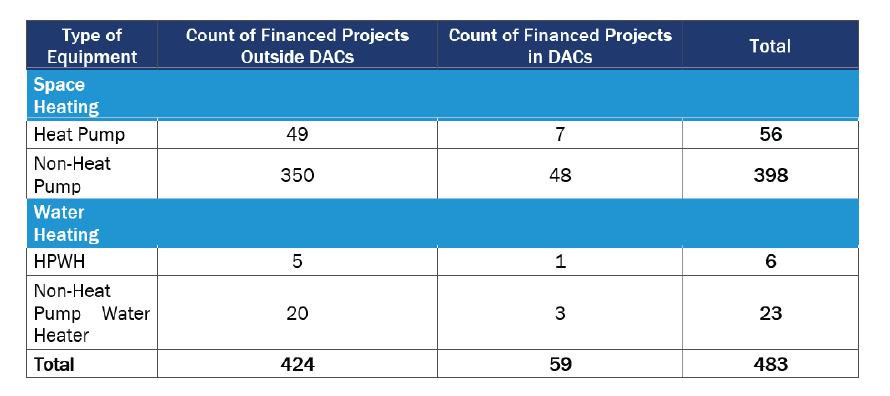
Contractors were split on whether they offer financing to residential customers when installing new heat pump equipment. Half (70 of 139; 50%) of surveyed contractors offered a financing option to residential customers purchasing new heat pump equipment. When split out by equipment type, contractors who installed both HVAC and water heater heat pump equipment were most likely to offer financing (43 of 62; 69%), compared to HVAC contractors (22 of 55; 40%) and water heater-only contractors (5 of 22; 23%). Financing through a private lender was by far the most common option offered by contractors for all market actor groups (Figure 33). Twelve respondents reported they provide some other type of financing to residential customers. These included Wells Fargo™ (three mentions), California First® (one mention), Costco® and Home Depot™ (one mention), Home Equity Line of Credit (HELOC) (one mention), House Call Pro® (one mention), in-house financing (one mention), Kwik Comfort℠ and Ally℠ financing (one mention), PayPal® lending (one mention), Salal Credit Union (one mention), and TECH (one mention).
Figure 33. Financing Options Offered by Market Actor (n=70)
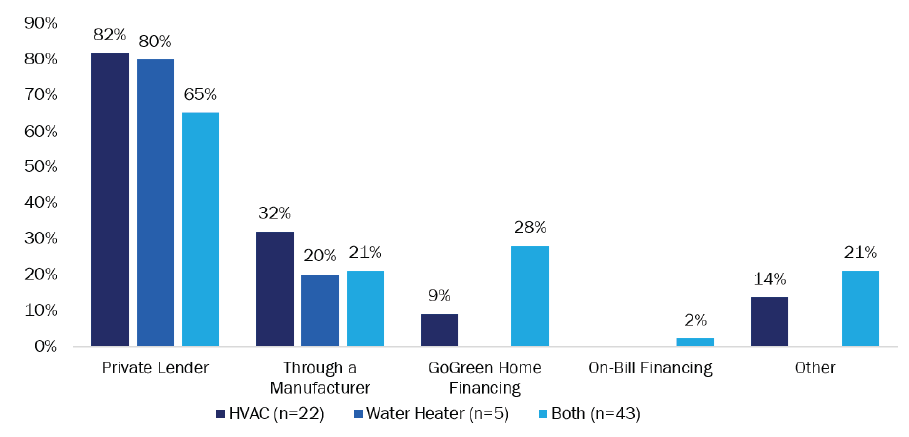
On average, one-fifth of surveyed contractors’ customers financed heat pump equipment. Among the 39 respondents with heat pump experience whose majority of work involves equipment installations, an average of 20% of their customers financed their heat pump projects. Half of HVAC contractors (6 of 12; 50%) and 60% of contractors who work on both HVAC and water heating equipment (15 of 25) reported 25% or fewer customers utilize financing offered by their company (Figure 34). Overall, nearly a quarter (9 of 38; 24%) of respondents reported none of their customers use financing when installing heat pump equipment, including the one water heating-only contractor who responded.
Figure 34. Percent of Customers Who Use Financing When Installing Heat Pump Equipment by Market Actor (n=38)
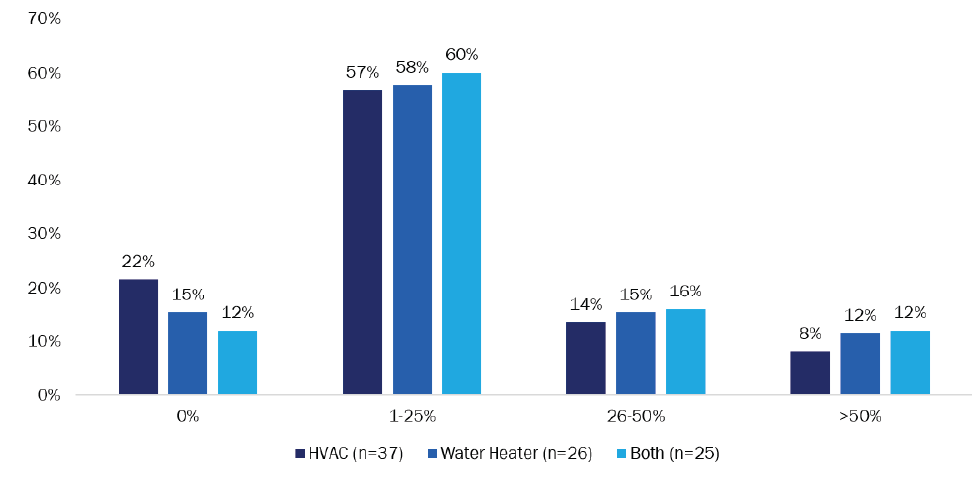
Note: Analysis excludes one respondent who provided “Don’t know” as response.
More than half (265 of 500; 53%) of the surveyed California homeowners were unaware of financing options homeowners could use to purchase new heat pump equipment; 32% were aware (162 of 500) and 15% were unsure (73 of 500). Of those aware, almost two-thirds (104 of 162; 64%) had heard of on-bill financing and more than half (89 of 162; 55%) had heard of energy efficiency-specific lending, and equipment financing and leasing (Figure 35). Respondents from DACs were more aware of the financing opportunities through PACE and their utility company than non-DAC respondents.
Figure 35. Financing Option Awareness (n= 162)
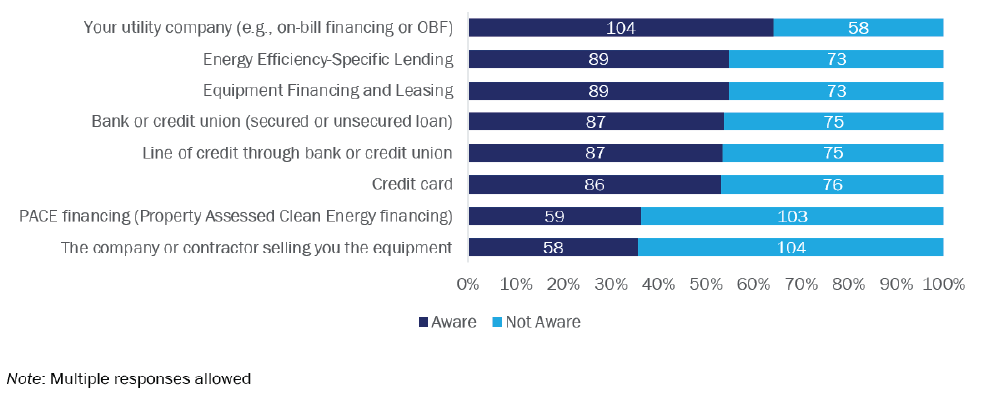
6. Summary and Considerations
We summarize key findings from across the data sources to characterize the baseline of the heat pump market in California prior to the TECH Initiative in this chapter. Considerations for increasing the installed base of heat pumps are integrated throughout.
Heat pumps represent a small portion of the installed base of HVAC and water-heating equipment. California is largely using natural gas-powered space-heating equipment or inefficient electric heating equipment. On the water-heating side, gas storage and gas tankless systems are common.
There will be a lot of replaced HVAC equipment in the coming few years. About half of the existing heating (51%) and cooling equipment (44%) is nine years or older with equipment a bit older in DACs compared to non-DACs. The equipment age demonstrates that millions of units will need to be replaced in the next few years, highlighting the importance of readying the workforce to install heat pumps when these customers call them.
A minority of homeowners agreed that electricity was becoming cleaner and more renewable. Just under half (248 of 500; 49%) of the surveyed homeowners agreed with the statement that electricity is becoming cleaner/more renewable every day. This is notable because it is important for consumers to understand why electrification matters. If the property owners purchasing equipment do not associate electricity with clean energy, they will not view electrification as a path toward meeting climate goals.
Homeowner awareness of heat pumps is moderate, but their understanding of them is low. Half of homeowners have heard of HVAC heat pumps and only half of those were either very or somewhat familiar with them, compared to 83% reporting the same for air conditioners. Less than one-third of ductless heat pump owners were very familiar with them. These data demonstrate a growing awareness of, yet lack of familiarity with, heat pumps among property owners.
Homeowners perceive ASHPs as expensive to install, service, and repair, and question whether they’re reliable and a good value. Reliability, performance, and cost were extremely important factors for homeowners when replacing their heating and/or cooling equipment. At the same time, more than half of surveyed homeowners were unsure if heat pumps are reliable and offer a better value than other electric heating and cooling options. Twice as many homeowners agreed heat pumps are expensive to install, service, and repair than disagreed. And homeowners’ biggest barrier to purchasing heat pumps is the possibility of increased utility bills. A higher percentage of respondents from DACs said a utility company endorsement was extremely or very important than respondents from non-DACs, for both primary heating (47% vs. 28%) and cooling (43% vs. 30%) systems. Programs and contractors must educate consumers to assuage these concerns when discussing heat pump options with customers.
At baseline, ASHPs are more expensive to install than gas-fired furnaces. The Delphi study participants estimated that the average cost to install an ASHP was roughly double the average cost of installing a natural gas furnace, though labor costs vary by region. Costs for ducting, electric, or ventilation modifications were similar between ASHPs and a gas furnace. The need to upgrade an electric panel for an ASHP was the main driver for increased ASHP modification costs, which would not be necessary if a gas furnace were installed in the scenario provided. These contractors likely engaged in “risk pricing” where they inflated their prices slightly to cover unforeseen risks; we expect the practice of risk pricing, and the resulting installation costs, to decrease as more workers gain experience and familiarity with installing heat pumps.
ASHP jobs comprise a minority of surveyed contractors’ work. The majority of surveyed contractors’ firms sold fewer than two ASHPs per month last year. Across the whole sample, they averaged about five ASHP installs per month, which was skewed by one high-performing firm.
A minority of the ASHPs are installed with time-of-use controls. Half of the surveyed contractors who sell ASHPs did not include time-of-use controls on the heat pumps, and the remainder did it infrequently. The potential for ASHPs to be responsive to grid conditions can be improved as more contractors become familiar with time-of-use controls and how to implement them on HVAC heat pumps.
Contractors are least familiar with centralized ASHP systems for large multifamily buildings and least confident in their ability to size, service, and maintain ASHPs. HVAC contractors have more experience with single-family and in-unit multifamily ASHP installs than they do with large, centralized multifamily heat pump systems. Contractors are more confident in their ability to install an ASHP than they are with their ability to size, service, and maintain those ASHPs. Sizing is an important aspect of the installation which impacts the unit’s energy efficiency. Contractor training around proper sizing may be warranted.
With few industry standards available for heat pump water heater system sizing, contractor training about sizing is warranted to provide guidance on how to balance maximizing energy efficiency and greenhouse gas reductions with oversizing HPWHs to maximize grid benefits.
Heat pump experience is attractive to firms hiring contractors, and surveyed contractor firms hire about four technicians each year at baseline.
Homeowner awareness of HPWHs is less than that for ASHPs (31% vs 50%), and their familiarity is also lower. When examining benefits and drawbacks of HPWHs, more than half of surveyed homeowners (55%) agreed HPWHs use less energy than other water heaters, but more than a quarter (27%) said HPWHs do not produce enough hot water. About one-quarter (23%) believed that HPWHs are expensive to install and service.
Homeowners prioritized reliability and warranties when purchasing water heating equipment. Slightly more homeowners were concerned about increased utility costs for HPWHs than for HVAC heat pumps (55% vs 50%). Although few homeowners thought finding a qualified contractor to install a HPWH would be a barrier (10%). Homeowner respondents from DACs were more likely to rate the following factors as extremely important when purchasing water heating equipment than those from non-DACs: indoor air quality, availability of discounts and rebates, performance, and cost.
The total cost to install a HPWH was similar to, though slightly higher than, a tankless water heater. The factors that influence HPWH installation costs included location (both of the unit within the house and of the home in California), contractor experience, and customer budgets. The extent of needed electrical or plumbing upgrades also contribute to project cost variation.
Surveyed contractors’ companies installed fewer than one HPWH per month in 2021. Over a quarter of surveyed contractors whose firms sell water heating equipment, and for whom at least half of their business comes from installation jobs, reported having no residential HPWH experience. Over one-third of surveyed contractors’ companies did not sell a single HPWH last year. About half of the remaining companies sold fewer than 10 HPWHs. Of those who sold at least one HPWH, the median number sold in California in 2021 was nine.
A minority of contractors installed HPWHs with thermostatic mixing valves, connectivity such as Wi-Fi or Bluetooth, or time-of-use controls. They were most likely to install thermostatic mixing valves and more likely to install these features in single-family homes compared to multifamily homes.
Half of contractors working on water heating equipment had not received training on HPWHs. They desired training from the manufacturers and via online courses. Training could be a way to increase the number of contractors installing HPWHs with time-of-use controls and connectivity that allows the unit to communicate with demand response programs and the grid.
At baseline, the heat pump incentive programs were concentrated in the Bay Area and northern California (SMUD, PG&E). The most common incentive for an ASHP was $500 and for a HPWH it was $1,000. About half of contractors knew of heat pump incentives and most of those promoted the incentives to their customers. A majority of homeowners who had heard of heat pumps were unaware of the incentives for them. Those who were aware of HVAC incentives most often learned about them from in-store promotional materials, while those who were aware of HPWH rebates learned about them from a contractor.
Half of surveyed contractors offer financing to their customers for heat pump retrofits and about 20% of their heat pump customers used financing. Half of surveyed homeowners were unaware of financing available to help them pay for HVAC or water-heating equipment. Homeowners residing in DACs were more aware of the financing opportunities through PACE and their utility company than non-DAC respondents.
Appendix:
Contractor Baseline Survey Recruitment
This contractor baseline research targeted two overlapping segments of California contractors: licensed contractors in California who either were or were not enrolled in the TECH Initiative. As a baseline study intended to capture contractors’ awareness and experience with space- and water-heating heat pumps prior to appreciable intervention by the TECH initiative, the evaluation team included a larger portion of contractors not enrolled in TECH within the sample frame. Of the 4,032 contractors we invited to complete the survey, 532 were participating in TECH.
We selected contractors who had one of the following licenses: C-20 HVAC Contractor, C-36 Plumbing Contractor, or B General Building Contractor. We prioritized the first two licenses, as those are the main licenses needed to install space- and water-heating heat pumps, though B General Building Contractors can also install them in some situations. Overall, more than one-third of the contractors in our sample (1,405 or 35%) held a combination of licenses, with some also holding other related licenses such as C-10 Electrical Contractor and D-34 Prefabricated Equipment.
The TECH-enrolled contractor group included all licensed contractors within the tracking data who were enrolled in the TECH program as of March 31, 2022 (n=532).[18]
The second group, comprised of licensed contractors in California not enrolled in TECH, was randomly selected from the population after determining they met the necessary criteria, including: (1) held a current C-20, C-36, and/or B license; and (2) work for a business located within the TECH-eligible region (see Table 29 for a breakdown of primary license types).
[18] These 532 TECH-enrolled contractors represent all TECH-enrolled contractors who had an email address on file as of April 8, 2022.
Table 29. Contractor Baseline Survey Sample Frame by TECH Enrollment and License Type
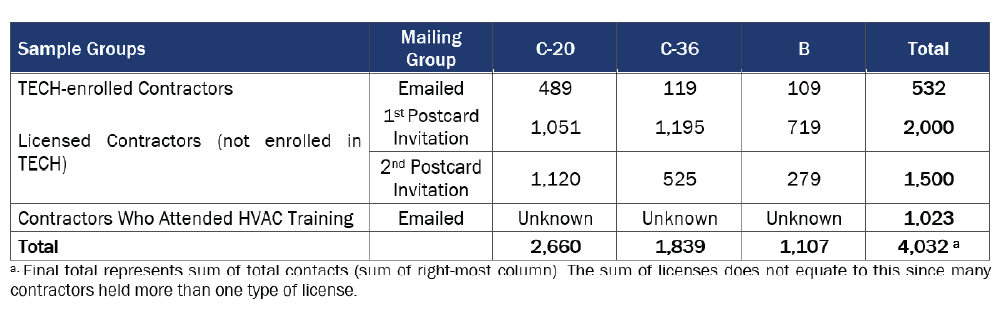
For sampling purposes, the evaluation team ensured all licensed contractors in the sample frame worked at companies located in TECH-eligible territory by cross-checking the contractors’ business zip code with the list of zip codes eligible for TECH. We ensured that contractors were from many regions in California and that some contractors’ zip codes represented disadvantaged communities.[19]
Contractor baseline data was collected through a web survey utilizing both email and mail outreach. Email outreach was used to contact TECH-enrolled contractors, involving an initial email invitation and one reminder email.
For the remaining portion of licensed contractors in the sample who were not enrolled in TECH, a mail-push-to-web outreach approach was used. Postcard invitations were initially mailed to 2,000 contractors’ business addresses inviting them to visit a website to complete the survey. After observing a low response rate to the survey, the evaluation team randomly selected an additional 1,500 non-TECH-enrolled licensed contractors from the population and sent a new batch of postcard invitations to this group. One postcard reminder was also delivered to 1,000 randomly selected contractors from the original mailing group who received the first postcard invitation and had not yet completed or been terminated from the survey.
The study team also reached out to an additional 1,023 contractors who attended an HVAC training at an investor-owned utility energy center when the low response rate was persisting during fielding; email outreach was used to contact this new group.
[19] Disadvantaged communities refers to areas throughout California that most suffer from a combination of economic, health, and environmental burdens. These burdens include poverty, high unemployment, air and water pollution, and presence of hazardous wastes, as well as high incidence of asthma and heart disease. (https://www.cpuc.ca.gov/industries-and-topics/electrical-energy/infrastructure/disadvantaged-communities#:~:text=Disadvantaged%20communities%20refers%20to%20the,of%20asthma%20and%20heart%20disease)
CSLB License Descriptions
Summaries of the licenses relevant for the installation of a residential heat pump are in Table 30.
Table 30. Description of CSLB Licenses [20]
License
Name
Description
B
General Building
An electrical contractor places, installs, erects, or connects any electrical wires, fixtures, appliances, apparatus, raceways, conduits, solar photovoltaic cells, or any part thereof, which generate, transmit, transform, or utilize electrical energy in any form or for any purpose.
C-10
Electrical
The principal business is in connection with any structure built, being built, or to be built, requiring in its construction the use of at least two unrelated building trades or crafts.
C-20
Warm-Air Heating, Ventilating and Air-Conditioning
A warm-air heating, ventilating and air-conditioning contractor fabricates, installs, maintains, services and repairs warm-air heating systems and water heating heat pumps, complete with warm-air appliances; ventilating systems complete with blowers and plenum chambers; air-conditioning systems complete with air-conditioning unit; and the ducts, registers, flues, humidity and thermostatic controls and air filters in connection with any of these systems. This classification shall include warm-air heating, ventilating and air-conditioning systems which utilize solar energy.
C-36
Plumbing
A plumbing contractor provides a means for a supply of safe water, ample in volume and of suitable temperature for the purpose intended and the proper disposal of fluid waste from the premises in all structures and fixed works. This classification includes but is not limited to: (a) Complete removal of waste from the premises or the construction and connection of on-site waste disposal systems; (b) Piping, storage tanks and venting for a safe and adequate supply of gases and liquids for any purpose, including vacuum, compressed air and gases for medical, dental, commercial and industrial uses; (c) All gas appliances, flues and gas connections for all systems including suspended space heating units (this does not include forced warm air units.); (d) Water and gas piping from the property owner’s side of the utility meter to the structure or fixed works; (e) Installation of any type of equipment to heat water or fluids, to a temperature suitable for the purposes listed in this section, including the installation of solar equipment for this purpose; and (f) The maintenance and replacement of all items described above and all health and safety devices such as, but not limited to, gas earthquake valves, gas control valves, back flow preventers, water conditioning equipment and regulating valves. (832.36 CCR)
D-34
Pre-fabricated Equipment License
A prefabricated products/equipment contractor performs installations of prefabricated products/equipment, including but not limited to the following:
(a) Theater stage equipment, school classroom equipment, playground equipment, bleacher bench/seat component parts (no installation or renovation of any supporting or structural member); store fixtures and display cases (either prefabricated or modular form); all forms and types of toilet/shower room partitions/accessories; and prefabricated closet systems.
(b) Laboratory and medical equipment, dust collecting systems; factory-built fireplaces and accessories (no masonry facing); major appliance installations and ventilating hoods in connection with existing fuel and energy lines which are installed by others.
(c) Bus stop shelters, prefabricated phone booths; prefabricated sound-proof environmental clean rooms; panelized refrigerated walk-in boxes (not to include the work of refrigeration contractor); all types of modular office, institutional or home improvement systems including, but not limited to all types of pre-finished and/or UL listed pre-wired wall panels.
[20] California Contractors State License Board. Description of Classifications. 2021. https://www.cslb.ca.gov/Resources/GuidesAndPublications/DescriptionOfClassifications.pdf
In 2021, a total of 138,980 California contractors held at least one of the five license types shown in Table 31. Since some contractors held more than one license, the total number of licensed contractors by climate zone totals 153,572.
Table 31. Licensed Contractors by Climate Zone
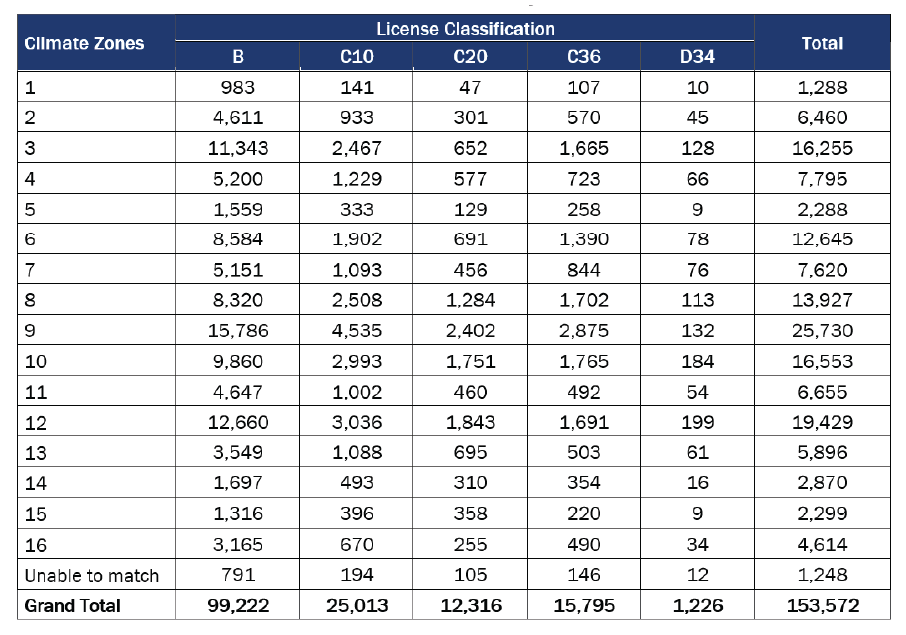
Data Collection Instruments

CPUC TECH Contractor Survey
CPUC TECH Homeowner Survey